ResourceSeparations

A Comparison of Two Solid Phase Extraction Methods for the Analysis of Polyaromatic Hydrocarbons in Butter

A Comparison of Two Solid Phase Extraction Methods for the Analysis of Polyaromatic Hydrocarbons in Butter

30 Nov 2015

This comparison shows that the Supelclean™ EZ-POP NP method produced better recoveries and lower background than direct SPE using a large silica cartridge for the analysis of PAHs from butter. When using EZ-POP NP, the final extract is clean enough for GC/MS analysis using the SLB®-35ms capillary column and single quadrupole instrument.

SLB-35ms Capillary GC Columns

Sigma-Aldrich Supelco

Application: The 35% phenyl equivalent phase provides a higher polarity option compared to columns containing a lower phenyl content, resulting in a greater retention of polar analytes relative to non-polar compounds. Its selectivity is complementary when paired with SLB-5ms for applications that require dual-column confirmatory analysis, such as for environmental analytes (such as pesticides, PCBs, and herbicides). The low bleed characteristics, inertness, and durable nature make it a great column anywhere a low bleed intermediate polar column is required.   USP Code: This column meets USP G42 requirements.   Phase: Bonded and highly crosslinked; proprietary polymer virtually equivalent in polarity to poly(35% diphenyl/65% dimethyl siloxane)   Temp. Limits: ≤0.32 mm I.D.: ambient to 350 °C (isothermal) or 360 °C (programmed)   Temp. Limits: ≥0.53 mm I.D.: ambient to 330 °C (isothermal) or 340 °C (programmed)
(0)

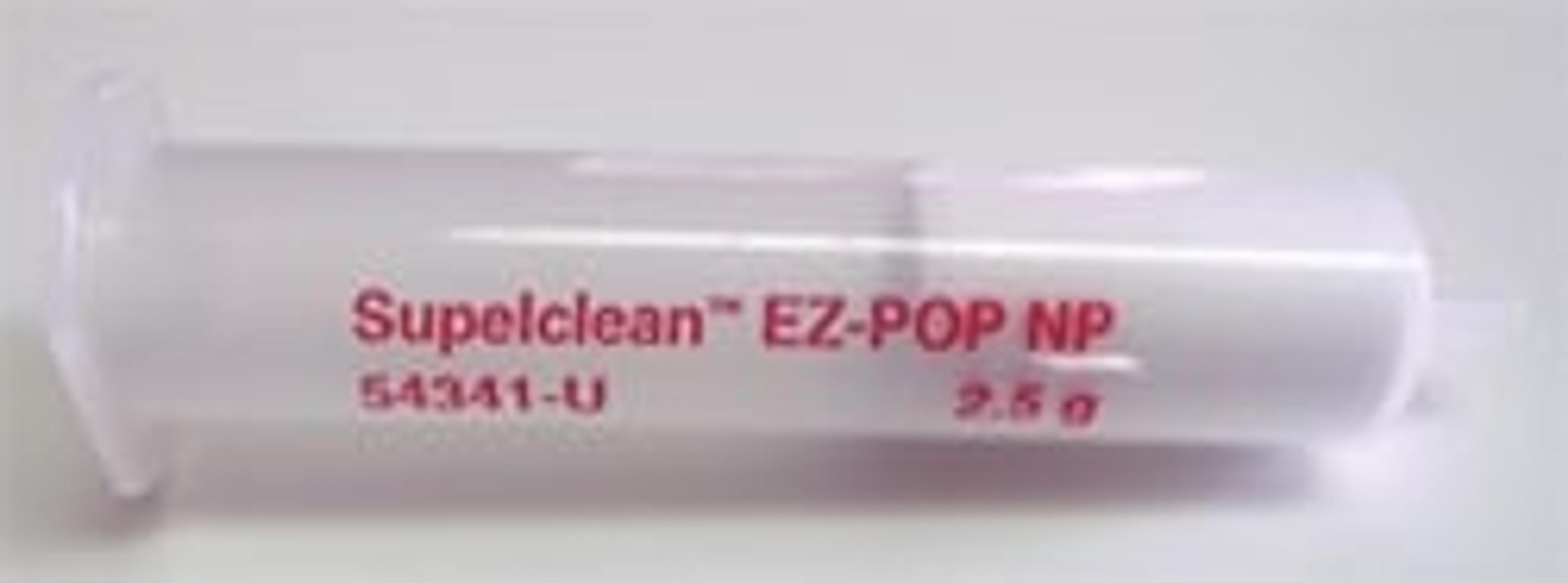
Supelclean™ EZ-POP NP

Sigma-Aldrich Supelco

This multi-bed solid phase extraction (SPE) cartridge was designed for the extraction of non-polar persistent organic pollutants (POPs), specifically heavy and light polynuclear aromatic hydrocarbons (PAHs), from edible oil matrices such as olive and corn oil. Fatty matrix is preferentially retained by the cartridge while PAHs are washed through using acetonitrile. The resulting extract is suitable for either GC-MS or HPLC-FLD analysis. The top layer of the SPE cartridge consists of Florisil®, a polar adsorption media that interacts with polar functional groups such as acids and alcohols. The bottom layer is comprised of a mixture of Discovery® DSC-18 and Z-Sep sorbents. C18 binds fatty matrix through hydrophobic interaction. Z-Sep, a zirconia coated silica, acts as a Lewis acid, interacting with the oxygen within OH and COOH groups found in fatty acids and mono and diacylglycerols.Features: Dual layer SPE that contains both LC-Florisil® (upper layer) and Z-Sep/C18 (lower layer) SPE sorbents, separated by a PE frit. Developed to offer superior cleanup when analyzing non-polar persistent organic pollutants (POPs) from oil matrices. Fatty matrix is preferentially retained by the cartridge, while non-polar POPs are washed through using acetonitrile.

(0)

Links

Tags

Mass SpectrometryMass spectrometry (MS) is a powerful analytical technique used to identify and quantify molecules based on the mass-to-charge ratio of gas-phase ions. It provides detailed information about the structure, composition, and properties of compounds and is widely used across fields such as environmental monitoring, materials science, drug discovery and development, food and beverage testing, and wider chemical research. Key MS techniques include tandem mass spectrometry (MS/MS), liquid chromatography–mass spectrometry (LS-MS) and inductively coupled plasma (ICP-MS). Choosing from these wide range of techniques and technologies can be a daunting task, so keep up to date with scientific applications, performance expectations, and customer reviews here all in one place. Visit our product directory to receive quotes direct from the manufacturer. Solid-Phase ExtractionSolid-phase extraction (SPE) is used for clean-up, extraction and concentration of semi-volatile or non-volatile analytes from complex mixtures including blood, urine and food samples. Multiple formats are available for conducting SPE, including prepacked SPE cartridges, disks and microplates, as well as SPE sorbent powders for manual packing. SPE systems can be used to automate the process and extract multiple samples at once. Solid-phase microextraction (SPME) and supported liquid extraction (SLE) products are also available in the same formats. Find the best SPE, SLE and SPME equipment in our peer-reviewed product directory: compare products, check customer reviews and receive pricing direct from manufacturers.Food and Beverage AnalyzersFood and Beverage Analyzers are commonly used to provide information about the chemical composition, structure and physical properties of food materials.Food and Beverage ProcessingFood and Beverage Processing involves the preparation of food products for further analysis. Typical instrumentation includes blanchers, color sorters, cookers, grinders, and refrigeration. These are used to replicate the processes commonly used in the commercial preparation of food and beverages.Particle CharacterizationParticle characterization instruments are used to determine particle size distribution, shape, surface area, zeta potential, density and porosity of particles and materials. Multiple tecchniques are available for determining particle size, shape and count including dynamic light scattering (DLS), laser diffraction, electrozone (Coulter technique), imaging particle analysis and single particle optical sensing. Determine the density of your material with a gas pycnometer or examine its surface area and porosity with gas adsorption analyzers and mercury porosimeters. Find the best particle characterization instruments in our peer-reviewed product directory: compare products, check customer reviews and receive pricing direct from manufacturers.Sample PreparationSample preparation can improve the quality and speed of separation techniques. Products to assist sample preparation include filtration equipment, evaporators, membranes and sieves.Food TestingFood testing refers to a variety experiments including PCR, mass spectrometry, processing, QuEChERS, analyzing and Kjeldahl.PAHsHydrocarbonSolid Phase Extraction (SPE)Solid phase extraction (SPE) is a sample preparation technique used to separate and concentrate analytes from complex mixtures. It is widely used in environmental, pharmaceutical, and clinical analysis. SPE provides higher sensitivity and selectivity compared to traditional liquid-liquid extraction methods, making it essential for accurate and reproducible results. Explore SPE tools and systems in our peer-reviewed product directory; compare products, check reviews, and get pricing directly from manufacturers.