Trending in analytical chemistry – 10 top resources for vodka, beer, wine & water analysis

From vodka aroma profiling to microplastics in water and better beer making, discover our pick of application guides and top tips to help you develop and optimize your analytical methods

5 Aug 2019

Finn Price
Administrator / Office Personnel

Editorial article

As we expand our footprint on the earth and continue to develop new products and technologies, we also face new analytical challenges. Whether you’re looking at traditional or more modern contaminants, looking to optimize old methods or create new ones, the underlying principles remain the same. Here, we offer a selection of useful resources to assist you in your work.

Environmental: contaminants in water

Radon in household water

Radon is a naturally occurring, colorless, odorless, radioactive gas that can dissolve and build up in water from underground sources. This gas can escape into the air during household water use, especially when it’s heated. This white paper presents an easy experimental setup for on-site determination of radon concentration in water samples and why it’s important to check radon levels before and after new builds.

Download white paper >>

Measuring arsenic in water

Arsenic is introduced into water through the dissolution of rocks, minerals and ores, industrial effluents and from atmospheric deposition. With such a large variety of sources it could come from, it’s important to have a cost-effective and sensitive solution for actively managing the concentration of arsenic in water supplies. Find out why Agilent’s 200 AA series graphite furnace atomic absorption spectrometers offer a potential solution to this problem.

Download application note >>

Microplastics in bottled water

Microplastic pollution in water, land or even air has become an increasing concern for society. In addition to its detrimental impact on ecosystems and human health, the recent revelation that some bottled water and other beverages may contain microplastics also puts many corporations at risk of negative publicity and brand erosion. In this application note, Thermo Fisher Scientific offers a complete solution to address the challenge of analyzing microplastics across a wide size range (1-5000 µm).

Download application note >>

Analysis of pharmaceuticals and personal care products in water

In this application note, Affinisep demonstrates how AttractSPE™ Disks – HLB can used to analyze compounds commonly found in water that originate from pharmaceuticals and personal care products, according to EPA method 1694.

Download method >>

Food & beverage: flavor profiling and analysis

Four glasses of beer

Chemical and microbiological monitoring for breweries

Monitoring a range of parameters such as bitterness, sulfite content, and spoilage contaminants throughout the beer-making process ensures that you can produce safe, delicious, and high-quality beer. This webinar presents a more cost-effective and streamlined solution for chemical and microbiological analysis of sulfur dioxide in beer during the brewing process instead of using traditional p-rosaniline or distillation methods.

Register now >>

Aroma profiling of vodka

Historically, a wide variety of sampling methods have been used to extract volatiles from alcoholic spirits, with a key driver being the need to improve upon inefficient solvent extraction methods. This application note demonstrates how immersive sampling using HiSorb, in conjunction with GC–MS, was used to identify a range of VOCs and SVOCs in vodka while overcoming issues faced by older analytical methods.

Download application note >>

Aroma profiling and flavor analysis with SIFT-MS

Aromas are chemically very diverse and have a wide range of sensory thresholds. Conventional analytical technologies (based, for example, on gas chromatography) lack the time resolution, responsiveness, and comprehensiveness of analysis required to provide rapid feedback to product developers or process-line managers. This webinar introduces SIFT-MS, a technique for direct analysis of aroma compounds in air at trace levels.

Register now >>

Identifying low-level odorants in wine

The yeast Brettanomyces bruxellensis is part of the natural microflora of wine, but its growth can result in the production of compounds that leave behind unpleasant ‘medicinal’, ‘phenolic’ or ‘horse sweat’ notes to wine and mask desirable ‘fruity’ aromas. This study shows how immersive sorptive extraction, using high-capacity HiSorb probes with GC-MS, can be used to screen wine for ppb levels of these yeast-derived spoilage compounds.

Download application note >>

Useful resources

Inside of a gas chromatography system

How to buy GC technology

The optimization of chromatographic methodology starts with column selection. In this guide, discover the latest advice on how to choose the best GC column for your analysis. Based on four significant factors, column selection is different for each type of analysis.

Download eBook >>

How to buy HPLC columns

There are many different types of HPLC column on the market and finding the correct one for your application may seem daunting, but by applying a few simple considerations, selecting the correct column can be made an easier task. This HPLC column buying guide presents the key factors and application considerations you should be taking into account when looking to buy new columns as well as advice from experts in the field.

Download eBook >>

Latest reviews

Don't just take our word for it, read reviews left by scientists to help you choose the best instruments for your lab, or share your opinion to help your peers by writing your own review today. Read one of our latest reviews below by Dr. David Tavakoli from Georgia Tech about Malvern Panalytical’s Empyrean X-ray Diffraction System.
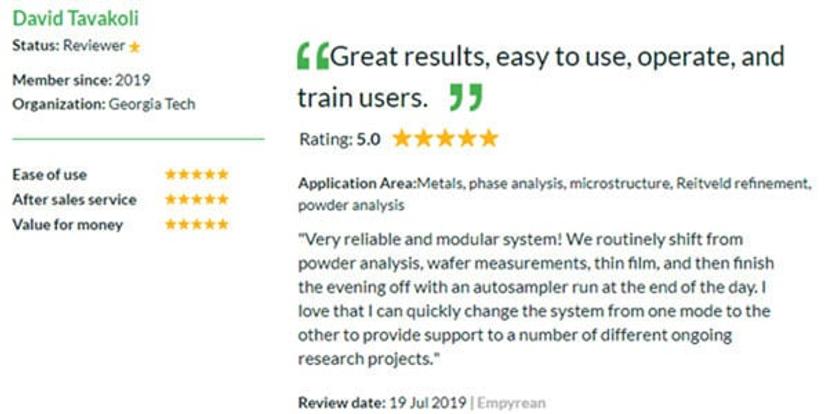
Dr. Tavakoli's review of Empyrean

Links

Tags

Atomic Absorption / Emission SpectroscopyAtomic absorption spectroscopy (AAS) and atomic emission spectroscopy (AES) — also called optical emission spectroscopy (OES) — are used to detect the elemental constituents in samples. Both techniques involve the atomization of a sample. Atomic absorption spectrometers may use a flame or furnace to create an atomic vapor of the sample before irradiation with spectral light. Optical emission spectrometers may use a flame, inductively coupled plasma (ICP), microwave plasma (MP) or spark arcs to atomize and excite the sample. At higher excitation energies, electrons can be emitted instead of photons, which can be useful for samples that can’t be atomized and for surface analysis. Explore electron spectroscopy equipment such as Auger spectrometers and photoelectron spectrometers for surface elemental analysis of samples. Find the best atomic absorption, photoelectron and optical emission spectrometers in our peer-reviewed product directory: compare products, check customer reviews and receive pricing direct from manufacturers.LC-MSLC-MS (liquid chromatography-mass spectrometry) systems and equipment are used for separation and quantitative analysis of complex mixtures, combining liquid chromatography and mass spectrometry. Quantify proteins, contaminants, pesticides or screen for drug metabolites with a high level of sensitivity. LC-MS systems and equipment include reverse phase, normal phase and specialized columns integrated with various MS detectors such as time-of-flight (TOF), quadrupole, orbitrap or ion trap mass analyzers. LC-MS/MS instruments equipped with a qTOF or triple quadrupole analyzer give greater sensitivity and resolving power to your analysis. Find the best LC-MS equipment in our peer-reviewed product directory: compare products, check customer reviews and receive pricing direct from manufacturers.Mass SpectrometryMass spectrometry (MS) is a powerful analytical technique used to identify and quantify molecules based on the mass-to-charge ratio of gas-phase ions. It provides detailed information about the structure, composition, and properties of compounds and is widely used across fields such as environmental monitoring, materials science, drug discovery and development, food and beverage testing, and wider chemical research. Key MS techniques include tandem mass spectrometry (MS/MS), liquid chromatography–mass spectrometry (LS-MS) and inductively coupled plasma (ICP-MS). Choosing from these wide range of techniques and technologies can be a daunting task, so keep up to date with scientific applications, performance expectations, and customer reviews here all in one place. Visit our product directory to receive quotes direct from the manufacturer. X-Ray Diffraction and SpectroscopyX-Ray diffraction & spectroscopy are used in material characterization to discern the structure and elemental composition of a sample. X-Ray diffractometers (XRD) are superior instruments in elucidating the dimensional atomic structure of crystalline materials, including powders, thin films and single crystals. For large unit cells or ordered macromolecules, consider small-angle X-ray scattering (SAXS). X-ray spectroscopic techniques include X-ray fluorescence (XRF) and X-ray photoelectron spectroscopy (XPS), both providing simple and accurate methods for determining the elemental composition of a material. Energy dispersive (EDXRF) and wavelength dispersive (WDXRF) XRF spectrometers are available, as well as handheld/portable devices. High-resolution, 3D microstructure characterization of materials can be achieved with X-ray microscopes combining sub-micron resolution imaging with 3D computed tomography. Find the best XRD and XRF spectrometers in our peer-reviewed product directory: compare products, check customer reviews and receive pricing direct from manufacturers.Solid-Phase ExtractionSolid-phase extraction (SPE) is used for clean-up, extraction and concentration of semi-volatile or non-volatile analytes from complex mixtures including blood, urine and food samples. Multiple formats are available for conducting SPE, including prepacked SPE cartridges, disks and microplates, as well as SPE sorbent powders for manual packing. SPE systems can be used to automate the process and extract multiple samples at once. Solid-phase microextraction (SPME) and supported liquid extraction (SLE) products are also available in the same formats. Find the best SPE, SLE and SPME equipment in our peer-reviewed product directory: compare products, check customer reviews and receive pricing direct from manufacturers.Food and Beverage AnalyzersFood and Beverage Analyzers are commonly used to provide information about the chemical composition, structure and physical properties of food materials.Food and Beverage ProcessingFood and Beverage Processing involves the preparation of food products for further analysis. Typical instrumentation includes blanchers, color sorters, cookers, grinders, and refrigeration. These are used to replicate the processes commonly used in the commercial preparation of food and beverages.GC-MS GC-MS (gas chromatography-mass spectrometry) instruments and equipment are used to separate, quantify and identify mixtures of small and volatile compounds, such as polycyclic aromatics, fatty acids and alcohols. Often used in drug detection, forensic investigation and environmental analysis for pesticides and contaminants, GC-MS is a powerful addition to your lab’s analytical capabilities. GC-MS/MS instruments equipped with a qTOF or triple quadrupole analyzers can give greater sensitivity and resolution to your analysis. Find the best GC-MS instruments and equipment in our peer-reviewed product directory: compare products, check customer reviews and receive pricing direct from manufacturers.Food SafetyFood safety describes the prevention of food-borne illnesses. Contamination with a variety of pathogens can be prevented with adequate temperature control, hygiene and labeling. Food samples can be tested using GC/MS, HPLC, SPE, and qPCR to ensure their adherence to regulations.Food AuthenticationFood authentication ensures that food products are accurately labeled and free from adulteration or misrepresentation. This is important for consumer safety, quality control, and regulatory compliance. Explore food authentication tools in our peer-reviewed product directory; compare products, check reviews, and get pricing directly from manufacturers.Gas AnalysisGas analysis is used to measure the composition of gases in various environments, such as industrial processes, air quality monitoring, and environmental studies. Techniques like gas chromatography and mass spectrometry are commonly used. Explore gas analysis tools in our peer-reviewed product directory; compare products, check reviews, and get pricing directly from manufacturers.Elemental AnalysisElemental analysis involves determining the elemental composition of a sample, often used in environmental, pharmaceutical, and material sciences. Techniques like ICP-MS, X-ray fluorescence, and atomic absorption spectroscopy allow precise quantification of elements such as metals and nonmetals in complex matrices. Browse our peer-reviewed product directory to find the best elemental analysis tools, compare products, check reviews, and get pricing directly from manufacturers.Environmental AnalysisEnvironmental analysis describes a variety of tests that determine the effect of chemicals, processes and particulates such as persistent organic pollutants (POPs) have on the environment.Solid Phase Extraction (SPE)Solid phase extraction (SPE) is a sample preparation technique used to separate and concentrate analytes from complex mixtures. It is widely used in environmental, pharmaceutical, and clinical analysis. SPE provides higher sensitivity and selectivity compared to traditional liquid-liquid extraction methods, making it essential for accurate and reproducible results. Explore SPE tools and systems in our peer-reviewed product directory; compare products, check reviews, and get pricing directly from manufacturers.Food QualityFood quality refers to the attributes of food that influence its safety, nutrition, and taste. Monitoring and ensuring food quality are essential in production to meet health regulations and consumer expectations. Techniques like spectroscopy, chromatography, and microbial testing are used to assess food properties and detect contaminants. Browse our peer-reviewed product directory to find food quality testing solutions; compare products, check reviews, and get pricing directly from manufacturers.