ResourceSeparations

Targeted Metabolomics Using the UPLC/MS-based Absolute IDQ p180 Kit

3 Jul 2013

The application note describes the use of Waters® ACQUITY UPLC® System with Xevo® TQ and Xevo TQ-S mass spectrometers in combination with the commercially available AbsoluteIDQ p180 Kit (BIOCRATES Life Sciences AG, Innsbruck, Austria) for the rapid identification and highly sensitive quantitative analyses of more than 180 endogenous metabolites from six different biochemical classes (biogenic amines, amino acids, glycerophospholipids, sphingolipids, sugars, and acylcarnitines). The assay is performed using MS-based flow injection and liquid chromatography analyses, which were validated on Waters’ tandem quadrupole instruments.

ACQUITY UPLC System

Waters

Waters ACQUITY UPLC - Dramatic Improvements in Speed, Sensitivity and Resolution Whether you work in methods development or quality assurance, in drug discovery and development or testing for safety in food supplies, you seek a productivity edge. With the ACQUITY UPLC® System, now you can get more information in a single, short run than you've ever seen with HPLC. Waters ACQUITY UPLC System UltraPerformance LC® (UPLC®) technology starts with unique 1.7 μm small-particle chemistries. Chromatographers no longer need to choose between speed and resolution–with UPLC you get both. Instrument Designed for Chemistry; Chemistry Designed for the Instrument The ACQUITY UPLC System has been holistically designed to match the performance needs of our innovative column chemistries with robust hardware, easy-to-use software and specialized support services. Small, pressure-tolerant particles High-pressure fluidic modules Minimized system volume Negligible carryover Reduced cycle times Fast response detectors Integrated system software and diagnostics With UPLC you have the ability to work more efficiently with higher speed, sensitivity and resolution at a much wider range of linear velocities, flow rates and backpressures to obtain superior results. The Waters ACQUITY UPLC System's high-pressure fluidics optimizes flow rates to make the most of small particle technology. The ACQUITY UPLC System's sample-handling design is designed to ensure exceptionally low carryover and reduced cycle time. And when interfaced with the Sample Organizer, it increases unattended sample capacity by ten times. High-speed detectors, both optical and mass, contribute to increased sensitivity and help manage the heightened speed and resolution requirements of UPLC. ACQUITY UPLC Systems are easily controlled, diagnosed, and monitored via a graphical system console interface. The console offers: Quick and easy access to critical instrument parameters Simple system start-up, elegant system status monitoring and predictive performance indicators to ensure maximum productivity Data management capabilities that are supported by both MassLynx™ and Empower™ software The ACQUITY UPLC System is also supported by Intelligent Device Management technology with our Connections® INSIGHT™ service, providing instrument diagnostics.
(167)

Xevo TQ-S

Waters

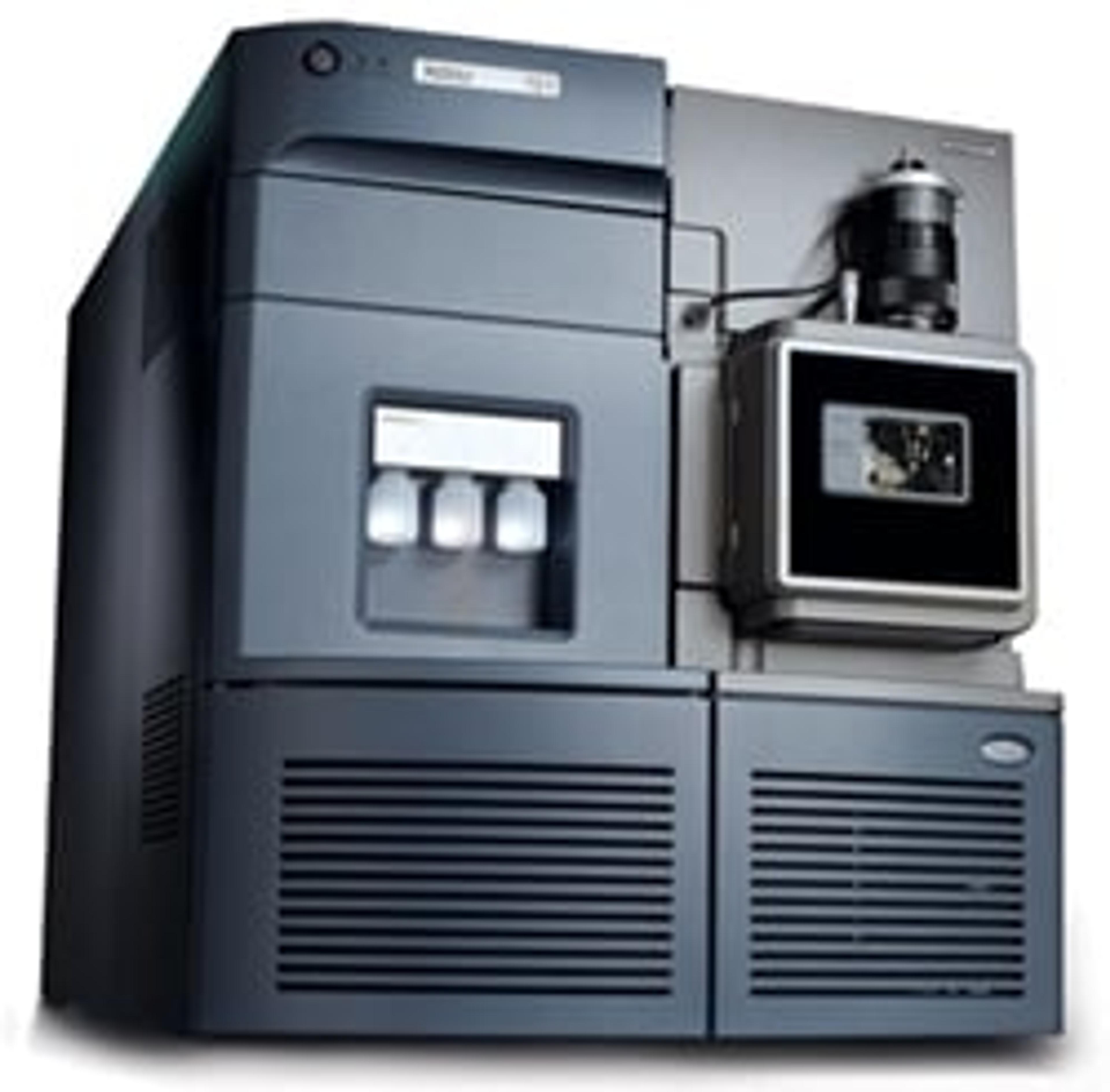
Xevo TQ-S tandem quadrupole mass spectrometer - designed for the most demanding quantitative UPLC/MS/MS applications. The ultimate in tandem quadrupole performance allows you to achieve unrivalled sensitivity and robustness, available to everyone due to the accessibility of the Xevo platform. The Xevo TQ-S gives you class leading sensitivity and robustness, qualitative information when you need it most and accelerated method development for sensitive and robust methods. Reducing complexity, increasing ease of use, and ensuring the correct result every time.

(19)

Links

Tags

UHPLC and HPLCHigh performance liquid chromatography (HPLC) and ultra high performance liquid chromatography (UHPLC), also known as UPLC, are analytical techniques used to separate, identify and quantitate components of complex mixtures including biological samples such as proteins and lipids as well as chemical mixtures of pesticides, drugs and oils. Both techniques are liquid chromatographic methods but differ by operating pressures (HPLC < 6000 psi < UHPLC ). Components of HPLC and UHPLC systems include columns, detectors, pumps, autosamplers and column heaters. Explore a range of UHPLC and HPLC columns for your specific sample needs including reverse phase, normal phase, ion exchange, HILIC, ion exclusion and size exclusion columns. For more specialized HPLC, explore FPLC, countercurrent LC and simulated moving bed systems. Find the best UHPLC and HPLC equipment in our peer reviewed product directory: compare products, check customer reviews and receive pricing direct from manufacturers.LC-MSLC-MS (liquid chromatography-mass spectrometry) systems and equipment are used for separation and quantitative analysis of complex mixtures, combining liquid chromatography and mass spectrometry. Quantify proteins, contaminants, pesticides or screen for drug metabolites with a high level of sensitivity. LC-MS systems and equipment include reverse phase, normal phase and specialized columns integrated with various MS detectors such as time-of-flight (TOF), quadrupole, orbitrap or ion trap mass analyzers. LC-MS/MS instruments equipped with a qTOF or triple quadrupole analyzer give greater sensitivity and resolving power to your analysis. Find the best LC-MS equipment in our peer-reviewed product directory: compare products, check customer reviews and receive pricing direct from manufacturers.Mass SpectrometryMass spectrometry (MS) is a powerful analytical technique used to identify and quantify molecules based on the mass-to-charge ratio of gas-phase ions. It provides detailed information about the structure, composition, and properties of compounds and is widely used across fields such as environmental monitoring, materials science, drug discovery and development, food and beverage testing, and wider chemical research. Key MS techniques include tandem mass spectrometry (MS/MS), liquid chromatography–mass spectrometry (LS-MS) and inductively coupled plasma (ICP-MS). Choosing from these wide range of techniques and technologies can be a daunting task, so keep up to date with scientific applications, performance expectations, and customer reviews here all in one place. Visit our product directory to receive quotes direct from the manufacturer. Cell Adhesion AssaysCell adhesion assays are used to quantitate attachment and analyze the molecular mechanisms for extracellular matrix adhesion, cell migration and sensitivity to inhibitors. Find the best cell adhesion assay equipment in our peer-reviewed product directory: compare products, check customer reviews and receive pricing direct from manufacturers.Cell / Tissue CultureCell culture or tissue culture is used to study the biology of cells or tissues and to isolate cellular products in an environment which can be manipulated and well defined. Accurately control your culture environment with bioreactors or culture incubators, bind your cells to a surface or together with an extracellular matrix. Distinguish cell types with differential media or proliferate cells with certain characteristics using selective media. Enrich your media with supplements such as growth factors, sera and vitamins. Find the best cell and tissue culture products, kits and equipment in our peer-reviewed product directory: compare products, check customer reviews and receive pricing direct from manufacturers.ADME-ToxicologyADME-toxicology (ADME-Tox) studies are used in pharmacology and pharmacokinetics to assess the activity/toxicity of drugs <i>in vivo</i> or <i>in vitro</i>. Find bioassays for absorption, distribution, metabolism, and excretion of drug molecules including cytotoxicity, transporter/permeability, metabolism and activity assays as well as hepatocytes and cell lines for ADME. Find the best ADME-toxicology products in our peer-reviewed product directory: compare products, check customer reviews and receive pricing direct from manufacturers.Cell-Based AssaysCell-based assays are used to monitor the presence, quantity and activities of a desired cellular analyte including drug molecules or biomarkers. This can reveal information on cell health (apoptosis, cytotoxicity, viability and proliferation assays), cell metabolism, cell migration and cell signaling mechanisms. Find the best cell-based assay products, kits and equipment with our peer reviewed product directory: compare products, check customer reviews and receiving pricing direct from manufacturers.MetabolitesMetabolites are the intermediate and end products of metabolism. Analyzing metabolites offers insight into cellular processes and disease mechanisms and is critical in fields like pharmacology, toxicology, and diagnostics. Explore our peer-reviewed product directory to find the best tools for metabolite analysis, compare products, check reviews, and get pricing directly from manufacturers.MetabolomicsMetabolomics is the study of small metabolites (the intermediates and products of metabolism). It involves the identification and quantification of cellular metabolites using analytical technologies such as GC, HPLC, NMR, and LC/MS.Biomarker DiscoveryClinical biomarkers refer to substances related to known medical conditions that can be accurately measured <i>in vitro</i>. Biomarkers can be used to diagnose presence of a disease and indicate disease severity. The discovery of new biomarkers is incredibly valuable in the field of diagnostics.World Cup