Steps to ensure cell culture success

6 Feb 2024
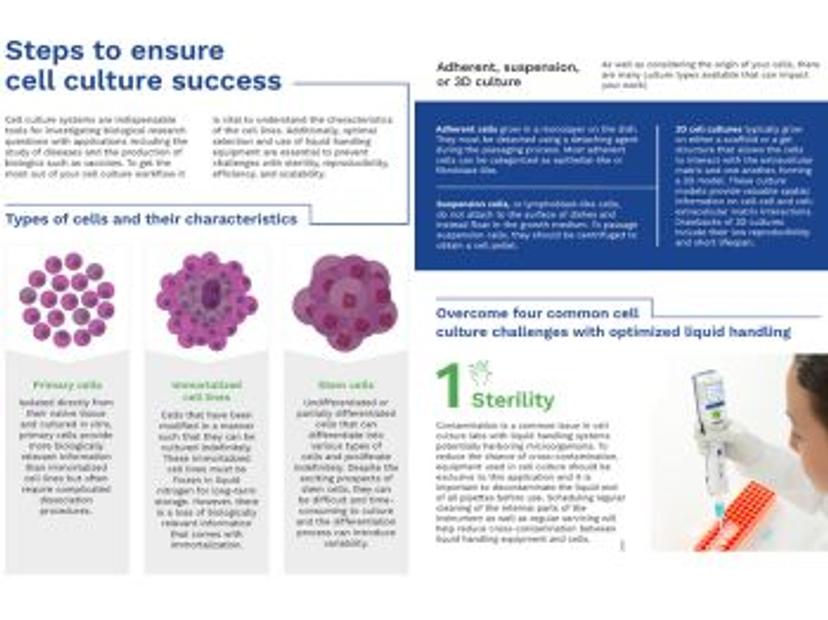
Preview of the steps to ensure cell culture success infographic

Optimal selection and use of liquid handling equipment is essential to preventing challenges with sterility, reproducibility, efficiency, and scalability that can arise when working with cell culture.

Many cell types with different structural and functional characteristics exist and the most appropriate cell line to use depends on the specific research area and application. Optimizing cell culture conditions is vital for investigating biological research questions with applications including the study of diseases and the production of biologics such as vaccines. Cell culture also plays a vital role in tissue engineering, where cells can be grown on a scaffold to create functional tissues and organs. To get the most out of your cell culture workflow it is vital to understand the characteristics of your cell lines, as well as the origin of your cells. Another factor to consider is how cells grow inside of a microplate well. For example, cells can adhere to the bottom of the well (adherent), they can float in media (suspension), or they can form spheroids in a matrix.

Liquid handling equipment used in cell culture workflows can include single channel, multichannel, repeater pipettes, and semi-automated pipetting systems. Many of the challenges that arise when working with cell cultures are rooted in poor, sub-optimal, or inappropriate liquid handling tools and techniques. Processes can be improved by optimal selection and use of liquid handling equipment. In this infographic, learn more about the different types of cells used in biological research and discover how to overcome four common cell culture challenges with optimized liquid handling.

Download this infographic to learn more about:

  • How different cell types can be used for various applications
  • The liquid handling tools required for efficient workflows, including single channel, multichannel, repeater, and semi-automated pipettes, and how optimal tool selection can help overcome common challenges in cell culture workflows related to sterility, reproducibility, efficiency, and scalability
  • Semi-automated 96-channel pipetting solutions that can speed up cell culture workflows and help overcome the challenges associated with manual pipetting

Rainin NanoRep

Rainin

An electronic repeater pipette dispenses multiple aliquots of the same volume. Also known as an electronic multi-dispenser pipette, these handheld lab tools include features beyond the delivery of multiple aliquots, such as mixing and titrating. NanoRep is the first handheld electronic pipette capable of repeat-dispensing aliquots as low as 0.1 μL.
(0)

MicroPro

METTLER TOLEDO

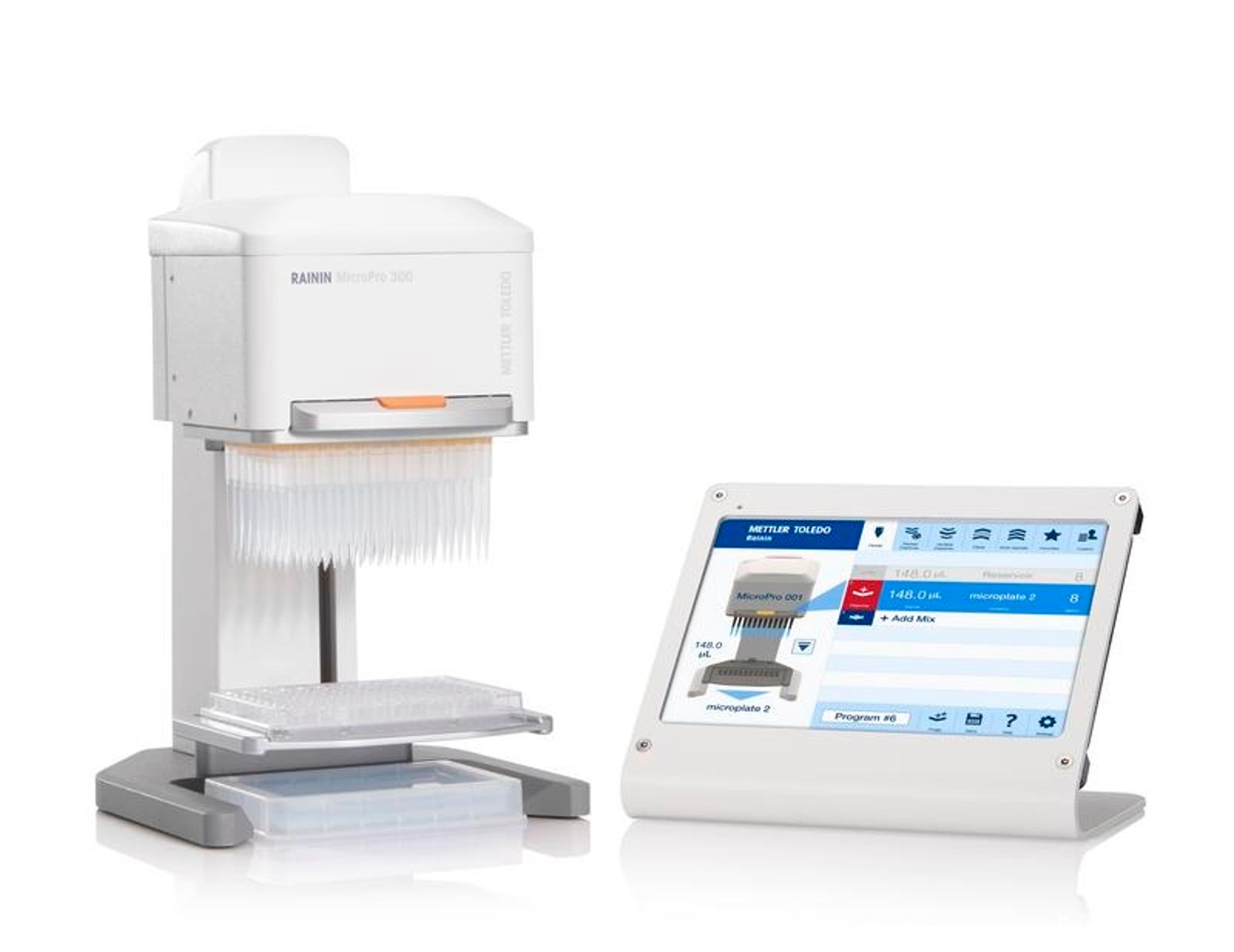
MicroPro is a compact 96-channel automated pipetting system that offers precision and faster-throughput when working in 96- or 384-well formats. At 32 cm tall, 19 cm wide and weighing just 5.1 kg, Rainin MicroPro 20 and MicroPro 300 pipetting workstations are the smallest 96-channel automatic pipettes available. 

(0)

Links

Tags

Cell / Tissue CultureCell culture or tissue culture is used to study the biology of cells or tissues and to isolate cellular products in an environment which can be manipulated and well defined. Accurately control your culture environment with bioreactors or culture incubators, bind your cells to a surface or together with an extracellular matrix. Distinguish cell types with differential media or proliferate cells with certain characteristics using selective media. Enrich your media with supplements such as growth factors, sera and vitamins. Find the best cell and tissue culture products, kits and equipment in our peer-reviewed product directory: compare products, check customer reviews and receive pricing direct from manufacturers.Cell Lines Stem Cells and Primary CellsPrimary cell cultures, established cell lines and stem cells are vital for <i>in vitro</i> and <i>ex vivo</i> experimentation. High-quality cells, optimized for your applications, alongside optimized cell substrates, growth medium and supplements, are critical for experimental success. Explore a range of cells suitable for your applications, including isogenic cell lines, competent cells, induced pluripotent stem cell (iPSC)-derived cell lines, fungal/bacterial/mammalian cell lines, stem cells and cancer cell lines. Find the best cells for your research in our peer-reviewed product directory: compare products, check customer reviews and receive pricing direct from manufacturers.Pipettes and DispensersPipettes and dispensers are essential lab equipment used to dispense measured volumes of liquid accurately. Explore a range of manual and electronic pipettes, including single and multichannel, serological and volumetric pipettes, as well as a range of pipette tips. Bottle-top dispensers are also available for simple and fast solvent dispensing. Find the best pipettes & dispensers in our peer-reviewed product directory: compare products, check customer reviews and receive pricing direct from manufacturers.Automated Liquid HandlingAutomated liquid handling equipment is used to mix, dilute and dispense allotted volumes of liquid into microplates and other vessels automatically. The robotic, liquid handling arms can dispense from single channel to 3456 multichannel as well as operate nanoliter dispensing, enabling high throughput of samples. Find the best automated liquid handlers in our peer-reviewed product directory: compare products, check customer reviews and receive pricing direct from manufacturers.Electronic PipetteElectronic pipettes are precision instruments used to transfer measured volumes of liquid in laboratory settings. They offer high accuracy, ease of use, and ergonomic benefits compared to traditional pipettes, reducing the risk of repetitive strain injuries. Electronic pipettes are widely used in molecular biology, chemistry, and diagnostics. Browse our peer-reviewed product directory to find the best electronic pipettes; compare products, check reviews, and get pricing directly from manufacturers.Liquid HandlingLiquid handling involves the precise transfer, mixing, and dispensing of liquids in laboratory settings. It is essential for accurate and consistent results in biological, chemical, and pharmaceutical research. Automated liquid handling systems improve efficiency and reduce human error in sample preparation and analysis. Explore liquid handling tools in our peer-reviewed product directory; compare products, read customer reviews, and get pricing directly from manufacturers.
Steps to ensure cell culture success