MicroPro
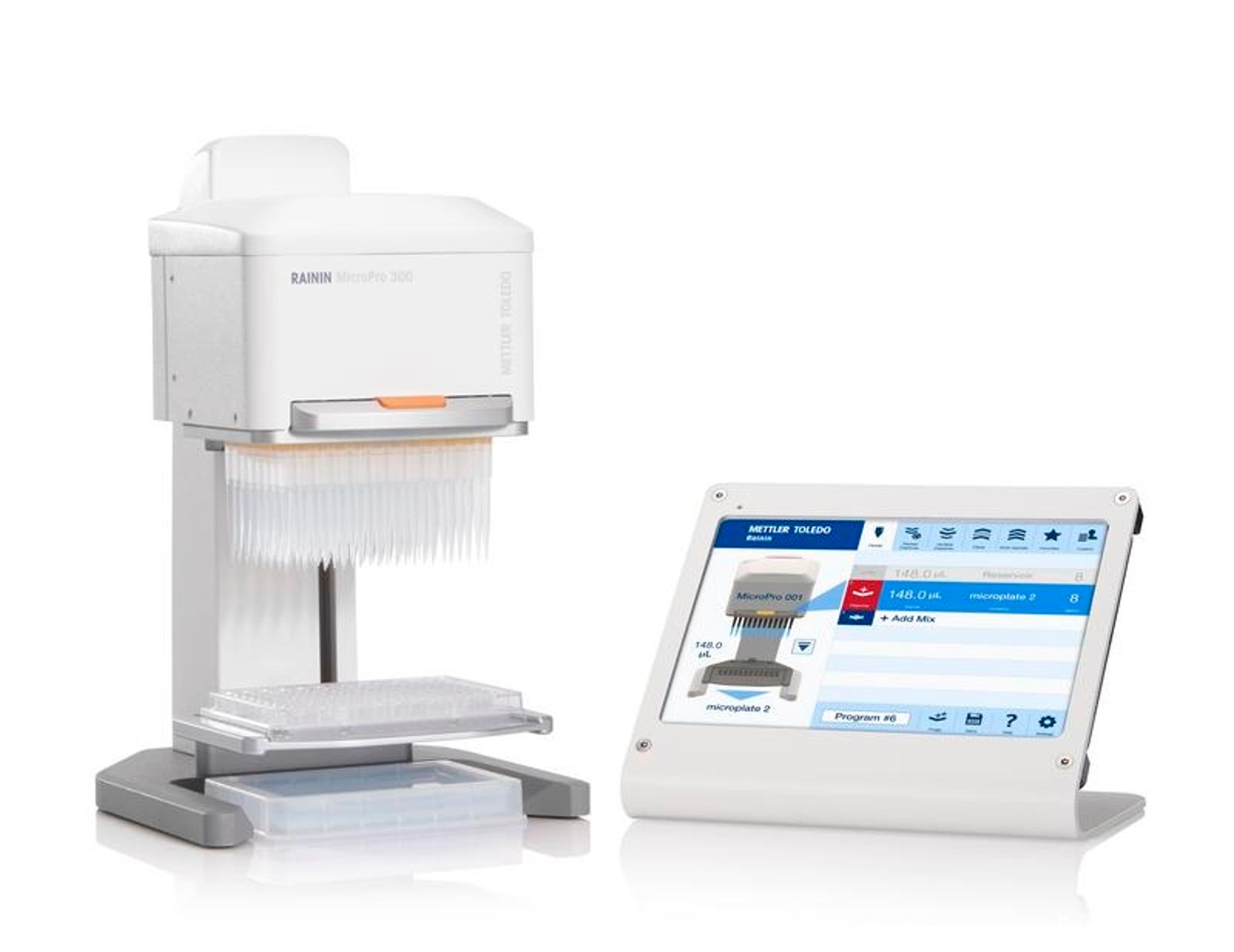
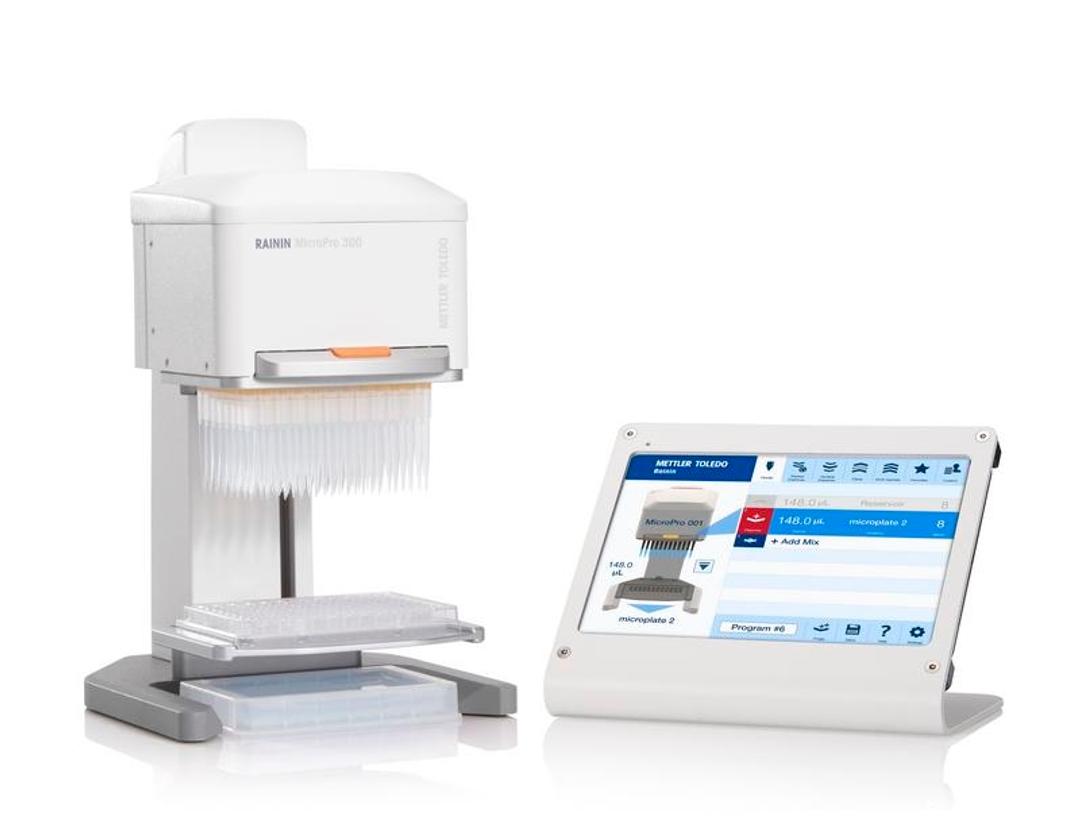
MicroPro is a compact 96-channel automated pipetting system that offers precision and faster-throughput when working in 96- or 384-well formats. At 32 cm tall, 19 cm wide and weighing just 5.1 kg, Rainin MicroPro 20 and MicroPro 300 pipetting workstations are the smallest 96-channel automatic pipettes available.

Receive your quote directly from the manufacturer.
Exceptional Ease and Speed
Simplify Your workflows
With touchless tip ejection, precise speed control and the ability to save protocols, MicroPro reduces operator error and improves reproducibility.
Your Research Assistant
MicroPro goes beyond simply adding and mixing reagents by offering helpful pipetting modes including multi-dispense, multi-aspirate, custom protocols.
Custom Protocols
Custom protocols that include your tailored instructions and liquid handing steps are easy to create, save, edit and recall.
The Rainin MicroPro 20 96-channel semi-automated pipettor has a volume range of 2-20 µL and precision of 1-5 µL < 3% C.V. and 6-20 µL < 2% C.V.
The Rainin MicroPro 300 96-channel semi-automated pipettor has a volume range of 5-300 µL and precision of 15-30 µL < 2% C.V. and 30-300 µL < 1% C.V.

Steps to ensure cell culture success
Optimal selection and use of liquid handling equipment is essential to preventing challenges with sterility, reproducibility, efficiency, and scalability that can arise when working with cell culture.
Many cell types with different structural and functional characteristics exist and the most appropriate cell line to use depends on the specific research area and application. Optimizing cell culture conditions is vital for investigating biological research questions with applications including the study of diseases and the production of biologics such as vaccines. Cell culture also plays a vital role in tissue engineering, where cells can be grown on a scaffold to create functional tissues and organs. To get the most out of your cell culture workflow it is vital to understand the characteristics of your cell lines, as well as the origin of your cells. Another factor to consider is how cells grow inside of a microplate well. For example, cells can adhere to the bottom of the well (adherent), they can float in media (suspension), or they can form spheroids in a matrix.
Liquid handling equipment used in cell culture workflows can include single channel, multichannel, repeater pipettes, and semi-automated pipetting systems. Many of the challenges that arise when working with cell cultures are rooted in poor, sub-optimal, or inappropriate liquid handling tools and techniques. Processes can be improved by optimal selection and use of liquid handling equipment. In this infographic, learn more about the different types of cells used in biological research and discover how to overcome four common cell culture challenges with optimized liquid handling.
Download this infographic to learn more about:
- How different cell types can be used for various applications
- The liquid handling tools required for efficient workflows, including single channel, multichannel, repeater, and semi-automated pipettes, and how optimal tool selection can help overcome common challenges in cell culture workflows related to sterility, reproducibility, efficiency, and scalability
- Semi-automated 96-channel pipetting solutions that can speed up cell culture workflows and help overcome the challenges associated with manual pipetting

TechTalk: Transform your 96-well plate workflows with the MicroPro
Monday, December 8 at 15:00 GMT | 16:00 CET | 10:00 EST | 7:00 PST
Join this 20-minute SelectScience TechTalk to discover how the Rainin MicroPro revolutionizes everyday lab workflows. From routine tasks like plate stamping and ELISA setup to complex procedures such as NGS bead cleanups, the MicroPro makes 96-well plate pipetting faster, easier, and more consistent compared to manual multichannel pipetting.
You will learn how semi-automation reduces human error, improves reproducibility, and ensures reliable results across drug discovery, genomics, and molecular biology experiments.
Key learning objectives
- Understand how the MicroPro streamlines common and advanced pipetting workflows.
- Learn about customizable features, such as pipetting tip depth and speed, which can be used to enhance accuracy and reproducibility.
- Explore flexible options like column-based pipetting for partial plates and fully customizable protocols.
- See how the MicroPro boosts throughput and data quality by ensuring every assay runs consistently.
Who should attend?
This session is ideal for:
- Laboratory professionals seeking to improve efficiency and accuracy.
- Researchers in drug discovery, genomics, and molecular biology.
- Anyone looking to reduce manual errors and standardize workflows.
Certificate of attendance
If you attend the live TechTalk, you will automatically receive a certificate of attendance, including a learning outcomes summary, for continuing education purposes.
If you view the on-demand TechTalk, you can request a certificate of attendance by emailing editor@selectscience.net.
TechTalk details
- Cost: Free to attend
- Location: Online
- Duration: 20 minutes
Registration is required to secure your place. If you register but can’t attend live, you will receive a link to the on‑demand recording once it becomes available