ResourceSeparations

Rapid Analysis of 303 Pesticide Residues in Green Beans using Triple Quadrupole GC-MS/MS

Rapid Analysis of 303 Pesticide Residues in Green Beans using Triple Quadrupole GC-MS/MS

29 Sept 2015

This application note demonstrates the method for analysis of 303 pesticides in green beans by using an acetonitrile extract, followed by SPE clean-up steps, and analysis by the TSQ Quantum GC-MS/MS using timed-SRM mode. The combination of triple quadrupole GC-MS/MS and ion trap GC-MS with QuEChERS sample preparation method has been investigated for the pesticide analysis in different food matrices. However, solid phase extraction (SPE) as a clean-up procedure is still the official analytical method for pesticide residues analysis in some countries.

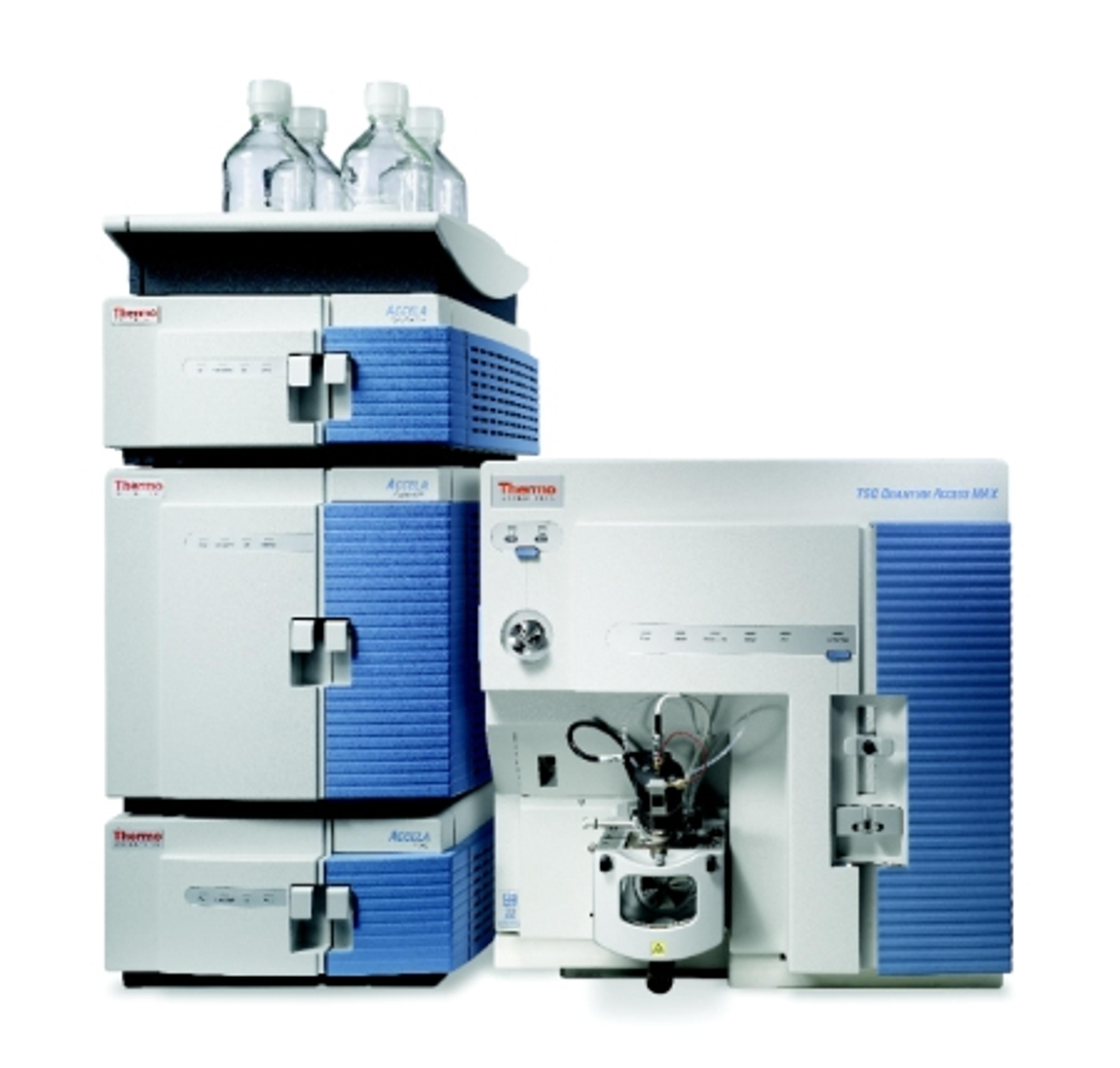
Thermo Scientific™ TSQ Quantum™ Access MAX Triple Quadrupole Mass Spectrometer

Thermo Fisher Scientific

Achieve high quantitative sensitivity and specificity economically with the Thermo Scientific™ TSQ Quantum™ Access Max triple quadrupole mass spectrometer. Applications such as pharmaceutical development, environmental and food safety testing, clinical research, and forensic toxicology demand analytical sensitivity and specificity—even when budgets are constrained. The Thermo Scientific™ TSQ Quantum™ Access MAX Triple Quadrupole Mass Spectrometer is an outstanding LC-MS/MS value, providing excellent sensitivity, specificity, and flexibility that is also more affordable.   Features: Thermo Scientific™ Ion Max™ API source with HESI-II probe reduces noise and increases sensitivity, enhancing quantitative performance. Up to 3,000 definable, timed SRMs and fast 25 ms positive/negative switching improve productivity. Quantitation-enhanced data-dependent MS/MS (QED-MS/MS) provides simultaneous compound confirmation and quantification. High-resolution selected reaction monitoring (H-SRM) with 2 ms dwell times enables quantification of hundreds of compounds in a single run. Mass range of 10–3000 m/z allows analysis of small molecules and intact proteins. Zero-cross-talk collision cell eliminates false positives. Optional FAIMS interface enhances specificity. Intuitive software with searchable compound libraries and database of methodologies for the analysis of pesticides, azo dyes and banned pharmaceuticals in water and food, make the system easy to use. Self-cleaning Ion Max API source heater with automatic source recognition simplifies use and increases reliability.

(1)

Links

Tags

Gas ChromatographyGas chromatography (GC) is an analytical technique used to separate and quantitate mixtures of small and volatile compounds. Gas chromatographs or GC systems include components such as GC columns, detectors, pumps and autosamplers. Choose from packed or capillary GC columns, flame ionization (FID), photoionization (PID) electron capture detectors and selective or non-selective detectors. Find the best gas chromatographs in our peer-reviewed product directory: compare products, check customer reviews and receive pricing direct from manufacturers.Gas Generators and AnalyzersGas generators are used for supplying or monitoring a regular flow of a high purity gas such as nitrogen, hydrogen or zero air for applications such as gas chromatography. Gas analyzers can be used in supply chain processes and laboratory experiments with portable analyzers for monitoring CO<sub>2</sub> and O<sub>2</sub> levels as well as trace gases. Regular flow can be produced with gas control modules and flow meters. Find the best gas generators and analyzers in our peer-reviewed product directory: compare products, check customer reviews and receive pricing direct from manufacturers.Environmental Monitoring and TestingEnvironmental monitoring and testing uses handheld portable analyzers, kits, spectrometers or chromatography systems for air, water, soil, food and other sample testing. Useful features of analyzers such as BOD and COD include portability, easy calibration, automation and sensitivity.  Environmental test kits for pH, water, moisture, etc, should be accurate, sensitive, reliable, fast and easy to use.Solid-Phase ExtractionSolid-phase extraction (SPE) is used for clean-up, extraction and concentration of semi-volatile or non-volatile analytes from complex mixtures including blood, urine and food samples. Multiple formats are available for conducting SPE, including prepacked SPE cartridges, disks and microplates, as well as SPE sorbent powders for manual packing. SPE systems can be used to automate the process and extract multiple samples at once. Solid-phase microextraction (SPME) and supported liquid extraction (SLE) products are also available in the same formats. Find the best SPE, SLE and SPME equipment in our peer-reviewed product directory: compare products, check customer reviews and receive pricing direct from manufacturers.Food and Beverage AnalyzersFood and Beverage Analyzers are commonly used to provide information about the chemical composition, structure and physical properties of food materials.Food and Beverage ProcessingFood and Beverage Processing involves the preparation of food products for further analysis. Typical instrumentation includes blanchers, color sorters, cookers, grinders, and refrigeration. These are used to replicate the processes commonly used in the commercial preparation of food and beverages.GC-MS GC-MS (gas chromatography-mass spectrometry) instruments and equipment are used to separate, quantify and identify mixtures of small and volatile compounds, such as polycyclic aromatics, fatty acids and alcohols. Often used in drug detection, forensic investigation and environmental analysis for pesticides and contaminants, GC-MS is a powerful addition to your lab’s analytical capabilities. GC-MS/MS instruments equipped with a qTOF or triple quadrupole analyzers can give greater sensitivity and resolution to your analysis. Find the best GC-MS instruments and equipment in our peer-reviewed product directory: compare products, check customer reviews and receive pricing direct from manufacturers.QuEChERSThe QuEChERS (Quick, Easy, Cheap, Effective, Rugged, and Safe) method is a streamlined approach that is used to extract multi-residue target compounds from food samples. It is most commonly used by analytical chemists studying pesticide residues in food.Sample PreparationSample preparation can improve the quality and speed of separation techniques. Products to assist sample preparation include filtration equipment, evaporators, membranes and sieves.PesticidesPesticides are used to protect crops from diseases, pests and unwanted plants. They are classed as persistent organic pollutants (POPs) and can be harmful to humans. The Environmental Protection Agency (EPA) currently regulates the use of pesticides in the USA. Food ContaminationFood contamination refers to the presence of harmful substances or pathogens in food, posing risks to human health. Contaminants can be biological, chemical, or physical, and their detection is crucial for ensuring food safety. Advanced testing methods like PCR, chromatography, and spectroscopy are used to identify contaminants in food products. Browse our peer-reviewed product directory to find the best solutions for food contamination detection, compare products, check reviews, and get pricing directly from manufacturers.Solid Phase Extraction (SPE)Solid phase extraction (SPE) is a sample preparation technique used to separate and concentrate analytes from complex mixtures. It is widely used in environmental, pharmaceutical, and clinical analysis. SPE provides higher sensitivity and selectivity compared to traditional liquid-liquid extraction methods, making it essential for accurate and reproducible results. Explore SPE tools and systems in our peer-reviewed product directory; compare products, check reviews, and get pricing directly from manufacturers.
Rapid Analysis of 303 Pesticide Residues in Green Beans using Triple Quadrupole GC-MS/MS