
ResourceFood and Beverage
Protein determination for nutritional composition of food and animal feed
27 Mar 2020This application note discusses how nitrogen/protein determination performed by elemental analysis can be used for quality and labeling purposes of food and animal feed.
Related products
Request Quote for All Products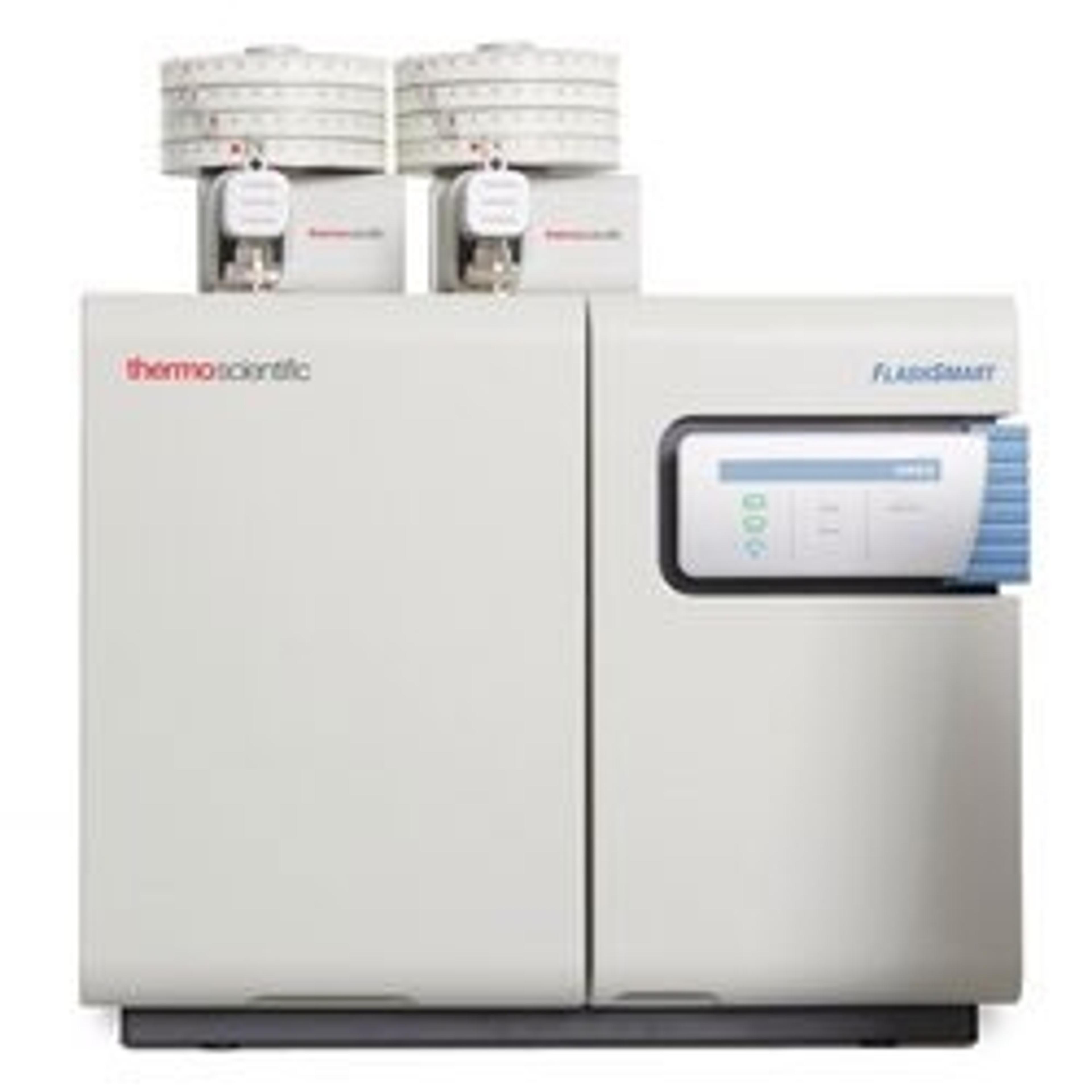
Thermo Scientific™ FlashSmart™ Elemental Analyzer
Thermo Fisher ScientificSolve more laboratory challenges, improve workflow, and minimize downtime when performing carbon, hydrogen, nitrogen, sulfur and oxygen (CHNS/O) analyses
Links
Tags
UHPLC and HPLCHigh performance liquid chromatography (HPLC) and ultra high performance liquid chromatography (UHPLC), also known as UPLC, are analytical techniques used to separate, identify and quantitate components of complex mixtures including biological samples such as proteins and lipids as well as chemical mixtures of pesticides, drugs and oils. Both techniques are liquid chromatographic methods but differ by operating pressures (HPLC < 6000 psi < UHPLC ). Components of HPLC and UHPLC systems include columns, detectors, pumps, autosamplers and column heaters. Explore a range of UHPLC and HPLC columns for your specific sample needs including reverse phase, normal phase, ion exchange, HILIC, ion exclusion and size exclusion columns. For more specialized HPLC, explore FPLC, countercurrent LC and simulated moving bed systems. Find the best UHPLC and HPLC equipment in our peer reviewed product directory: compare products, check customer reviews and receive pricing direct from manufacturers.Atomic Absorption / Emission SpectroscopyAtomic absorption spectroscopy (AAS) and atomic emission spectroscopy (AES) — also called optical emission spectroscopy (OES) — are used to detect the elemental constituents in samples. Both techniques involve the atomization of a sample. Atomic absorption spectrometers may use a flame or furnace to create an atomic vapor of the sample before irradiation with spectral light. Optical emission spectrometers may use a flame, inductively coupled plasma (ICP), microwave plasma (MP) or spark arcs to atomize and excite the sample. At higher excitation energies, electrons can be emitted instead of photons, which can be useful for samples that can’t be atomized and for surface analysis. Explore electron spectroscopy equipment such as Auger spectrometers and photoelectron spectrometers for surface elemental analysis of samples. Find the best atomic absorption, photoelectron and optical emission spectrometers in our peer-reviewed product directory: compare products, check customer reviews and receive pricing direct from manufacturers.LC-MSLC-MS (liquid chromatography-mass spectrometry) systems and equipment are used for separation and quantitative analysis of complex mixtures, combining liquid chromatography and mass spectrometry. Quantify proteins, contaminants, pesticides or screen for drug metabolites with a high level of sensitivity. LC-MS systems and equipment include reverse phase, normal phase and specialized columns integrated with various MS detectors such as time-of-flight (TOF), quadrupole, orbitrap or ion trap mass analyzers. LC-MS/MS instruments equipped with a qTOF or triple quadrupole analyzer give greater sensitivity and resolving power to your analysis. Find the best LC-MS equipment in our peer-reviewed product directory: compare products, check customer reviews and receive pricing direct from manufacturers.Mass SpectrometryMass spectrometry (MS) is a powerful analytical technique used to identify and quantify molecules based on the mass-to-charge ratio of gas-phase ions. It provides detailed information about the structure, composition, and properties of compounds and is widely used across fields such as environmental monitoring, materials science, drug discovery and development, food and beverage testing, and wider chemical research. Key MS techniques include tandem mass spectrometry (MS/MS), liquid chromatography–mass spectrometry (LS-MS) and inductively coupled plasma (ICP-MS). Choosing from these wide range of techniques and technologies can be a daunting task, so keep up to date with scientific applications, performance expectations, and customer reviews here all in one place. Visit our product directory to receive quotes direct from the manufacturer.
PCR and Thermal CyclingPolymerase chain reaction (PCR) kits and thermal cyclers are used for the in vitro amplification of DNA permitting subsequent analysis and experimental procedures. Explore a range of high-quality polymerase, primers and nucleotides or simplify your workflow with a PCR mastermix. Find reverse transcription PCR (RT-PCR) and cDNA synthesis kits for RNA products and libraries. Quantitatively measure the amplification of DNA with real-time PCR (qPCR) and droplet digital PCR (ddPCR) kits and systems, and discover automated PCR setup solutions to increase throughput. Alternative DNA amplification methods also include recombinase polymerase amplification (RPA) kits. Find the best PCR kits and thermal cyclers and purification equipment in our peer-reviewed product directory: compare products, check customer reviews and receive pricing direct from manufacturers.Next Generation SequencingNext-generation sequencing (NGS), also known as whole-genome sequencing, high-throughput sequencing and massive parallel sequencing, produces and analyses thousands to millions of nucleotide sequences at once. Sequencing systems operate via varying technologies depending on the manufacturer, including sequencing by synthesis, ligation, pyrosequencing, ion semiconductor and single-molecule real-time sequencing. For NGS, library preparation is paramount to successful sequencing. In this section, explore a range of library preparation kits, from targeted, amplicon-based or hybridization-based kits including epigenomic, transcriptomic and genomic workflows to fragmentation kits. Find the best next-generation sequencing products in our peer-reviewed product directory: compare products, check customer reviews and receive pricing direct from manufacturers.KjeldahlKjeldahl is an analytical chemistry technique for the quantitation of nitrogen in chemical substances. Applications of Kjeldahl include analyzing the protein content of food, nitrogen analysis in environmental sciences and the pharmaceutical industry and total kjeldahl nitrogen, nitrate and ammonia analyses in agricultural sciences.Food and Beverage AnalyzersFood and Beverage Analyzers are commonly used to provide information about the chemical composition, structure and physical properties of food materials.Food and Beverage ProcessingFood and Beverage Processing involves the preparation of food products for further analysis. Typical instrumentation includes blanchers, color sorters, cookers, grinders, and refrigeration. These are used to replicate the processes commonly used in the commercial preparation of food and beverages.Particle CharacterizationParticle characterization instruments are used to determine particle size distribution, shape, surface area, zeta potential, density and porosity of particles and materials. Multiple tecchniques are available for determining particle size, shape and count including dynamic light scattering (DLS), laser diffraction, electrozone (Coulter technique), imaging particle analysis and single particle optical sensing. Determine the density of your material with a gas pycnometer or examine its surface area and porosity with gas adsorption analyzers and mercury porosimeters. Find the best particle characterization instruments in our peer-reviewed product directory: compare products, check customer reviews and receive pricing direct from manufacturers.Thermal Analysis EquipmentThermal analysis equipment is used for measuring heat flow, weight loss, dimension changes or thermomechanical properties and is important for analyzing a material’s performance and stability. Thermal analysis equipment includes differential scanning calorimeters (DSC), thermogravimetric analyzers (TGA), thermomechanical analyzers (TMA), dilatometers, thermometers, vapor sorption analyzers, boiling and melting point apparatus. Thermal analyzers can reveal properties such as melting, crystallization and glass transitions or other processes such as oxidation, decomposition, volatilization, as well as coefficients of thermal expansion and modulus. Find the best thermal analysis equipment in our peer-reviewed product directory: compare products, check customer reviews and receive pricing direct from manufacturers.QuEChERSThe QuEChERS (Quick, Easy, Cheap, Effective, Rugged, and Safe) method is a streamlined approach that is used to extract multi-residue target compounds from food samples. It is most commonly used by analytical chemists studying pesticide residues in food.Protein DetectionProtein detection techniques are essential for understanding protein expression, localization, and function. Methods such as western blotting, ELISA, and mass spectrometry are commonly used in research and diagnostics. Browse our peer-reviewed product directory to find the best tools for protein detection, compare products, check reviews, and get pricing directly from manufacturers.Food SafetyFood safety describes the prevention of food-borne illnesses. Contamination with a variety of pathogens can be prevented with adequate temperature control, hygiene and labeling. Food samples can be tested using GC/MS, HPLC, SPE, and qPCR to ensure their adherence to regulations.Food ContaminationFood contamination refers to the presence of harmful substances or pathogens in food, posing risks to human health. Contaminants can be biological, chemical, or physical, and their detection is crucial for ensuring food safety. Advanced testing methods like PCR, chromatography, and spectroscopy are used to identify contaminants in food products. Browse our peer-reviewed product directory to find the best solutions for food contamination detection, compare products, check reviews, and get pricing directly from manufacturers.