ResourceSeparations

Determination of Carbendazim and Benomyl Residues in Oranges and Orange Juice by Automated Online Sample Preparation Using TLX-LC-MS/MS

Determination of Carbendazim and Benomyl Residues in Oranges and Orange Juice by Automated Online Sample Preparation Using TLX-LC-MS/MS

21 Oct 2015

This application note describes an adaptation of an existing online, multi-residue pesticide method proven and verified specially for the actual carbendazim contamination issue of orange juices in the US. Methyl 2-benzimidazole carbamate, most commonly known as carbendazim, is a widely used broad-spectrum benzimidazole fungicide and a decomposition product of benomyl. Carbendazim is used to control plant diseases in cereals and fruit, including citrus, bananas, strawberries, pineapples, and pome fruits. Many methods in widespread use for monitoring carbendazim have been developed for multi-residue determination of fungicides and employ a variety of sample preparation and cleanup techniques.

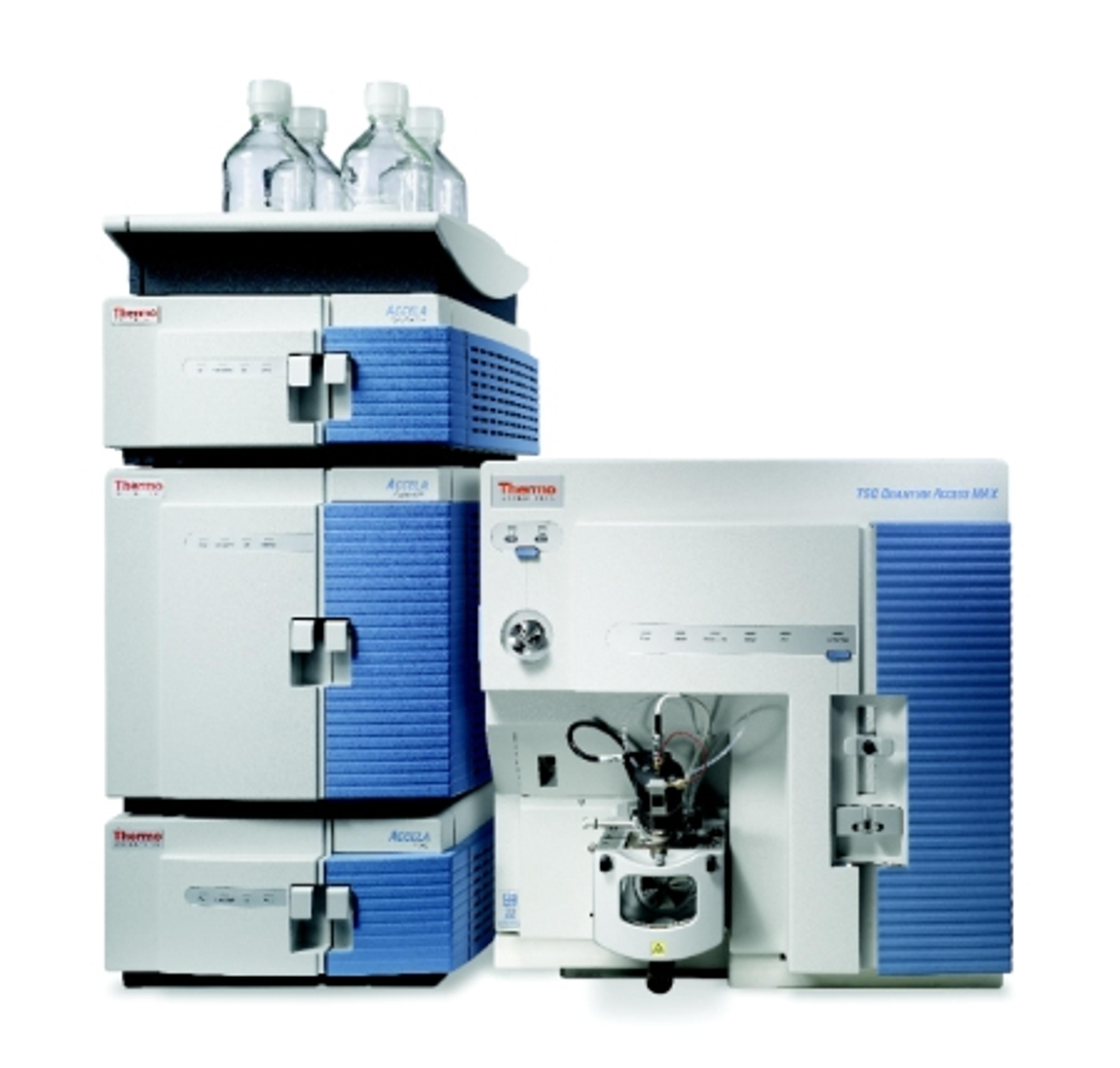
Thermo Scientific™ TSQ Quantum™ Access MAX Triple Quadrupole Mass Spectrometer

Thermo Fisher Scientific

Achieve high quantitative sensitivity and specificity economically with the Thermo Scientific™ TSQ Quantum™ Access Max triple quadrupole mass spectrometer. Applications such as pharmaceutical development, environmental and food safety testing, clinical research, and forensic toxicology demand analytical sensitivity and specificity—even when budgets are constrained. The Thermo Scientific™ TSQ Quantum™ Access MAX Triple Quadrupole Mass Spectrometer is an outstanding LC-MS/MS value, providing excellent sensitivity, specificity, and flexibility that is also more affordable.   Features: Thermo Scientific™ Ion Max™ API source with HESI-II probe reduces noise and increases sensitivity, enhancing quantitative performance. Up to 3,000 definable, timed SRMs and fast 25 ms positive/negative switching improve productivity. Quantitation-enhanced data-dependent MS/MS (QED-MS/MS) provides simultaneous compound confirmation and quantification. High-resolution selected reaction monitoring (H-SRM) with 2 ms dwell times enables quantification of hundreds of compounds in a single run. Mass range of 10–3000 m/z allows analysis of small molecules and intact proteins. Zero-cross-talk collision cell eliminates false positives. Optional FAIMS interface enhances specificity. Intuitive software with searchable compound libraries and database of methodologies for the analysis of pesticides, azo dyes and banned pharmaceuticals in water and food, make the system easy to use. Self-cleaning Ion Max API source heater with automatic source recognition simplifies use and increases reliability.

(1)

Thermo Scientific™ Hypersil GOLD™ C18 Selectivity LC Columns

Thermo Fisher Scientific

Achieve exceptional peak shape and resolution for your HPLC and LC/MS applications with Thermo Scientific™ Hypersil GOLD™ HPLC columns. These endcapped, ultrapure, silica-based columns deliver significant reduction in peak tailing using generic gradients with C18 selectivity. With their excellent resolution, efficiency, and sensitivity, Hypersil GOLD columns give you confidence in the accuracy and quality of your analytical data.

(0)

Links

Tags

UHPLC and HPLCHigh performance liquid chromatography (HPLC) and ultra high performance liquid chromatography (UHPLC), also known as UPLC, are analytical techniques used to separate, identify and quantitate components of complex mixtures including biological samples such as proteins and lipids as well as chemical mixtures of pesticides, drugs and oils. Both techniques are liquid chromatographic methods but differ by operating pressures (HPLC < 6000 psi < UHPLC ). Components of HPLC and UHPLC systems include columns, detectors, pumps, autosamplers and column heaters. Explore a range of UHPLC and HPLC columns for your specific sample needs including reverse phase, normal phase, ion exchange, HILIC, ion exclusion and size exclusion columns. For more specialized HPLC, explore FPLC, countercurrent LC and simulated moving bed systems. Find the best UHPLC and HPLC equipment in our peer reviewed product directory: compare products, check customer reviews and receive pricing direct from manufacturers.LC-MSLC-MS (liquid chromatography-mass spectrometry) systems and equipment are used for separation and quantitative analysis of complex mixtures, combining liquid chromatography and mass spectrometry. Quantify proteins, contaminants, pesticides or screen for drug metabolites with a high level of sensitivity. LC-MS systems and equipment include reverse phase, normal phase and specialized columns integrated with various MS detectors such as time-of-flight (TOF), quadrupole, orbitrap or ion trap mass analyzers. LC-MS/MS instruments equipped with a qTOF or triple quadrupole analyzer give greater sensitivity and resolving power to your analysis. Find the best LC-MS equipment in our peer-reviewed product directory: compare products, check customer reviews and receive pricing direct from manufacturers.Environmental Monitoring and TestingEnvironmental monitoring and testing uses handheld portable analyzers, kits, spectrometers or chromatography systems for air, water, soil, food and other sample testing. Useful features of analyzers such as BOD and COD include portability, easy calibration, automation and sensitivity.  Environmental test kits for pH, water, moisture, etc, should be accurate, sensitive, reliable, fast and easy to use.Food and Beverage AnalyzersFood and Beverage Analyzers are commonly used to provide information about the chemical composition, structure and physical properties of food materials.Food and Beverage ProcessingFood and Beverage Processing involves the preparation of food products for further analysis. Typical instrumentation includes blanchers, color sorters, cookers, grinders, and refrigeration. These are used to replicate the processes commonly used in the commercial preparation of food and beverages.Sample PreparationSample preparation can improve the quality and speed of separation techniques. Products to assist sample preparation include filtration equipment, evaporators, membranes and sieves.PesticidesPesticides are used to protect crops from diseases, pests and unwanted plants. They are classed as persistent organic pollutants (POPs) and can be harmful to humans. The Environmental Protection Agency (EPA) currently regulates the use of pesticides in the USA. Plant SciencePlant science studies the biology of plants, including genetics, physiology, ecology, and biotechnology. Research in this field is essential for improving crop yields, disease resistance, and sustainability. Explore plant science tools in our peer-reviewed product directory; compare products, check reviews, and get pricing directly from manufacturers.QuEChERSFruit Juice