ResourceSeparations

Aminoglycoside Analysis in Honey Using Molecularly Imprinted Polymer Cleanup and LC/MS/MS Detection

Aminoglycoside Analysis in Honey Using Molecularly Imprinted Polymer Cleanup and LC/MS/MS Detection

26 Oct 2015

Streptomycin and related compounds belong to a well-known class of antibiotics called aminoglycosides that are widely used to control bacterial and fungal diseases of fruit trees, seeds, and ornamental crops. A simple and sensitive method for the cleanup, analysis, and quantification of aminoglycosides in honey has been developed using SupelMIP® SPE - Aminoglycosides and LC/MS/MS analysis.

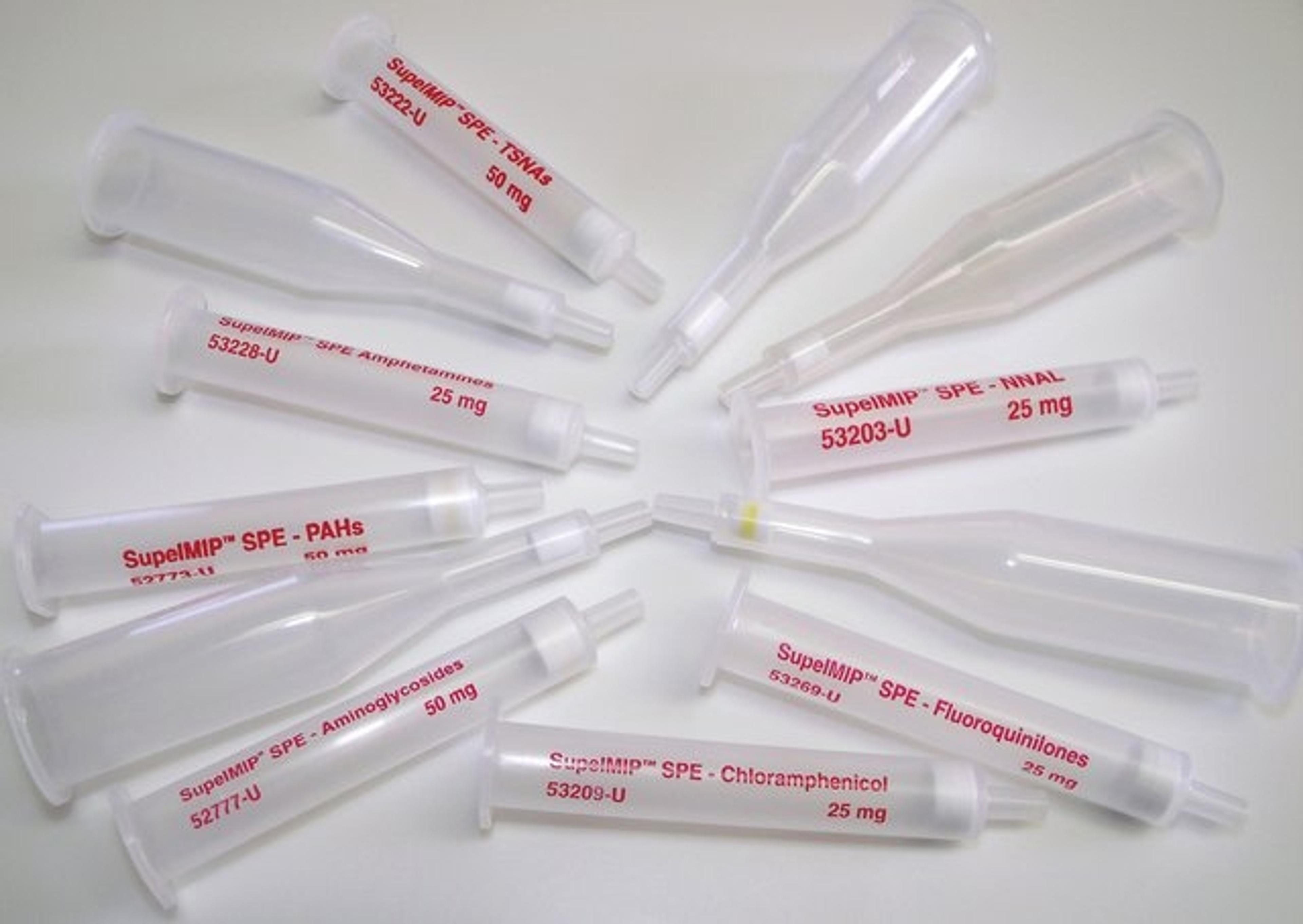
SupelMIP® SPE - Aminoglycosides

Sigma-Aldrich Supelco

The SupelMIP SPE line consist s of highly cross-linked polymers that are engineered to extract a single analyte of interest or a class of structurally related analytes with an extremely high degree of selectivity. This is possible because selectivity is introduced during MIP synthesis in which a template molecule, designed to mimic the analyte, guides the formation of specific cavities or imprints that are sterically and chemically complementary to the analyte(s) of interest. By careful design of the imprinting site, either by molecular modeling, experimental design, or screening methods, the binding cavities can be engineered to offer multiple interaction points with the analyte(s) of interest. This leads to a stronger interaction between the solid-phase and the analyte(s). As a consequence, harsher wash conditions can be tolerated during SPE methodology resulting in cleaner extracts. Because extraction selectivity is significantly improved, lower background is observed allowing analysts to achieve lower limits of detection.   Features and Benefits: Highly selective SPE for trace analysis in complex matrices Achieve lower detection limits Significant time and cost savings Improved MS-compatibility
(0)

Ascentis® Express C18

Sigma-Aldrich Supelco

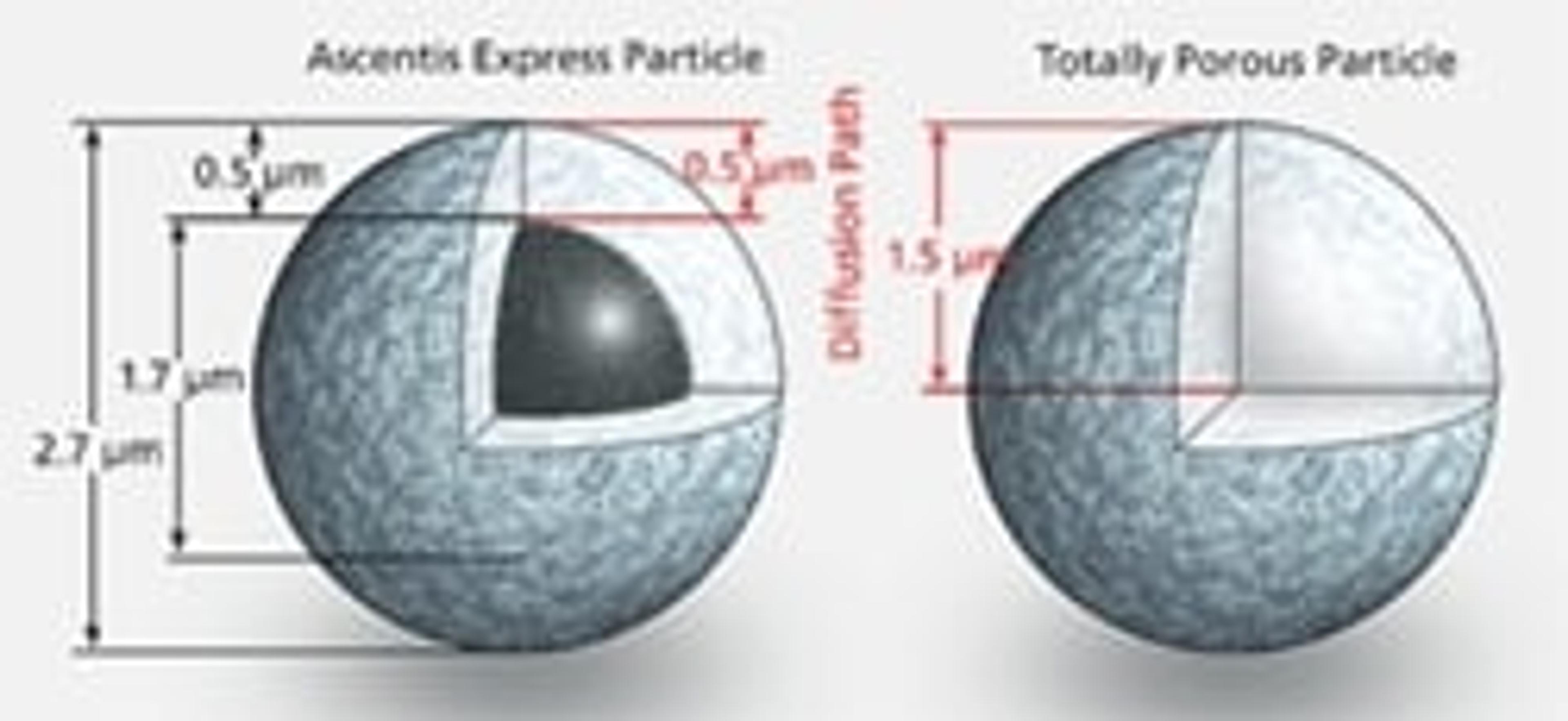
  C18 HPLC column for High Speed and High Resolution Applications. Ascentis® Express C18 is the first choice for starting a new method. Ascentis Express HPLC columns, through the use of Fused-Core® particle technology, can provide you with both the high speed and high efficiencies of sub-2 μm particles at lower system pressure. With identical conditions, the Ascentis Express C18 column performs more than 4X faster than a standard C18 column, for most applications. The combination of high efficiency and lower operating pressure benefits UHPLC (or other ultra high pressure system) users, as well as conventional HPLC users. The increased efficiency of Ascentis Express columns enables you to use shorter columns and reduce solvent usage/cost. The Ascentis® Express C18 is also featured in an application note about liquid GC columns which can be found on the SelectScience website here, and a study on HPLC separation of bile acid here. Column details: Mode: Reversed Phase USP Code: L1 Particle Size: 2.7, <2.0 μm Pore Size: 90 Å Length: 20, 30, 50, 75, 100, 150 mm ID: 1.0, 2.1, 3.0, 4.6, 10 mm

(3)

Links

Tags

Sample PreparationSample preparation can improve the quality and speed of separation techniques. Products to assist sample preparation include filtration equipment, evaporators, membranes and sieves.LC-MSLC-MS (liquid chromatography-mass spectrometry) systems and equipment are used for separation and quantitative analysis of complex mixtures, combining liquid chromatography and mass spectrometry. Quantify proteins, contaminants, pesticides or screen for drug metabolites with a high level of sensitivity. LC-MS systems and equipment include reverse phase, normal phase and specialized columns integrated with various MS detectors such as time-of-flight (TOF), quadrupole, orbitrap or ion trap mass analyzers. LC-MS/MS instruments equipped with a qTOF or triple quadrupole analyzer give greater sensitivity and resolving power to your analysis. Find the best LC-MS equipment in our peer-reviewed product directory: compare products, check customer reviews and receive pricing direct from manufacturers.Mass SpectrometryMass spectrometry (MS) is a powerful analytical technique used to identify and quantify molecules based on the mass-to-charge ratio of gas-phase ions. It provides detailed information about the structure, composition, and properties of compounds and is widely used across fields such as environmental monitoring, materials science, drug discovery and development, food and beverage testing, and wider chemical research. Key MS techniques include tandem mass spectrometry (MS/MS), liquid chromatography–mass spectrometry (LS-MS) and inductively coupled plasma (ICP-MS). Choosing from these wide range of techniques and technologies can be a daunting task, so keep up to date with scientific applications, performance expectations, and customer reviews here all in one place. Visit our product directory to receive quotes direct from the manufacturer. Environmental Monitoring and TestingEnvironmental monitoring and testing uses handheld portable analyzers, kits, spectrometers or chromatography systems for air, water, soil, food and other sample testing. Useful features of analyzers such as BOD and COD include portability, easy calibration, automation and sensitivity.  Environmental test kits for pH, water, moisture, etc, should be accurate, sensitive, reliable, fast and easy to use.Solid-Phase ExtractionSolid-phase extraction (SPE) is used for clean-up, extraction and concentration of semi-volatile or non-volatile analytes from complex mixtures including blood, urine and food samples. Multiple formats are available for conducting SPE, including prepacked SPE cartridges, disks and microplates, as well as SPE sorbent powders for manual packing. SPE systems can be used to automate the process and extract multiple samples at once. Solid-phase microextraction (SPME) and supported liquid extraction (SLE) products are also available in the same formats. Find the best SPE, SLE and SPME equipment in our peer-reviewed product directory: compare products, check customer reviews and receive pricing direct from manufacturers.Food and Beverage AnalyzersFood and Beverage Analyzers are commonly used to provide information about the chemical composition, structure and physical properties of food materials.Food and Beverage ProcessingFood and Beverage Processing involves the preparation of food products for further analysis. Typical instrumentation includes blanchers, color sorters, cookers, grinders, and refrigeration. These are used to replicate the processes commonly used in the commercial preparation of food and beverages.BacteriaBacteria are microorganisms that play critical roles in the environment, human health, and biotechnology. Understanding bacterial genetics, growth, and metabolism is essential for developing antibiotics, vaccines, and improving industrial processes. Browse our peer-reviewed product directory to find the best bacterial research tools, compare products, check reviews, and get pricing directly from manufacturers.PolymersPolymers are large molecules made up of many repeat units. Natural polymers such as DNA and proteins are essential to life, whereas synthetic polymers such as polystyrene and polyethylene are used widely due to their functionality. Typical techniques for analysis include GPC, SEC, DSC, FT-IR and NMR.Food ContaminationFood contamination refers to the presence of harmful substances or pathogens in food, posing risks to human health. Contaminants can be biological, chemical, or physical, and their detection is crucial for ensuring food safety. Advanced testing methods like PCR, chromatography, and spectroscopy are used to identify contaminants in food products. Browse our peer-reviewed product directory to find the best solutions for food contamination detection, compare products, check reviews, and get pricing directly from manufacturers.Environmental ContaminationContaminants in the environment are harmful chemicals that are present in the air, land and water. These include pesticides, pharmaceuticals, persistent organic pollutants (POPs) and many more.Solid Phase Extraction (SPE)Solid phase extraction (SPE) is a sample preparation technique used to separate and concentrate analytes from complex mixtures. It is widely used in environmental, pharmaceutical, and clinical analysis. SPE provides higher sensitivity and selectivity compared to traditional liquid-liquid extraction methods, making it essential for accurate and reproducible results. Explore SPE tools and systems in our peer-reviewed product directory; compare products, check reviews, and get pricing directly from manufacturers.AntibioticsAntibiotics are substances that kill or inhibit the growth of microorganisms, such as bacteria and fungi. They are essential in the treatment of infections and in preventing disease spread. Explore antibiotics research and diagnostic tools in our peer-reviewed product directory; compare products, check reviews, and get pricing directly from manufacturers.