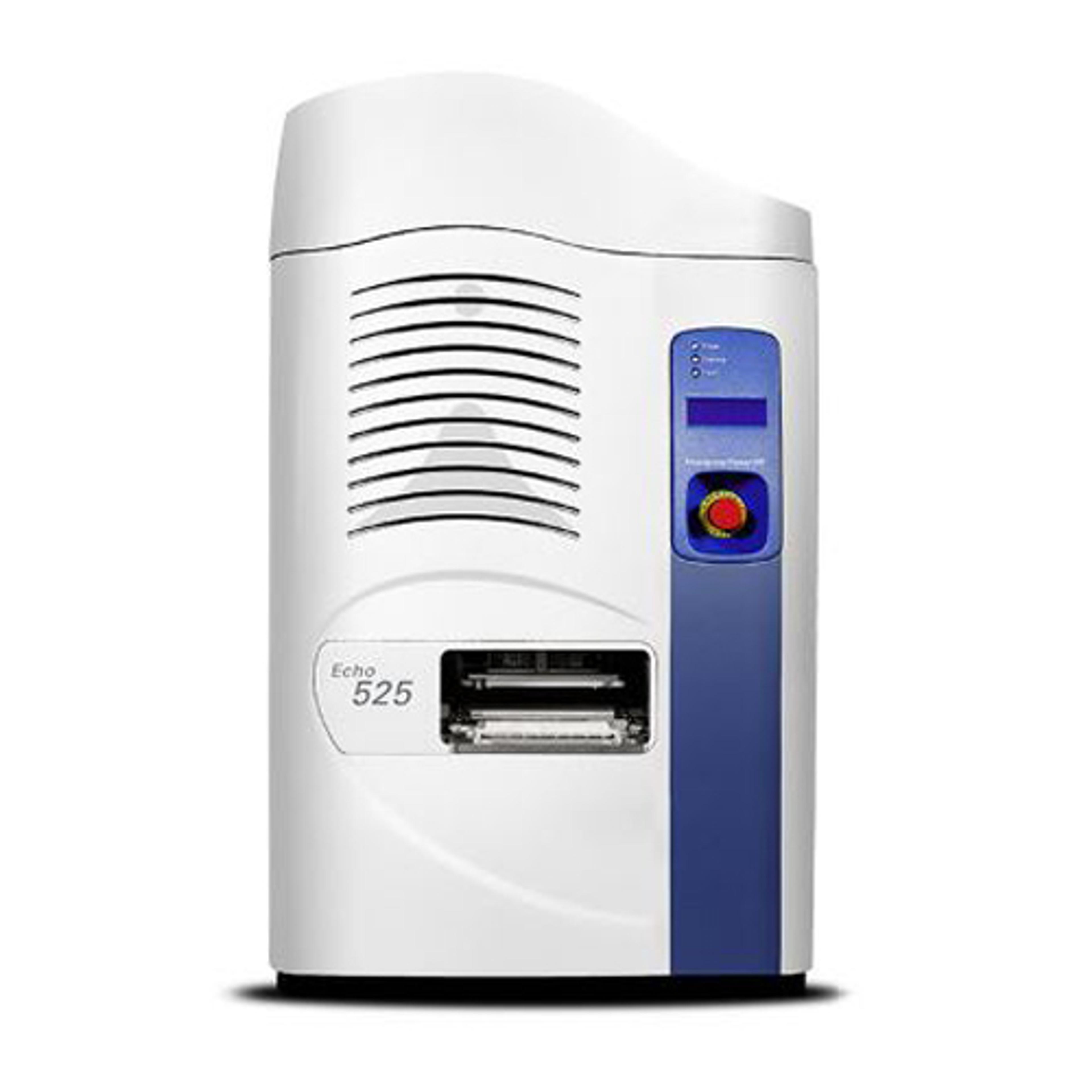
Echo® 525 Liquid Handler
The Echo 525 platform, like the other Echo liquid handler models, is designed to use sound energy to transfer reagents. Unlike the other Echo models, the Echo 525 platform transfers at a larger volume increment (25 nL). This enables the more rapid transfer of aqueous reagents required in biochemical and genomics assays setup.


The supplier does not provide quotations for this product through SelectScience. You can search for similar products in our Product Directory.
The Echo 525 platform, like the other Echo liquid handler models, is designed to use sound energy to transfer reagents. Unlike the other Echo models, the Echo 525 platform transfers at a larger volume increment (25 nL). This enables the more rapid transfer of aqueous reagents required in biochemical and genomics assays setup.
The benefits of acoustic transfer are enabled at volumes to allow full assay assembly at volumes that are typical of medium and high-throughput screening assays:
- Elimination of the need for calibration through Dynamic Fluid Analysis™ technology, a patented Labcyte process
- Elimination of cross-contamination, carryover or leachates
- Tipless transfer, resulting in dramatic cost savings
- Greatly simplified assay development and dilution processes through the flexibility to transfer any volume of liquid from any well to any other well
- Accurate, precise movement of nanoliter-scale quantities, enabling assay miniaturization and further reducing costs

Accelerate green chemistry with smarter synthetic biology
Synthetic biology is driving a new era in sustainable science—enabling researchers to design microorganisms for the efficient production of environmentally friendly materials. Whether you're engineering microbial strains or optimizing growth conditions, minimizing waste and maximizing process efficiency are core goals of any green chemistry workflow.
Download this eBook to:
- Miniaturize and automate strain development — cut reagent use and reduce plastic waste
- Improve strain growth and optimization — minimize costly trial-and-error steps
- Speed up process development — reduce timelines without sacrificing data quality
Explore real-world case studies and practical tools that support sustainable innovation—from DNA purification to high-throughput bioprocessing. Learn how automation, precision liquid handling, and scalable workflows can help you bring green chemistry principles to life in your lab.

NGS for high quality and consistent ‘omics results: Your essential guide
Next-generation sequencing (NGS) is a high-throughput DNA sequencing technology that enables rapid and cost-effective analysis of large amounts of genetic information. Unlike traditional Sanger sequencing, NGS allows for the simultaneous sequencing of millions of DNA fragments, providing a more comprehensive and detailed view of an organism’s genetic makeup.
Despite its many advantages, NGS workflows also face several challenges, which can affect the quality and reliability of the generated data. Automated sequencing preparation can help solve several challenges in the NGS workflow by streamlining and standardizing the sample preparation process, reducing manual processing errors, and increasing efficiency. This eBook provides an informative guide on how automated solutions can be leveraged to optimize your NGS workflows for the following fields:
- Whole genome sequencing
- Metagenomics
- Transcriptomics
- Targeted capture and enrichment
- Exome sequencing
- Single-cell sequencing

Enable seamless, scalable high-throughput proteomics sample prep solutions with open platform liquid handling
Evosep and Beckman Coulter Life Sciences have partnered to automate sample preparation workflows utilizing the unique analytical properties of the Evotip Pure to facilitate end-to-end workflows for proteomics applications and LC-MS analysis using the Evosep One.
The Evosep One is designed for high-throughput and high-volume applications, where standardized methods with increasing robustness enable routine analysis of hundreds of samples per instrument per day. This has moved the bottleneck towards sample preparation, which requires standardized and fully automated end-to-end workflows.
The integration of the Biomek i-Series workstation with Evosep technology offers a robust and scalable solution for high-throughput sample preparation for proteomics.
This is illustrated by fully automated sample loading on the Evotip integrated with digestion workflows for both cell lysates and plasma. By combining cutting-edge technologies in automation with liquid chromatography, these workflows address the growing demand for standardized and scalable proteomics solutions.
Key learning objectives:
- Explore how the Evotip Pure can be seamlessly integrated into LC-MS workflows
- Learn how to setup the Biomek i-Series for proteomics
- Discover how standard proteomics workflows can be automated and cost-efficient for scalability
Who should attend?
- Researchers from the pharmaceutical and biotech industries, as well as academia, who have an interest in proteomics and multiomics.
- Scientists and end users of all skill levels who are currently conducting or wish to conduct proteomic sample preparation.
- Scientists and end users seeking a standardized solution to the challenges of proteomic sample preparation.
Certificate of attendance
All webinar participants can request a certificate of attendance, including a learning outcomes summary, for continuing education purposes.

Supercharging synthetic biology for a sustainable future
Discover how Beckman Coulter Life Sciences is advancing synthetic biology research to tackle the challenges of our growing population