
Thermo Scientific's Listeria Monocytogenes PCR Assay Offers Validated Method for Fast, Simple Detection of Food Pathogens
25 Jul 2013Product news
Food microbiology laboratories can now confidently test to a recognized standard for Listeria monocytogenes with the Thermo Scientific SureTect Listeria monocytogenes Assay, which has been granted Performance Tested MethodSM status by the AOAC Research Institute.
Listeria monocytogenes can be present in a variety of foodstuffs, including some processed meats and cheeses, and in fresh foods such as cantaloupe melon and raw spinach.
The SureTect Listeria monocytogenes PCR Assay has proven to be comparable to the reference method ISO 11290-1:1996, including Amendment 1:2004 (Listeria monocytogenes). This follows the recent granting of AOAC-RI Performance Method status for the SureTect Salmonella species PCR Assay.
“We are delighted to have received validation of our Listeria monocytogenes PCR assay, which is one of a number of assays we offer for molecular food testing,” says Sumi Thaker, VP Global Marketing, Microbiology, Thermo Fisher Scientific. “These assays are part of the SureTect Real-Time PCR System that has been designed to streamline test workflow and reduce time to result, which are primary considerations in today’s pathogen test selection. We anticipate validation on a number of new assays over the next few months.”
The SureTect System was developed to detect microorganisms quickly and accurately in a broad range of foods and associated samples. This unique solution combines:
• Ease of use: Pre-filled lysis tubes and tableted PCR reagents to minimize the number of pipetting steps and hands-on time
• Speed: Optimized single enrichment step for key food matrices and straightforward sample lysis in less than 20 minutes
• Convenience: Common PCR protocols facilitate efficient processing of multiple assays in the same run
• Superior PCR Technology: Probe-based real-time assays for unparallel sensitivity and specificity
Related products
Request Quote for All Products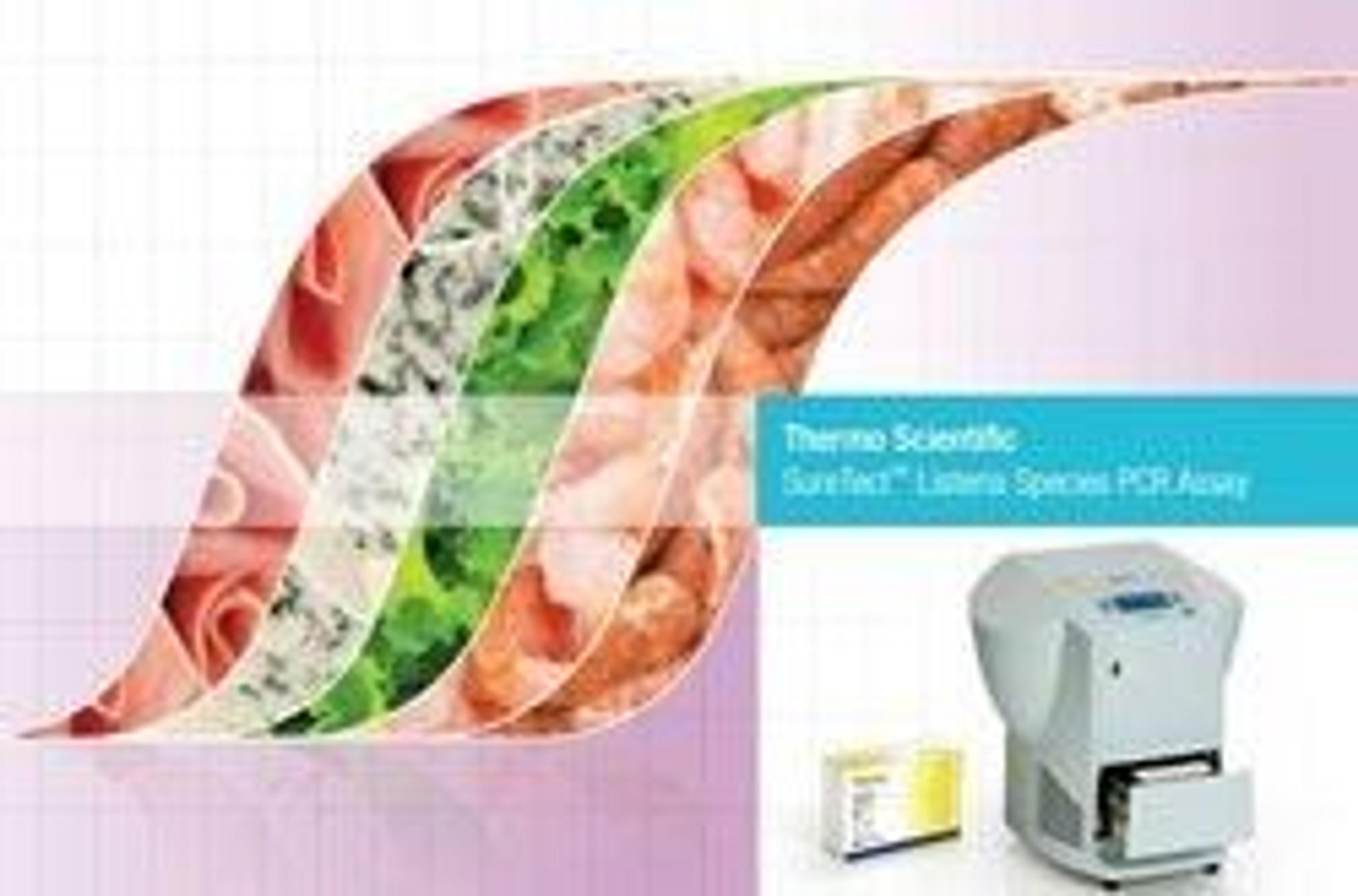
SureTect* Listeria monocytogenes PCR Assay
Thermo Fisher ScientificThe Thermo Scientific* SureTect Listeria monocytogenes PCR Assay is a multiplex real-time assay that incorporates unique primer and probe components for highly-specific detection of the prfA gene, specific to and found only in Listeria monocytogene.The assay also includes primer and probe components, for simultaneous detection of an internal amplification control (IAC), for confirmation of successful PCR and increased confidence in results.SureTect* Listeria monocytogenes PCR Assay Features: Single enrichment step - no secondary enrichment or regrowth required, for faster, simpler testing. Pre-filled lysis tubes Tableted PCR reagents - eliminates PCR reagent pipetting, to enhance reproducibility and minimize hands-on time. Streamlined protocol - facilitates processing of multiple assays in the same run, for maximum efficiency. Simple, intuitive software Automatic data interpretation - reliably reports test results as positive or negative.