
Quantachrome Instruments Announces the Release of the New Vstar™ Vapor Sorption Analyzer
11 Jun 2014
Product news
There is a new star in the Quantachrome lineup of precision sorption analyzers!
The Vstar™ vapor sorption analyzer goes beyond water sorption to provide vapor sorption analysis using a wide variety of organic vapors at a wide range of temperatures.
Quantachrome announces the release of the Vstar™ vapor sorption analyzer, the latest in a proud family of precision sorption analyzers, which includes the Autosorb iQ for micropore analysis and cutting edge research, the Autosorb 6iSA for high throughput surface area and pore analysis, the Nova for low-cost routine analysis, and the Aquadyne DVS for gravimetric water sorption measurements.
The Vstar™ provides a fast, accurate, and reliable means of obtaining water sorption isotherms on a wide variety of materials, but it doesn’t stop there. The Vstar™ also can measure adsorption isotherms of a variety of organic vapors, providing insight into the materials’ resistance to organic vapors, viability as an adsorbent for these vapors in storage or sequestration applications, and information on the chemical properties of these materials.
Simultaneous analysis
The Vstar™ is available in one-, two-, three-, or four-station models, each of which is available with a variety of options. The ability to analyze up to 4 samples simultaneously (on the Vstar™ 4) provides unprecedented throughput; superior manifold temperature control ensures the highest accuracy; independent sample temperature control (with additional circulators) and wider sample temperature range provide maximum flexibility; and a high-vacuum option enables analysis of microporous materials. Meticulous control of the manifold temperature from the vapor source to the sample eliminates the possibility of local condensation of the adsorptive and ensures the most accurate analysis possible.
Pharmaceutical excipients and material hydrophobicity
The Vstar™ has benefits for many applications. For material science, the hydrophobicity of the material as well as its affinity to water and organic vapors can be quickly and accurately determined. The effects of humidity on pharmaceutical excipients and active ingredients can be measured in a fraction of the time of existing techniques. The Vstar™ can measure the resistance to moisture of building materials, and tolerance of solvents and other organic materials. For the food industry vapor sorption measurements of the raw ingredients and the finished products can provide valuable insight for the optimization of formulations.
Related products
Request Quote for All Products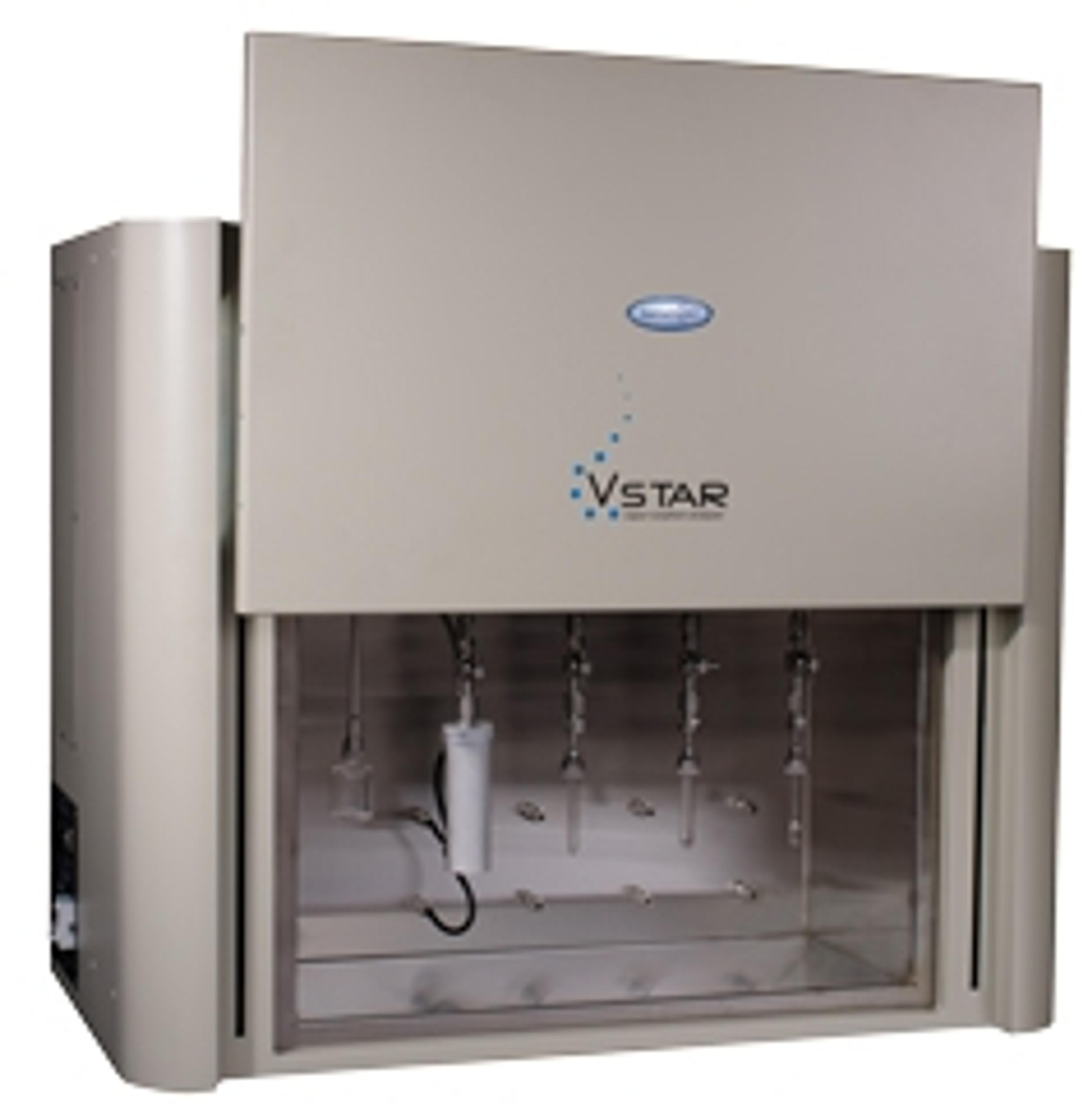
VSTAR™ Vapor Sorption Analyzer
Quantachrome InstrumentsThe VSTAR™ vapor sorption analyzer goes beyond water sorption to provide vapor sorption analysis using a wide variety of organic vapors at a wide range of temperatures. Meticulous control of the manifold temperature from the vapor source to the sample eliminates the possibility of local condensation of the adsorptive and ensures the most accurate analysis possible. The VSTAR™ measures complete adsorption-desorption isotherms, that is the quantitative uptake of vapor as a function of relative pressure / relative humidity at a user selectable, thermostatically controlled temperature. Such measurements are of critical importance to material scientists developing adsorption based technologies for chemical process and environmental applications.The VSTAR™ is available in one-, two-, three-, or four-station models, each of which is available with a variety of options. The ability to analyze up to 4 samples simultaneously (on the VSTAR™ 4) provides unprecedented throughput.Features & Benefits: Wide Vapor Compatibility Homogeneous Temperature Wide Range of Temperature Flexible Modular Throughput Independent Sample Temperature Wide Temperature Range with High Sensitivity Small Thermal Gradients Reduced Void Volume with Simultaneous Equilibration Low Pressure Operation Space Saving Design Vacuum Pump Protection Sensitive Sample Protection Flexible Software Interface Easy Setup Applications: Material Science Food Development Pharmaceuticals Building Materials