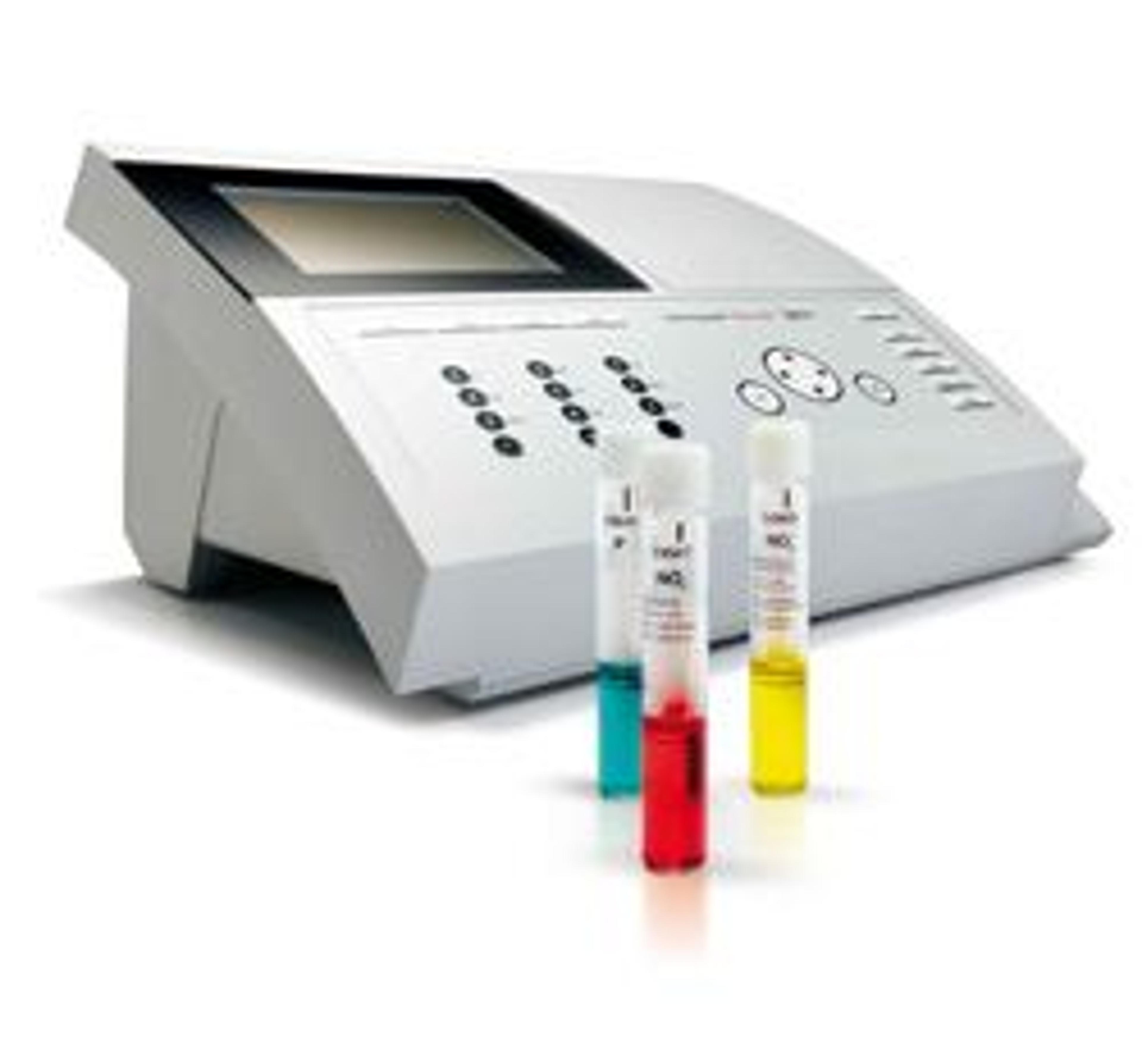
EMD Millipore Introduces Spectroquant® Prove Family of System Spectrophotometers for Simplified, Durable and Secure Water Analysis

5 Nov 2015

Lois Manton-O'Byrne, PhD
Executive Editor

Product news

  • Applications include waste water, drinking water, beverages and process water
  • Offers the largest choice of water test kits with Live ID for accurate and fully traceable results
  • Available in three models for routine applications, sensitive measurements and complex analyses

EMD Millipore, a leading science and technology company, has introduced Spectroquant® Prove, a new class of spectrophotometers for simplified, durable and secure analysis of waste water, drinking water, beverages and process water. Spectroquant® Prove is available in three models to meet a broad range of requirements and offers the largest choice of water test kits and methods including complete documentation.

  • Spectroquant® Prove 100 performs Vis measurements and offers high quality and exceptional value for routine applications with Spectroquant® cell test kits.
  • Spectroquant® Prove 300 allows UV/Vis analyses. Its long-lasting xenon lamp makes it ideal for more intensive use. Preprogrammed free applications, like bromate and brewery tests, make it the perfect choice for drinking water and beverage testing.
  • Spectroquant® Prove 600 offers all the benefits of the Prove 300 system, delivers excellent resolution and sensitivity and is designed for complex analyses with high-end UV/Vis optics. The system offers a 1.8nm bandwidth and cuvettes up to 100mm. Together with the most sensitive silicate and chloride test kits, the lowest measuring ranges in process water are reached.

Spectroquant® Prove's simple design requires only a minimal amount of space and its surfaces are durable against many chemicals used in the lab. Spectroquant® Prove also allows for easy data transfers with maximum flexibility and minimal effort.

The Spectroquant® Prove family of instruments and test kits increases the efficiency and reliability of water analysis through a variety of key features, including:

  • Live ID, a new, data-rich identification system on all cell and reagent tests for transferring "live" data like expiry and lot number together with automatic, complementary calibration updates
  • Cell Test Port offers direct insertion of round cell tests without opening any lids
  • AutoSelector for Reagent Tests automatically detects the analysis method and provides all Live ID data
  • Automatic cell size recognition for rectangular cells calculates results accordingly
  • Smart Screen for simple, seamless menu navigation
  • AQA prime for exceptionally secure and easy analytical quality assurance
  • Long-life lamp, new reference beam technology minimizes the effort and costs of replacing lamps
  • Removable cell compartment, the cell holder can be removed and cleaned if something is spilled

Spectroquant® quality assurance for photometers

Merck KGaA, Darmstadt, Germany

The Spectroquant® analysis system includes photometers with cell tests and reagent tests which can be identified by barcodes pre-diluted standard solutions in various concentrations for increased reliability requirements residue-free cleaning agents Three-stage concept for internal controls Photometer Check - AQA 1 Easy to perform with certified color standards and/or Certipur® UV/VIS standards. System Check - AQA 2 Reliable documentation by measuring the recovery with CombiCheck standard solution, Certified Reference Material standard solutions (CRM), or Certipur® standard solutions. Matrix Check - AQA 3 Through one-time spiking with CombiCheck R-2 solution or multiple dilution/spiking with self-prepared solutions. Error-free results with analytical quality assurance With the Spectroquant® analysis system Merck Millipore offers a complete analytical quality assurance (AQA) concept for all Spectroquant® photometers. This allows users to be sure at all times that laboratory processes are running within defined minimum margins of error from beginning to end, providing reliable measurement results. Merck Millipore's ammonium standard solutions for photometric applications have an expanded measurement uncertainty of no more than 0.012 mg/l.

(2)

Links

Tags

Sample PreparationSample preparation can improve the quality and speed of separation techniques. Products to assist sample preparation include filtration equipment, evaporators, membranes and sieves.Atomic Absorption / Emission SpectroscopyAtomic absorption spectroscopy (AAS) and atomic emission spectroscopy (AES) — also called optical emission spectroscopy (OES) — are used to detect the elemental constituents in samples. Both techniques involve the atomization of a sample. Atomic absorption spectrometers may use a flame or furnace to create an atomic vapor of the sample before irradiation with spectral light. Optical emission spectrometers may use a flame, inductively coupled plasma (ICP), microwave plasma (MP) or spark arcs to atomize and excite the sample. At higher excitation energies, electrons can be emitted instead of photons, which can be useful for samples that can’t be atomized and for surface analysis. Explore electron spectroscopy equipment such as Auger spectrometers and photoelectron spectrometers for surface elemental analysis of samples. Find the best atomic absorption, photoelectron and optical emission spectrometers in our peer-reviewed product directory: compare products, check customer reviews and receive pricing direct from manufacturers.Fluorescence SpectroscopyFluorometers and spectrofluorometers (also called fluorescence spectrometers) are used to measure the intensity and wavelength of fluorescent light emitted from a sample after excitation by illumination. Spectrofluorometers utilize monochromators to select the desired wavelengths, whereas filter fluorometers employ a set of filters. Spectrofluorometers for measuring steady-state fluorescence and lifetime fluorescence (or time-resolved fluorescence) are available, as well as fluorescence microscopes and microplate readers. Find the best fluorescence spectroscopy products in our peer-reviewed product directory: compare products, check customer reviews and receive pricing direct from manufacturers.Environmental Monitoring and TestingEnvironmental monitoring and testing uses handheld portable analyzers, kits, spectrometers or chromatography systems for air, water, soil, food and other sample testing. Useful features of analyzers such as BOD and COD include portability, easy calibration, automation and sensitivity.  Environmental test kits for pH, water, moisture, etc, should be accurate, sensitive, reliable, fast and easy to use.Food and Beverage AnalyzersFood and Beverage Analyzers are commonly used to provide information about the chemical composition, structure and physical properties of food materials.Food and Beverage ProcessingFood and Beverage Processing involves the preparation of food products for further analysis. Typical instrumentation includes blanchers, color sorters, cookers, grinders, and refrigeration. These are used to replicate the processes commonly used in the commercial preparation of food and beverages.Water PurificationThere are a number of water purification methods available to remove contamination from laboratory water. These systems include demineralization, reverse osmosis, filtration and ultrafiltration. A combination of methods is sometimes necessary to achieve purified water suitable for use in experiments.Waste WaterPesticidesPesticides are used to protect crops from diseases, pests and unwanted plants. They are classed as persistent organic pollutants (POPs) and can be harmful to humans. The Environmental Protection Agency (EPA) currently regulates the use of pesticides in the USA. Routine QuantitationWater AnalysisAnalytical methods used to test the purity of drinking water include determining the level of contaminants abides to the level set by the Environmental Protection Agency (EPA).Trace Level ImpuritiesTrace level impurities refer to low concentrations of unwanted substances found in chemicals, pharmaceuticals, and other products. Detecting and removing these impurities is crucial for product safety and regulatory compliance. Explore trace impurity analysis tools in our peer-reviewed product directory; compare products, check reviews, and get pricing directly from manufacturers.Beverage AnalysisBeverage analysis involves testing and evaluating the composition, quality, and safety of drinks, from alcoholic beverages to soft drinks. Techniques like chromatography and spectroscopy are commonly used to analyze flavors, nutrients, contaminants, and additives. Browse our peer-reviewed product directory to find the best beverage analysis tools, compare products, check reviews, and get pricing directly from manufacturers.SpectrophotometrySpectrophotometry is a technique used to measure the absorption or transmission of light through a sample. It is commonly used in chemical analysis, environmental monitoring, and quality control. Explore spectrophotometry tools in our peer-reviewed product directory; compare products, check reviews, and get pricing directly from manufacturers.Drinking Water AnalysisAnalytical methods used to test the purity of drinking water include determining the level of contaminants abides to the level set by the Environmental Protection Agency (EPA).