Building a bridge between organoid research and drug discovery
3 Mar 2025Step inside the world of next-generation 3D cell culture with Dr Elad Katz, founder of Navigate Precision Biology, a spin-out from the University of Dundee. In this interview, Dr Katz shares how their groundbreaking NaviPlate system generates 384 identical organoids in a single microplate — a powerful, automation-friendly platform for studying disease models and accelerating drug discovery.
Discover how Dr Katz relies on the PHERAstar FSX microplate reader to push the boundaries of organoid research, using fluorescence intensity to analyze life/death assays with as few as 500 cells per well. From cancer and bone microtissues to heart, kidney, and lung organoids, learn how high-throughput, ultra-sensitive detection is driving innovations in fibrosis research, calcium flux oscillations, and beyond.
About the company

BMG LABTECH
BMG LABTECH - The Microplate Reader Company
BMG LABTECH has been committed to providing high quality microplate readers for academic and high-throughput laboratories since 1989, and has earned the reputation of being a technology leader through ongoing innovations and by carefully listening to the needs of the scientific community.
BMG LABTECH has developed the widest range of dedicated, multi-mode, life science, and HTS microplate readers available.
The CLARIOstar® is a multi-mode, high-performance microplate reader with revolutionary monochromator technology. The patent-pending LVF Monochromators™ give the CLARIOstar filter-like performance combined with the flexibility of monochromators.
BMG LABTECH also provides the perfect microplate readers for High-Throughput Screening, assay development, and high-end applications. The PHERAstar® FSX is designed to read multiple detection modes including UV/Vis absorbance spectra, fluorescence intensity, FRET, fluorescence polarization, time-resolved fluorescence, HTRF, LANCE, DELFIA, AlphaScreen / AlphaLISA, luminescence and BRET in all plate formats up to 3456.
The Omega Series are the only life science microplate readers with Tandem Technology - ultra-fast UV/Vis spectrometer based absorbance and highly sensitive filter-based detection for measuring fluorescence and luminescence. These multi-mode microplate readers are also capable of reading TR-FRET assays such as HTRF and LanthaScreen as well as AlphaTechnology based assays.
Related products
Request Quote for All Products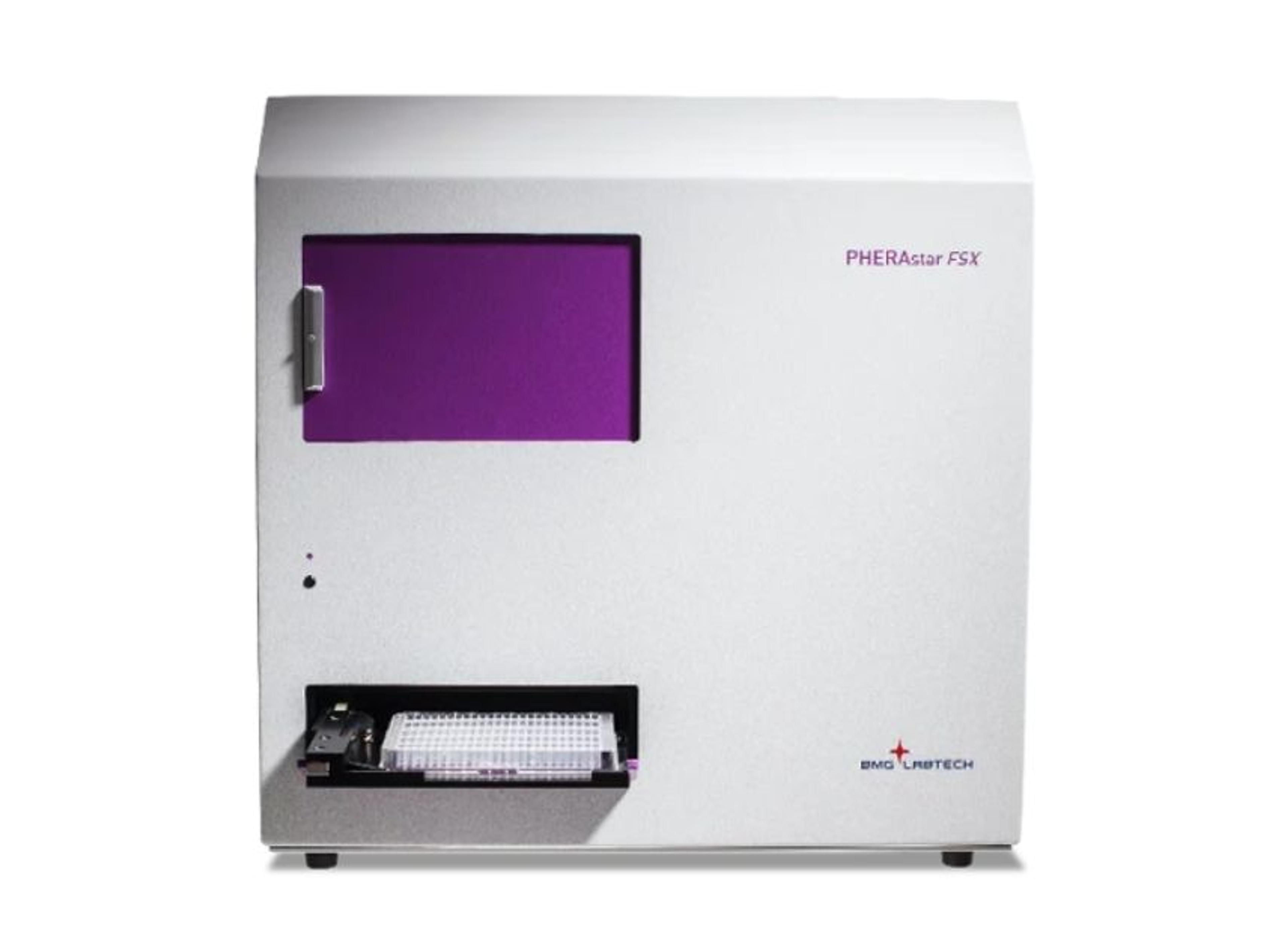
PHERAstar® FSX HTS Microplate Reader
BMG LABTECHThe most sensitive microplate reader for high-throughput screening