ResourceSeparations

Rapid, Sensitive, and Quantitative LC/MS/MS Determination of Digitoxin and Digoxin in Plasma

Using a Simple Procedure for Simultaneous Clean-up of Phospholipids and Proteins

18 Jan 2016

This application note describes the development of an LC/MS/MS method to measure digoxin and Digitoxin levels in the body, as these glycosides are used for treating heart conditions. Current methods using immunoassays are not selective between the two compounds due to the similarities between the molecules.

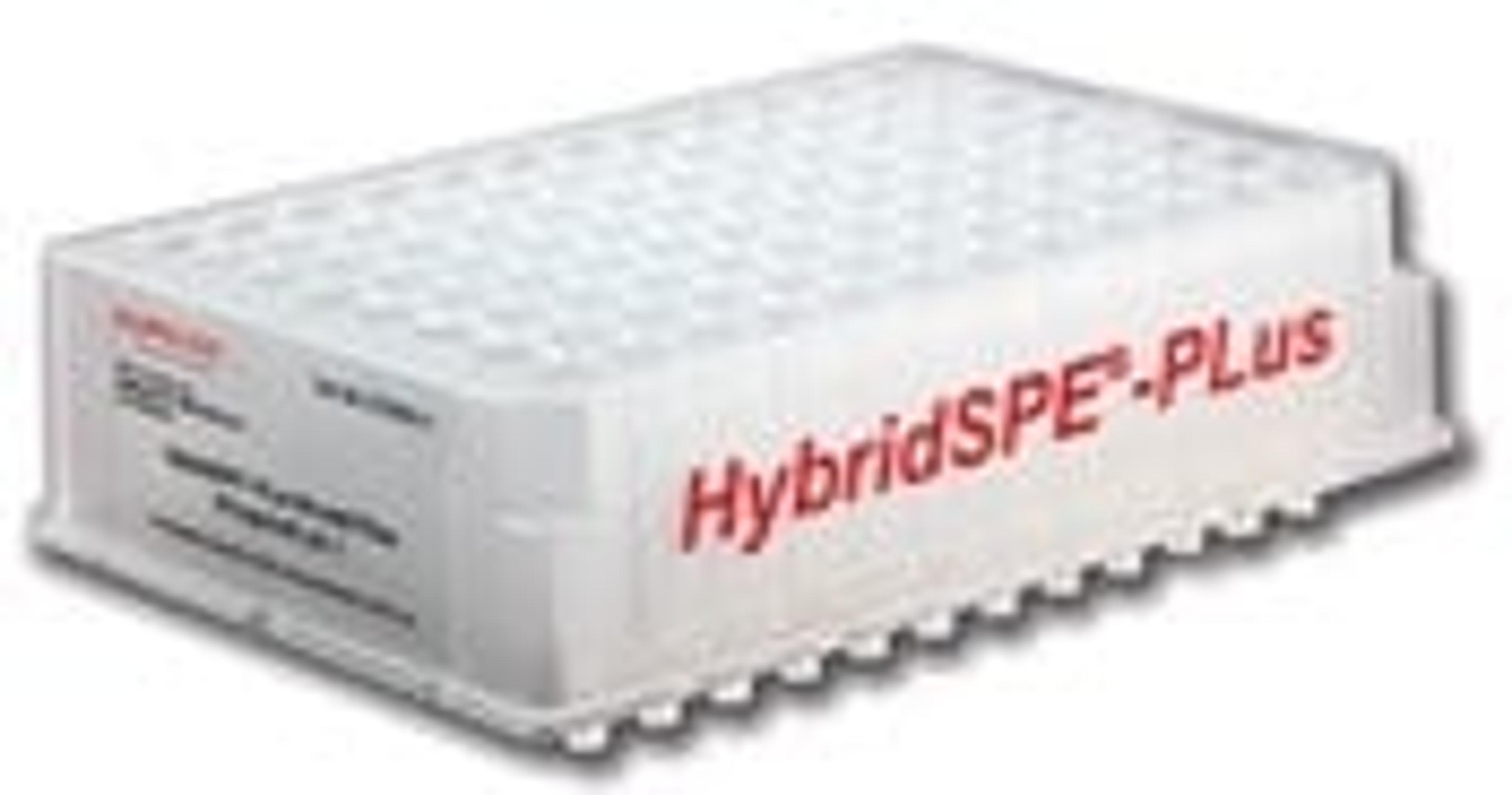
HybridSPE®-Precipitation, 96-well Plate, pk of 1

Sigma-Aldrich Supelco

Patent pending HybridSPE – Precipitation (HybridSPE-PPT) technology is a simple and generic sample prep platform designed for the gross level removal of endogenous protein and phospholipid interferences from biological plasma and serum prior to LC-MS or LC-MS/MS analysis. Biological plasma or serum is first subjected to protein precipitation via the addition and mixing of acidified acetonitrile. Precipitated proteins are then removed by centrifugation and the resulting supernatant is loaded on the HybridSPE-PPT 96-well plate or cartridge which acts as a chemical filter that specifically targets the removal of endogenous sample phospholipids. The phospholipid retention mechanism is based on a highly selective Lewis acid-base interaction between the proprietary zirconia ions functionally bonded to the HybridSPE-PPT stationary phase and the phosphate moiety consistent with all phospholipids. The resulting eluent is ready for immediate LC-MS or LC-MS-MS analysis. An alternative “In-well Precipitation” method is available for the HybridSPE-PPT 96-well version in which biological plasma/serum is first added to the 96-well plate followed by acidified acetonitrile (precipitation agent). After a brief mixing/vortexing step, vacuum is applied to the 96-well plate. Because the 96-well version contains a series of low porosity hydrophobic filters/frits, the packed-bed filter/frit assembly acts as a depth filter facilitating the concurrent removal of both phospholipids and precipitated proteins during the extraction process.

(0)

Links

Tags

UHPLC and HPLCHigh performance liquid chromatography (HPLC) and ultra high performance liquid chromatography (UHPLC), also known as UPLC, are analytical techniques used to separate, identify and quantitate components of complex mixtures including biological samples such as proteins and lipids as well as chemical mixtures of pesticides, drugs and oils. Both techniques are liquid chromatographic methods but differ by operating pressures (HPLC < 6000 psi < UHPLC ). Components of HPLC and UHPLC systems include columns, detectors, pumps, autosamplers and column heaters. Explore a range of UHPLC and HPLC columns for your specific sample needs including reverse phase, normal phase, ion exchange, HILIC, ion exclusion and size exclusion columns. For more specialized HPLC, explore FPLC, countercurrent LC and simulated moving bed systems. Find the best UHPLC and HPLC equipment in our peer reviewed product directory: compare products, check customer reviews and receive pricing direct from manufacturers.Sample PreparationSample preparation can improve the quality and speed of separation techniques. Products to assist sample preparation include filtration equipment, evaporators, membranes and sieves.LC-MSLC-MS (liquid chromatography-mass spectrometry) systems and equipment are used for separation and quantitative analysis of complex mixtures, combining liquid chromatography and mass spectrometry. Quantify proteins, contaminants, pesticides or screen for drug metabolites with a high level of sensitivity. LC-MS systems and equipment include reverse phase, normal phase and specialized columns integrated with various MS detectors such as time-of-flight (TOF), quadrupole, orbitrap or ion trap mass analyzers. LC-MS/MS instruments equipped with a qTOF or triple quadrupole analyzer give greater sensitivity and resolving power to your analysis. Find the best LC-MS equipment in our peer-reviewed product directory: compare products, check customer reviews and receive pricing direct from manufacturers.HematologyIn Haematology / Hematology, complete blood cell counts (or full blood counts) are obtained using automated blood count analyzers to enumerate blood cell types.  Hematology also encompasses haemostasis and coagulation, thrombophilia and hemophilia, plasma viscosity and ESR analysis, hemoglobinopathies, cell morphology and haematinic measurement.ImmunologyImmunological techniques measure and characterize immune responses. Immunology kits and analysis systems often use techniques such as ELISA, radioimmunoassay (RIA) and immunodiffusion assays, Immunohistochemistry, and flow cytometry. Immunologists use equipment such as flow Cytometers, plate readers, plate washers and fluorescent microscopes.Clinical ChemistryBiochemistry (or clinical chemistry) involves the analysis of bodily fluids using chemical tests. Techniques used include HPLC, chromatography, spectroscopy, mass spectrometry, immunochemical, electrophoresis, turbidometric / spectrophotometric assay, MRI and ISE analysis. Tests are often carried out on plasma or serum but urine (urinalysis) and fecal specimens are also processed.GC-MS GC-MS (gas chromatography-mass spectrometry) instruments and equipment are used to separate, quantify and identify mixtures of small and volatile compounds, such as polycyclic aromatics, fatty acids and alcohols. Often used in drug detection, forensic investigation and environmental analysis for pesticides and contaminants, GC-MS is a powerful addition to your lab’s analytical capabilities. GC-MS/MS instruments equipped with a qTOF or triple quadrupole analyzers can give greater sensitivity and resolution to your analysis. Find the best GC-MS instruments and equipment in our peer-reviewed product directory: compare products, check customer reviews and receive pricing direct from manufacturers.HPLC Method DevelopmentIt is important to develop and validate HPLC methods in order to identify, quantify or purify compounds of interest in the most efficient way. Effective method development ensures optimization, quality control and cost effectiveness.SpectroscopySpectroscopy is a technique that analyzes the interaction of light with matter to study molecular properties, concentrations, and structural information. Widely used in chemical, pharmaceutical, and environmental analysis, spectroscopy offers insights into molecular composition and helps identify unknown compounds. It plays a key role in quality control, research, and diagnostics. Browse our peer-reviewed product directory to compare spectroscopy tools, read reviews, and get prices directly from manufacturers.Molecular DiagnosticsMolecular diagnostics use an individual’s genetic code and gene expression to diagnose and monitor diseases. The technique is used increasingly in the field of infectious diseases and oncology, as well as areas such as coagulation, HLA typing and pharmacogenomics. Molecular diagnostics plays a pivotal role in personalized medicine.Cardiovascular DiseaseCardiovascular disease refers to a group of disorders of the heart and blood vessels, including heart attacks, strokes, and high blood pressure. Early diagnosis and effective treatment are essential for improving patient outcomes. Explore cardiovascular disease research and diagnostic tools in our peer-reviewed product directory; compare products, check reviews, and get pricing directly from manufacturers.HPLCHigh-performance liquid chromatography (HPLC) is a technique for separating, identifying, and quantifying components in mixtures. It is widely used in chemical, pharmaceutical, and environmental analysis to ensure purity and identify unknown compounds. Explore the best HPLC systems in our peer-reviewed product directory; compare products, read reviews, and get pricing directly from manufacturers.