
Production of Human Induced Pluripotent Stem CellDerived Cortical Neurospheres in the DASbox Mini Bioreactor System
8 Nov 2018Stem cell-derived cortical neurospheres are of great interest in basic neurobiology research and drug research. Cultivation in controlled, stirred-tank bioreactors can improve the homogeneity of neural spheroid cultures and allows culture scale-up. We used a DASbox Mini Bioreactor System for the generation of human induced pluripotent stem cell (hiPSC) spheroids and subsequent neural differentiation. Results from three independent bioprocesses demonstrate the reproducibility of the neural differentiation protocol. In a single DASbox Mini Bioreactor, we obtained 2 x 10⁸ cells, demonstrating the potential of stirred-tank bioreactors for the generation of high numbers of iPSCderived neurospheres.
Related products
Request Quote for All Products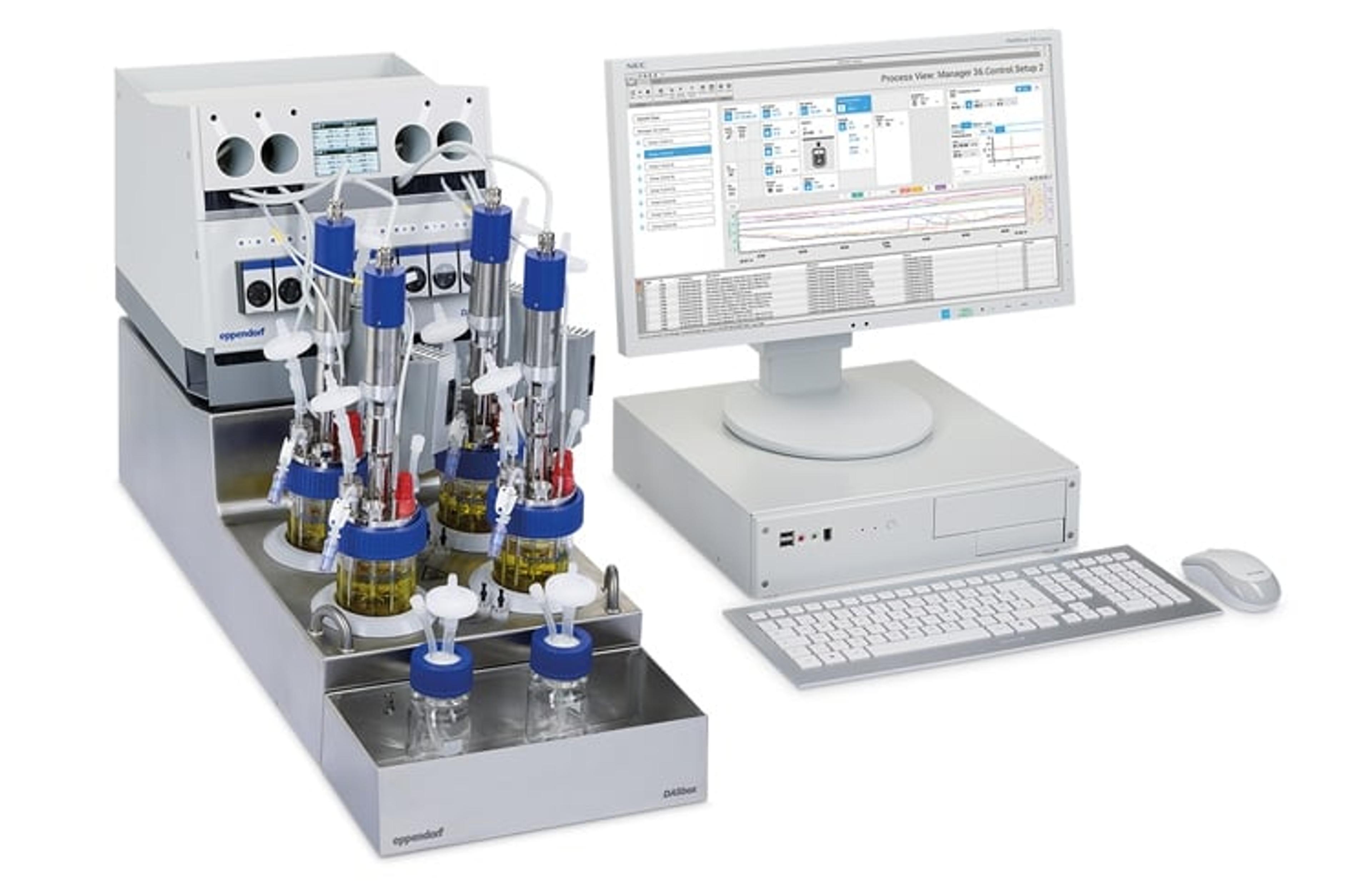
DASbox® Mini Bioreactor System
EppendorfThe DASbox is a unique mini bioreactor system suitable for microbial and cell culture as well as stem cell applications. It is designed as a 4-fold system with up to twenty-four parallel operating bioreactors. With working volumes of 60 – 250 mL the DASbox is the optimal tool for advanced process development and Design of Experiments (DoE) applications. All critical process parameters can be precisely controlled. Liquid-free temperature control and exhaust condensation satisfy users with easy handling. In addition to using industry standard glass bioreactors the DASbox can be equipped with Eppendorf BioBLU® 0.3 vessels, all fully instrumented single-use mini bioreactors. Eppendorf DASbox® Mini Bioreactor System Features: Parallel set-up of up to 24 bioreactors; Excellent scalability and reproducibility in both microbial and cell culture applications; Supports industry standard glass bioreactors (DASbox Mini Bioreactor) as well as the BioBLU 0.3 Single-Use Vessels; Small working volumes save on the amount of cell material, media and supplements required; Extremely compact system with a footprint of only 7.5 cm (3 in) benchspace per vessel; Individual temperature control with liquid-free heating and cooling (Peltier); Liquid-free Peltier exhaust condenser with easy handling by automatic slide in activation and slide out deactivation mode; LC display with key process parameters and integrated alarm function simplifies monitoring; Fully mass flow-controlled gas mixing with individual gas mixture from Air, O2, CO2 and N2, each directable either to headspace or sparger; Standard sensors for precise measurement and control of temperature, pH, DO, level and ORP (redox potential); optical pH sensors available; Precise miniature variable speed pumps, continuous flow rates down to 0.3 mL/h; Sealed magnetic overhead drives for single-use vessels and direct overhead drives for autoclavable vessels; up- or downflow selectable; Optional pull-out system for enhanced accessibility of bioreactors and control unit. Applications: Process development in cell culture and microbiology; Design of Experiments (DoE) Media optimization Clone and cell line screening, strain characterization.