
Optimization of Trypsin Digestion for MRM Quantification of Therapeutic Proteins in Serum
19 Feb 2013In this application note a general workflow for the quantification of therapeutic proteins in serum without analyte pre-fractionation was tested to determine the quantification of trastuzumab in human serum. The analytical workflow of trypsin digestion can be optimized to develop a successful multiple reaction monitoring (MRM) assay. Some of the benefits of trypsin digestion include higher assay sensitivity, reduced sample preparation time, and higher assay reproducibility.
Related products
Request Quote for All Products
ACQUITY UPLC System
WatersWaters ACQUITY UPLC - Dramatic Improvements in Speed, Sensitivity and Resolution Whether you work in methods development or quality assurance, in drug discovery and development or testing for safety in food supplies, you seek a productivity edge. With the ACQUITY UPLC® System, now you can get more information in a single, short run than you've ever seen with HPLC. Waters ACQUITY UPLC System UltraPerformance LC® (UPLC®) technology starts with unique 1.7 μm small-particle chemistries. Chromatographers no longer need to choose between speed and resolution–with UPLC you get both. Instrument Designed for Chemistry; Chemistry Designed for the Instrument The ACQUITY UPLC System has been holistically designed to match the performance needs of our innovative column chemistries with robust hardware, easy-to-use software and specialized support services. Small, pressure-tolerant particles High-pressure fluidic modules Minimized system volume Negligible carryover Reduced cycle times Fast response detectors Integrated system software and diagnostics With UPLC you have the ability to work more efficiently with higher speed, sensitivity and resolution at a much wider range of linear velocities, flow rates and backpressures to obtain superior results. The Waters ACQUITY UPLC System's high-pressure fluidics optimizes flow rates to make the most of small particle technology. The ACQUITY UPLC System's sample-handling design is designed to ensure exceptionally low carryover and reduced cycle time. And when interfaced with the Sample Organizer, it increases unattended sample capacity by ten times. High-speed detectors, both optical and mass, contribute to increased sensitivity and help manage the heightened speed and resolution requirements of UPLC. ACQUITY UPLC Systems are easily controlled, diagnosed, and monitored via a graphical system console interface. The console offers: Quick and easy access to critical instrument parameters Simple system start-up, elegant system status monitoring and predictive performance indicators to ensure maximum productivity Data management capabilities that are supported by both MassLynx™ and Empower™ software The ACQUITY UPLC System is also supported by Intelligent Device Management technology with our Connections® INSIGHT™ service, providing instrument diagnostics.

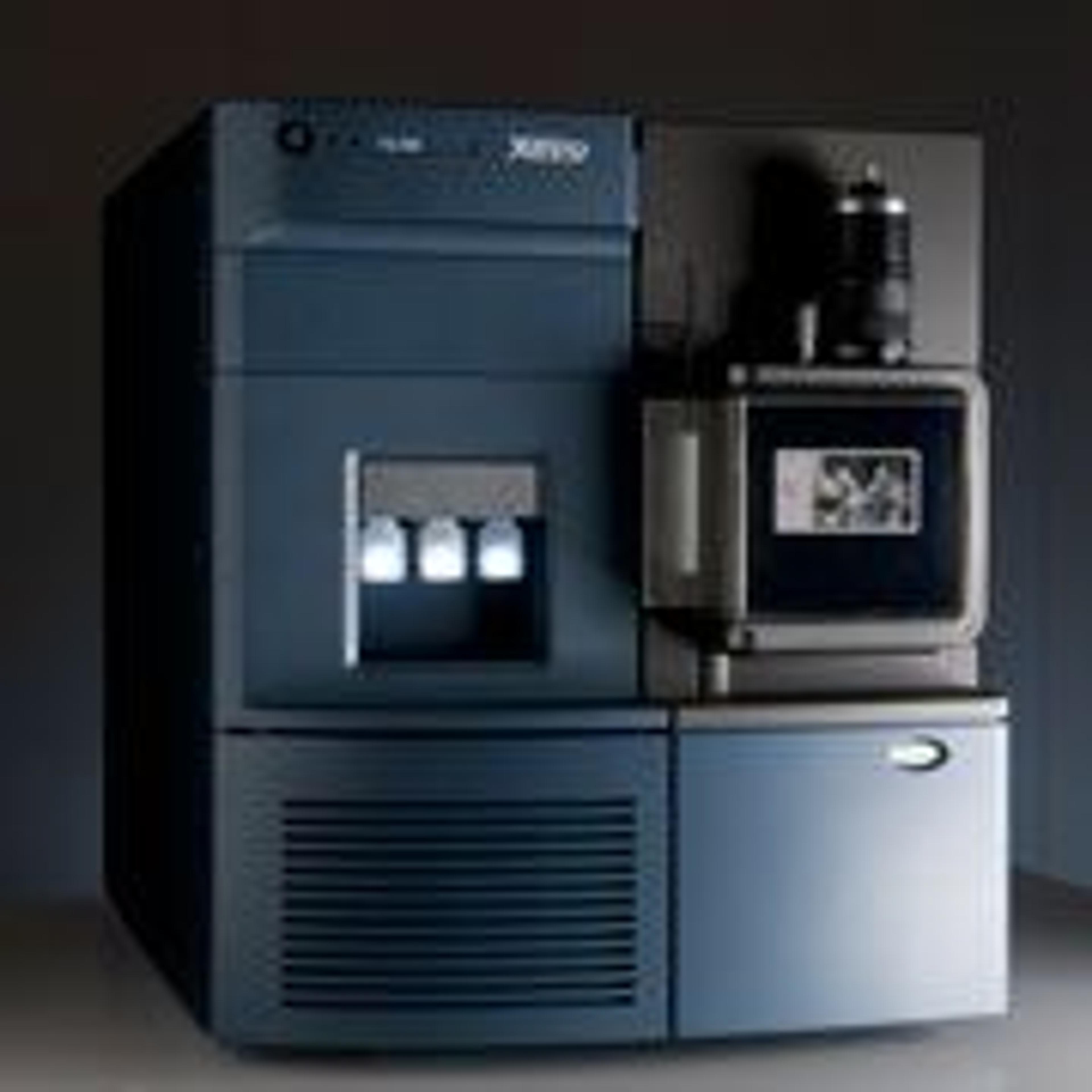
Xevo TQ MS
WatersWaters Xevo™ TQ MS provides the ultimate in quantitative capabilities for your most demanding applications and your most complex sample matrices. It is a highly advanced tandem quadrupole mass spectrometer designed to enable uncomplicated access to superior HPLC and UPLC®/MS/MS performance, delivering the highest levels of sensitivity, selectivity, robustness, speed, and accuracy. Waters Xevo TQ MS is equipped with unique collision cell technology (ScanWave™) to provide new enhanced spectral LC/MS/MS data acquisition capabilities. Unlike conventional tandem quadrupole mass spectrometers, the Xevo TQ MS is designed not only to provide the very best quantitative data, but also to provide you with superior spectral MS/MS information. Xevo TQ MS offers you much more versatility in a single instrument platform that is adaptable to a variety of different UPLC/MS/MS applications both quantitative and qualitative: bioanalysis, ADME screening, food safety, environmental monitoring, forensic, and more. Features: Automated system set up and system checks for simple access Automated instrument optimization and quantitative method development tools for ease-of-use The latest innovations in high efficiency, robust, easy-to-use ZSpray™ atmospheric pressure ion source technology Versatile range of ionization options, including multi-mode ionization capability in a single run Unique, innovative T-Wave™ and ScanWave enabled collision cell technology Footprint that sits easily on your laboratory benchtop Dedicated application managers for your specialized analytical requirements