ResourceSpectroscopy

High-Performance Automation and Centrifugation Preparation of Carbon Nanotubes for Analytical Ultracentrifugation

29 Aug 2016

Single walled carbon nanotubes experienced increasing interest in the past 15 years for semiconductors, fuel cells and biomedical applications. This application note focuses on two challenging areas for nanoparticles: reliable, rapid scale-up of nanoparticle purification; and quantitative analysis of the concentration of species present. The Biomek 4000 Laboratory Automation Workstation helps overcome the human variable and gives a consistent, reproducible, high-throughput method for gradient setup, which provides a breakthrough for scale-up problems.

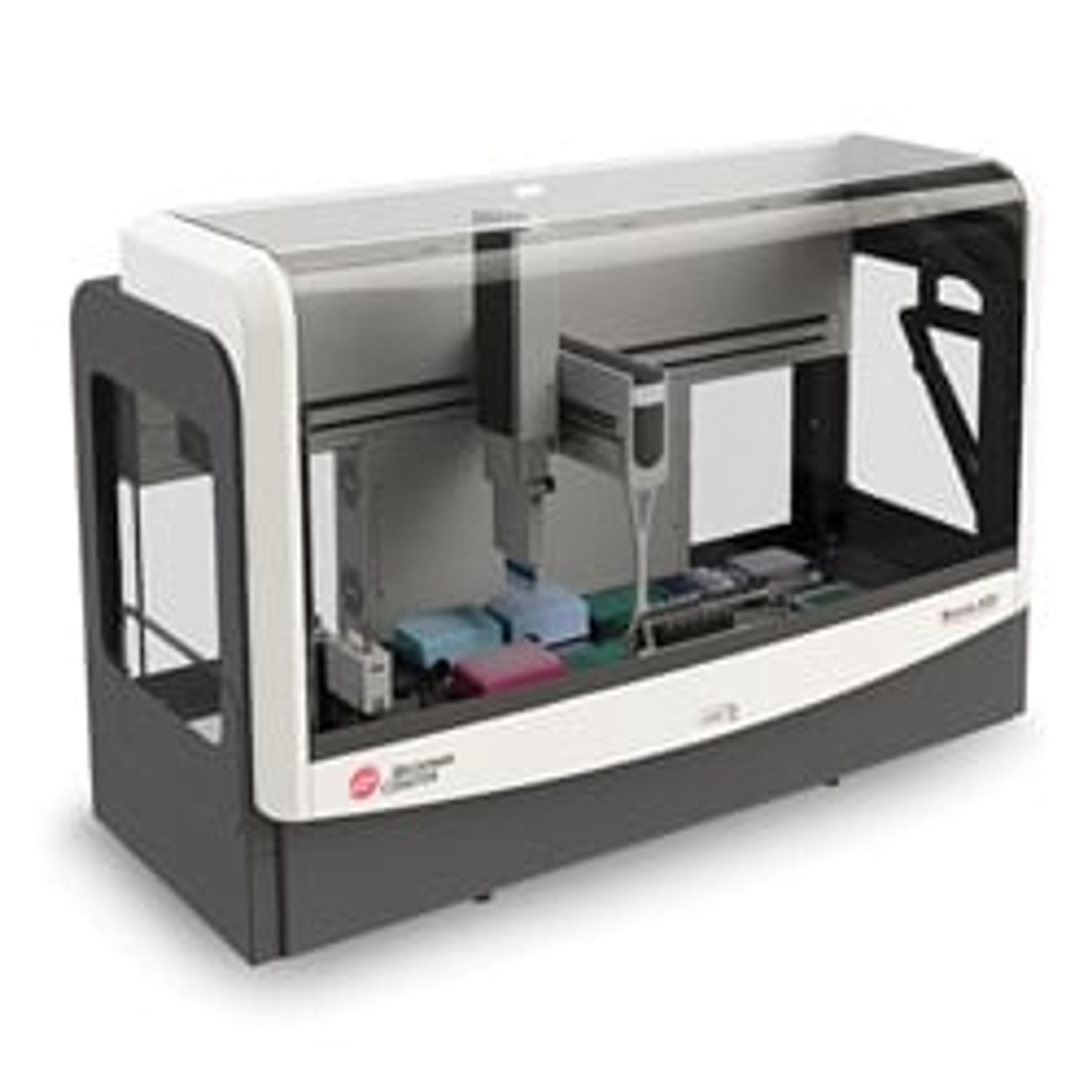
Biomek® 4000 Laboratory Automation Workstation

Beckman Coulter Life Sciences

Biomek Liquid Handlers enable you can spend less time on manual process and more time on powerful discoveries. Beckman Coulter Life Sciences is a leader when it comes to providing solutions and support that cover the full spectrum of the NGS sample preparation workflow with reagents and automation. Throughput options allow you to choose the right solution for your laboratory.
(8)

Links

Tags

Atomic Absorption / Emission SpectroscopyAtomic absorption spectroscopy (AAS) and atomic emission spectroscopy (AES) — also called optical emission spectroscopy (OES) — are used to detect the elemental constituents in samples. Both techniques involve the atomization of a sample. Atomic absorption spectrometers may use a flame or furnace to create an atomic vapor of the sample before irradiation with spectral light. Optical emission spectrometers may use a flame, inductively coupled plasma (ICP), microwave plasma (MP) or spark arcs to atomize and excite the sample. At higher excitation energies, electrons can be emitted instead of photons, which can be useful for samples that can’t be atomized and for surface analysis. Explore electron spectroscopy equipment such as Auger spectrometers and photoelectron spectrometers for surface elemental analysis of samples. Find the best atomic absorption, photoelectron and optical emission spectrometers in our peer-reviewed product directory: compare products, check customer reviews and receive pricing direct from manufacturers.CentrifugesCentrifuges are used to separate particulates suspended in a liquid via the application of a centrifugal force including cells, macromolecules, nanoparticles and precipitates. Centrifuges come in three sizes: microcentrifuges, benchtop and floor-standing centrifuges, depending on the volume and number of samples that require separation. When choosing a centrifuge, consider its maximum separation power indicated by its relative centrifugal force (RCF) value. Low force centrifuges reach a maximum RCF of 8,000 g, high-force centrifuges can reach maximum RCF values of 80,000 g. For extremely high forces, consider ultracentrifuges (up to 800,000 g). Refrigerated and vacuum centrifuges also known as concentrators are available for more specialized applications. A range of volumes are available for centrifuge tubes and microfuge tubes, depending on sample sizes. Find the best centrifuges in our peer-reviewed product directory: compare products, check customer reviews and receive pricing direct from manufacturers.NanotechnologyNanotechnology, or nanotech, is an engineering technique using molecular scale functional systems. Applications of nanotechnology include medicine and medical devices, electronics, air and water purification, food science and energy production.Automated Liquid HandlingAutomated liquid handling equipment is used to mix, dilute and dispense allotted volumes of liquid into microplates and other vessels automatically. The robotic, liquid handling arms can dispense from single channel to 3456 multichannel as well as operate nanoliter dispensing, enabling high throughput of samples. Find the best automated liquid handlers in our peer-reviewed product directory: compare products, check customer reviews and receive pricing direct from manufacturers.Sample PreparationSample preparation can improve the quality and speed of separation techniques. Products to assist sample preparation include filtration equipment, evaporators, membranes and sieves.AutomationAutomation in laboratories and manufacturing processes enhances efficiency, precision, and scalability by reducing the need for manual intervention. It plays a critical role in improving productivity, minimizing human error, and accelerating workflows in fields like diagnostics, drug development, and industrial testing. Automation technologies include robotic systems, automated liquid handlers, and process control systems that streamline complex tasks and ensure consistent, reproducible results. Explore our peer-reviewed product directory to discover the best automation solutions, compare options, read user reviews, and get prices directly from manufacturers.NanotubesLiquid Handling WorkstationLiquid handling workstations automate the process of sample preparation, improving accuracy and efficiency. These systems are essential for high-throughput applications in biological, chemical, and pharmaceutical research, reducing human error and increasing reproducibility. Workstations come equipped with robotic arms, pipetting tools, and other accessories to streamline lab workflows. Explore liquid handling workstations in our peer-reviewed product directory; compare products, check reviews, and get pricing directly from manufacturers.NanomaterialsNanomaterials such as carbon nanotubes, fullerenes and nanoparticles are a group of materials that measure between 1-1000nm for a single unit. Analysis techniques include AFM, electron microscopy and super resolution microscopy.NanoparticlesNanoparticles are between 1-100nm in size. Nanoparticles can be used for a wide variety of applications including biomedical, catalysis and electronics.Centrifuge
High-Performance Automation and Centrifugation Preparation of Carbon Nanotubes for Analytical Ultracentrifugation