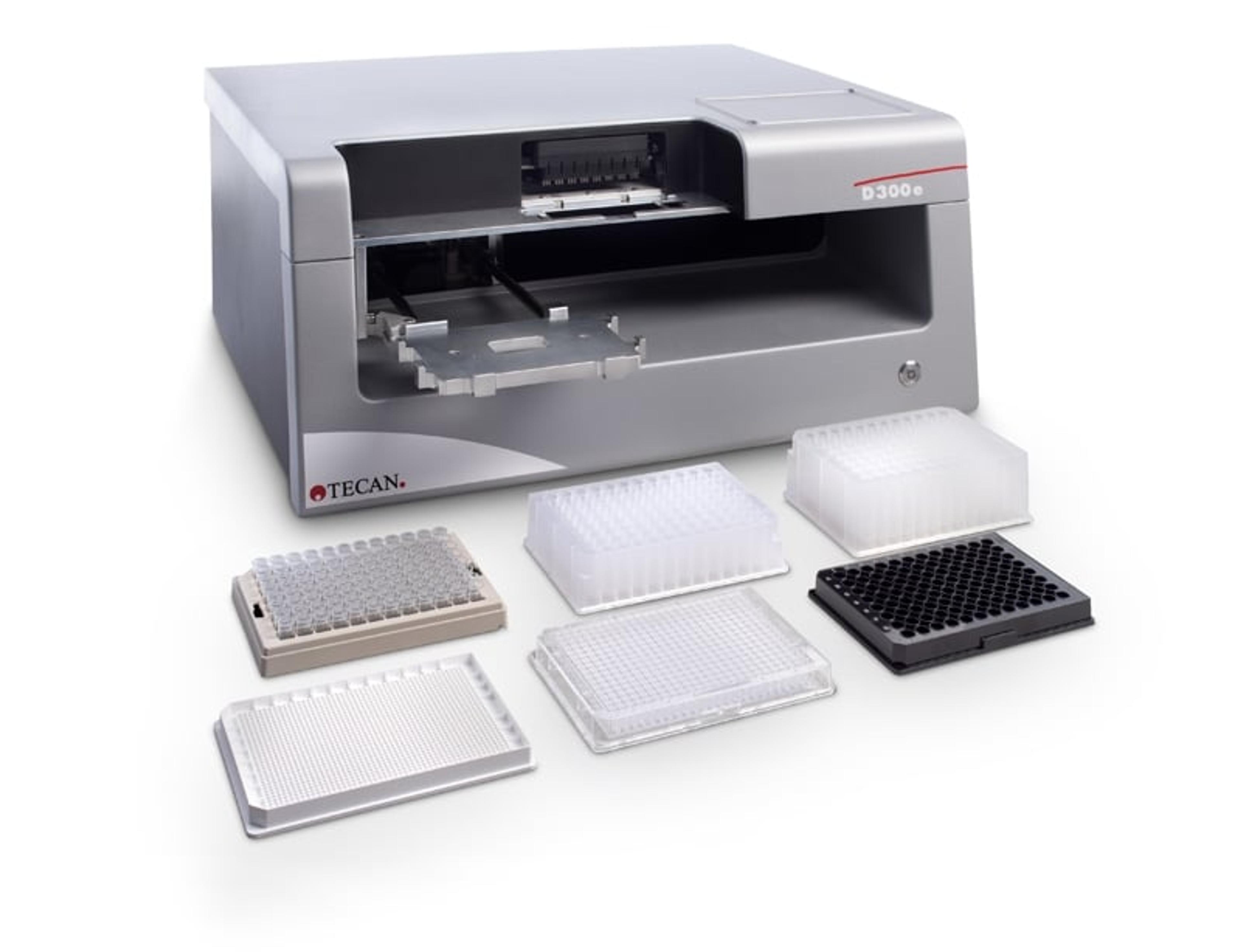
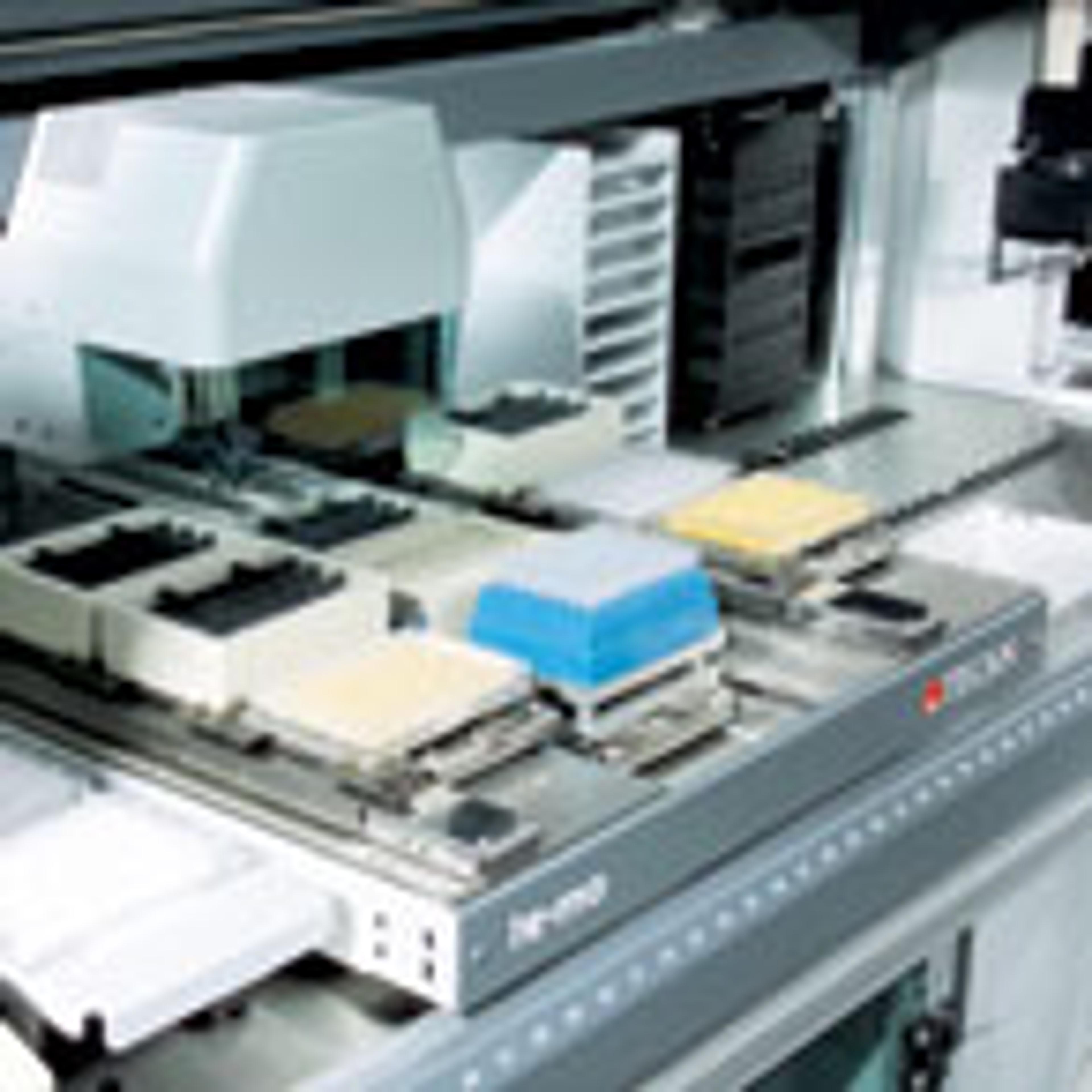
D300e Digital Dispenser
The D300e Digital Dispenser* uses direct digital dispensing technology to enable rapid delivery of picoliter to microliter sample volumes. It delivers fast, reliable performance across a large dynamic range, eliminating the need for slow, error-prone and wasteful serial dilutions for creation of dose-response curves and enabling miniaturized qPCR reaction set-up.


Receive your quote directly from the manufacturer.
Great performance, very valuable.
To dispenser small molecule tool compounds or drug candidates to treat in vitro cellular assay plate
Very effective, very helpful, save time and reagents, also very accurate and stable performance, high quality data, very user friendly.
Review Date: 5 Jun 2023 | Tecan
Great instrument, a must have!
drug dispensing
Very easy to use, great software and very intuitive. Ideal for direct dispense of compounds in concentration ranges, normalizing the diluent. Also great for complex designs, checkerboards, synergy experiments. Randomize function to thorougly test your newly developed assay.
Review Date: 29 Mar 2023 | Tecan
The D300e Digital Dispenser is an automated benchtop instrument that uses direct digital dispensing technology to enable rapid delivery of picoliter to microliter sample volumes.
It provides fast and reliable performance across a large dynamic range, eliminating the need for slow, error-prone and wasteful serial dilutions for creation of dose-response curves. Using disposable Dispenseheads to avoid cross-contamination, the instrument offers complete freedom for non-contact dispensing from 11 pl to 10 μl, delivering any dose to any well and virtually eliminating waste of valuable compounds. It combines ready-to-run, walk up and use convenience with intuitive experiment design software to increase productivity while giving reliable results.
This innovative device allows the creation of assay plates using aqueous solutions or DMSO, and can cut set-up times from hours or days to just minutes. The D300e is compatible with a wide range of microplate formats from 12 to 1,536 wells – including deep-well plates – and, for maximum flexibility, can even accommodate tube racks. Users can choose between dispensing aqueous solutions in combination with a surfactant – for the investigation of proteins, antibodies, enzymes and nucleic acids – and DMSO for small molecule studies, offering greater flexibility for life sciences workflows. A choice of T8+ and high capacity D4+ Dispenseheads, combined with intuitive software, provide straightforward set-up of enzyme profiles, dose-response curves and synergy studies. Even the most complex experimental plate layouts – such as drug-drug interaction studies and enzyme profiles – can be quickly and easily generated, with optional randomization to reduce the impact of edge effects and increase the integrity of experimental data. *For research use only. Not for use in diagnostic procedures.

Automated 3D cell culture and drug testing using Corning Matrigel Matrix
This application note details an automated workflow for 3D cell culture. It includes controlled pipetting of Matrigel® matrix, cell seeding and spheroid cultivation using a Fluent Automation Workstation with an integrated, liquid-cooled four-position carrier and a Thermo Scientific™ Cytomat™ 2 C450-LiN automated incubator. Drug treatments were performed using the D300e Digital Dispenser. A Spark® Cyto multimode reader was used to monitor cell growth by brightfield imaging, as well as to perform luminescence-based viability assessment using the CellTiter-Glo® 3D Cell Viability Assay (Promega).

Scaling the potential of patient derived organoids through automation and label free image analysis of individual organoids
3D patient-derived tumor organoids hold great potential for many basic and translational applications. However, traditional approaches to organoid image analysis and downstream data processing are often challenging and labor-intensive. Download this presentation to discover how Dr. Christophe Deben, Group Leader of the University of Antwerp’s Tumoroid Screening Lab, has developed a label-free brightfield image analysis software (OrBITS) to monitor organoid growth rates and track movements.
Dr. Deben also shares a semi-automated workflow for cell seeding drug treatment using the Tecan D300e digital drug dispenser and live-cell imaging using the Tecan Spark® Cyto multimode plate reader.