
Wyatt Technology announces advances in dynamic light scattering (DLS) technology with walk-up measurements
9 Feb 2022
Product news
Wyatt Technology, a manufacturer of instrumentation for absolute macromolecular and nanoparticle characterization, introduces advanced walk-up capabilities in DLS technology with the next-generation DynaPro® NanoStar® II.
The DynaPro NanoStar II instrument promises ease-of-use while performing high-quality measurements of size, particle concentration, molar mass and stability. For novice and casual users, an intuitive on-board touch-screen app enables walk-up measurements of proteins, polymers and nanoparticles. Advanced users will appreciate the detailed analyses available in powerful Windows software with 21 CFR Part 11 compliance.
Combining intuitive operation with sophisticated engineering and software, the NanoStar II promises to meet the needs of biologists, chemists and pharmaceutical scientists for routine or occasional analyses. The NanoStar II uses DLS and static light scattering (SLS) to determine fundamental physical properties of solutions and nanosuspensions. Requiring just 2 μL in a quartz cuvette or 4 μL in a high-quality, disposable microcuvette, analysis in the NanoStar makes the most of precious samples and is key to successful quantification from R&D to QC. Measure size and titer in a few seconds, then assess stability versus temperature.
Geofrey Wyatt, CEO of Wyatt Technology, said, “I’m delighted about the number of early adopters of the NanoStar II. The “Holy Grail” of analytical instrumentation is to make the customer experience a positive one. Our DYNAMICS® Touch™ software running on a beautiful touch-screen comes as close as I’ve ever seen to this prize!
Want the latest science news straight to your inbox? Become a SelectScience member for free today>>
Related products
Request Quote for All Products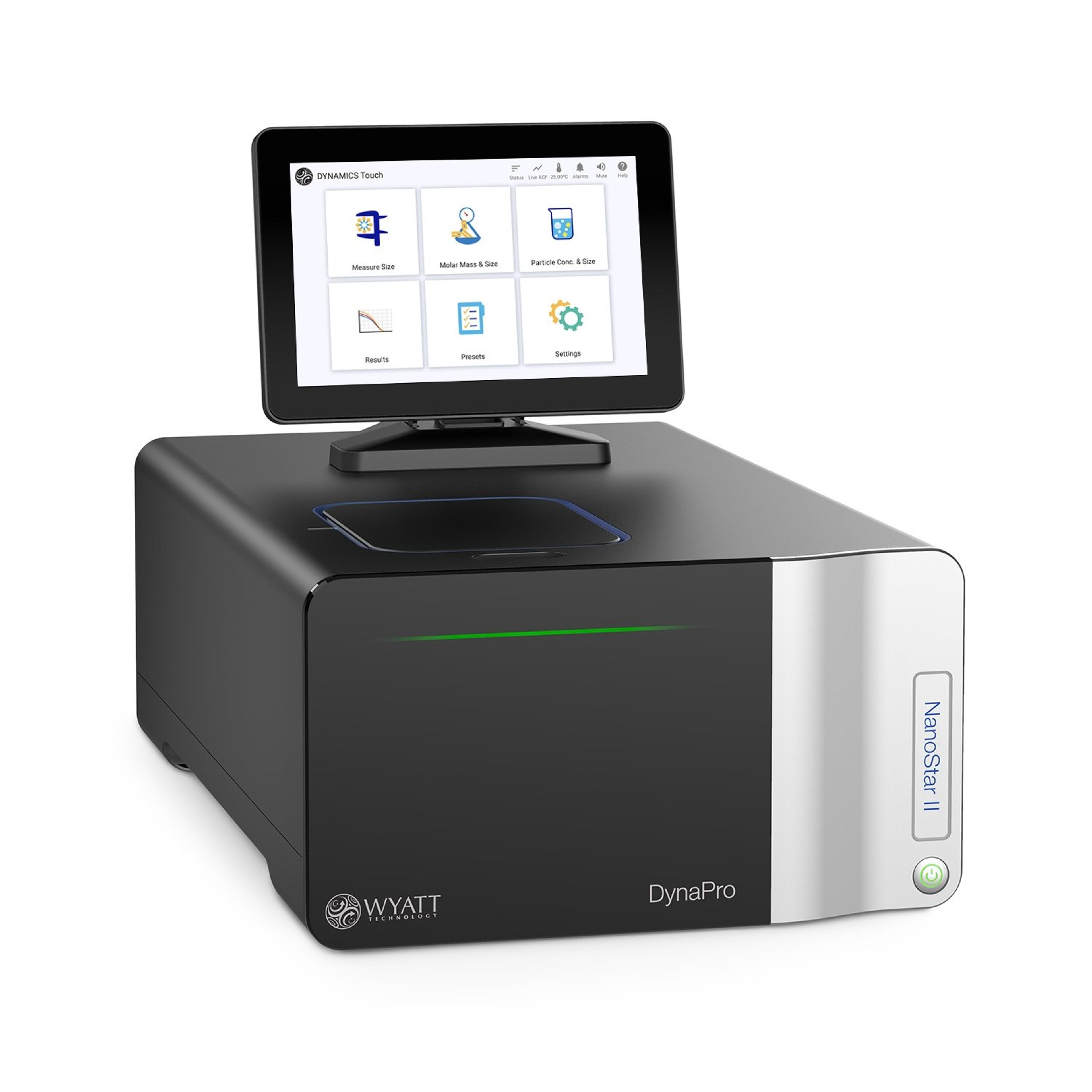
DynaPro™ NanoStar™ II Dynamic Light Scattering Detector
Waters | Wyatt TechnologyThe DynaPro™ NanoStar™ II DLS instrument determines size and molar mass with as little as 2 µL of solution.