Top resources for cannabis potency testing

A compilation of application notes, latest news and videos to aid scientists in testing the potency of cannabis products, both for medical and recreational markets

6 Dec 2019

Cameron Smith-Craig
Cameron Smith-Craig
Pharma and Applied Sciences Editor

Editorial article

“With around 100 molecules in the plant, we can probably point to 500 of them which have some kind of biological effect.” Dr. Markus Roggen, founder of Complex Biotech Discovery Ventures.

With the increase in demand for many cannabis-based products, there is a pressing need for scientists to consolidate potency standards for both quality control and the accurate labeling of products. As it stands, “potency” is primarily determined through the quantitation of major cannabinoids such as THCA, THC, CBD and CBN. However, as Roggen points out, many other metabolites are now being considered in cannabis production to ensure product consistency is achieved.

In this week’s cannabis testing compilation, we’ve rounded up some of the latest techniques and technologies in potency testing to help scientists quantify these molecules and streamline their analysis, with insight on LCMS, UPLC, high-performance water purification systems, optimized gas chromatography and more.

Application note: Quantitative analysis of 16 cannabinoids with complete baseline separation of Δ8 and Δ9-THC utilizing the Triple Quad LCMS-8050

Discover a rapid, selective and robust method for the detection of various cannabinoids using the Shimadzu LCMS-8050. This application note demonstrates the ability of the Nexera X2 UHPLC and LCMS-8050 mass spectrometer to enable simultaneous, accurate measurement of many cannabinoids of interest.

Dr. Markus Roggen

The Scientists’ Channel: Dr. Markus Roggen, Complex Biotech Discovery Ventures

Dr. Markus Roggen, founder of Complex Biotech Discovery Ventures (CBDV), highlights the importance of collaboration in cannabis science. A chemist by background, Roggen discusses the challenges of consistency within cannabis production as a result of the 500 or so molecules within the plant that may have a biological effect.

Application note: UPLC separation for the analysis of cannabinoid content in cannabis flower and extracts

In this application note, Waters presents the modification of a simple isocratic HPLC separation of 16 cannabinoids to a separation under UPLC conditions. An increase in testing productivity greater than a twofold can be observed, whilst maintaining linearity, selectivity and suitability.

Application note: Analytical cannabis testing and the importance of high-quality water
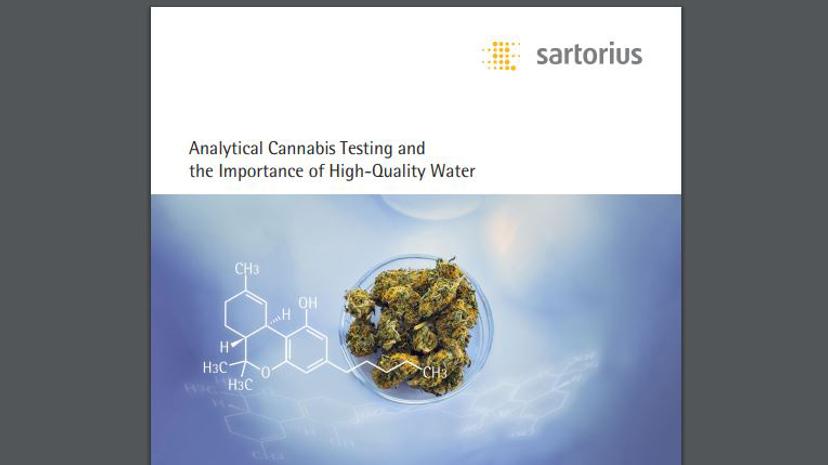
Sartorius Water Purification eBook

State and Federal regulations for cannabis testing continue to evolve and grow. This means the robustness of testing services must increase to keep pace with these intensifying regulations. High-performance water filtration systems, such as the arium® Series from Sartorius, provide long-term practical and economical advantages to cannabis testing.

Industry news: 4 infographics on sample prep techniques for GC and GC-MS

Markes International has released a series of infographics summarizing sample preparation techniques for GC and GC-MS. Each infographic explains a sample prep technique covering how it works, key applications, advantages and disadvantages and more. These infographics are useful for anyone who wants to optimize their gas chromatography techniques, including for use in cannabis potency testing.

Visit our Cannabis Testing Community to stay up-to-date on the latest news >>

Links

Tags

Gas ChromatographyGas chromatography (GC) is an analytical technique used to separate and quantitate mixtures of small and volatile compounds. Gas chromatographs or GC systems include components such as GC columns, detectors, pumps and autosamplers. Choose from packed or capillary GC columns, flame ionization (FID), photoionization (PID) electron capture detectors and selective or non-selective detectors. Find the best gas chromatographs in our peer-reviewed product directory: compare products, check customer reviews and receive pricing direct from manufacturers.UHPLC and HPLCHigh performance liquid chromatography (HPLC) and ultra high performance liquid chromatography (UHPLC), also known as UPLC, are analytical techniques used to separate, identify and quantitate components of complex mixtures including biological samples such as proteins and lipids as well as chemical mixtures of pesticides, drugs and oils. Both techniques are liquid chromatographic methods but differ by operating pressures (HPLC < 6000 psi < UHPLC ). Components of HPLC and UHPLC systems include columns, detectors, pumps, autosamplers and column heaters. Explore a range of UHPLC and HPLC columns for your specific sample needs including reverse phase, normal phase, ion exchange, HILIC, ion exclusion and size exclusion columns. For more specialized HPLC, explore FPLC, countercurrent LC and simulated moving bed systems. Find the best UHPLC and HPLC equipment in our peer reviewed product directory: compare products, check customer reviews and receive pricing direct from manufacturers.LC-MSLC-MS (liquid chromatography-mass spectrometry) systems and equipment are used for separation and quantitative analysis of complex mixtures, combining liquid chromatography and mass spectrometry. Quantify proteins, contaminants, pesticides or screen for drug metabolites with a high level of sensitivity. LC-MS systems and equipment include reverse phase, normal phase and specialized columns integrated with various MS detectors such as time-of-flight (TOF), quadrupole, orbitrap or ion trap mass analyzers. LC-MS/MS instruments equipped with a qTOF or triple quadrupole analyzer give greater sensitivity and resolving power to your analysis. Find the best LC-MS equipment in our peer-reviewed product directory: compare products, check customer reviews and receive pricing direct from manufacturers.Mass SpectrometryMass spectrometry (MS) is a powerful analytical technique used to identify and quantify molecules based on the mass-to-charge ratio of gas-phase ions. It provides detailed information about the structure, composition, and properties of compounds and is widely used across fields such as environmental monitoring, materials science, drug discovery and development, food and beverage testing, and wider chemical research. Key MS techniques include tandem mass spectrometry (MS/MS), liquid chromatography–mass spectrometry (LS-MS) and inductively coupled plasma (ICP-MS). Choosing from these wide range of techniques and technologies can be a daunting task, so keep up to date with scientific applications, performance expectations, and customer reviews here all in one place. Visit our product directory to receive quotes direct from the manufacturer. GC-MS GC-MS (gas chromatography-mass spectrometry) instruments and equipment are used to separate, quantify and identify mixtures of small and volatile compounds, such as polycyclic aromatics, fatty acids and alcohols. Often used in drug detection, forensic investigation and environmental analysis for pesticides and contaminants, GC-MS is a powerful addition to your lab’s analytical capabilities. GC-MS/MS instruments equipped with a qTOF or triple quadrupole analyzers can give greater sensitivity and resolution to your analysis. Find the best GC-MS instruments and equipment in our peer-reviewed product directory: compare products, check customer reviews and receive pricing direct from manufacturers.Quality ControlQuality control is needed in all production processes. Quality control is a monitoring procedure or set of procedures that are put in place to ensure that a manufactured product adheres to a defined set of quality criteria. Drug TestingIt is essential to test the efficacy and toxicity of drugs at every stage of their development to ensure that a pharmaceutical product is fit for purpose and safe for use before reaching the stage of mass production and distribution.Quality TestingQuality testing ensures that products meet required specifications and safety standards in various industries, including pharmaceuticals, food, and materials. It is essential for maintaining product quality and consumer safety. Explore quality testing tools in our peer-reviewed product directory; compare products, check reviews, and get pricing directly from manufacturers.Food TestingFood testing refers to a variety experiments including PCR, mass spectrometry, processing, QuEChERS, analyzing and Kjeldahl.Food QualityFood quality refers to the attributes of food that influence its safety, nutrition, and taste. Monitoring and ensuring food quality are essential in production to meet health regulations and consumer expectations. Techniques like spectroscopy, chromatography, and microbial testing are used to assess food properties and detect contaminants. Browse our peer-reviewed product directory to find food quality testing solutions; compare products, check reviews, and get pricing directly from manufacturers.CannabinoidsCannabinoids are compounds found in cannabis that have therapeutic effects, such as pain relief, anti-inflammatory properties, and potential neuroprotective benefits. Research into cannabinoids is growing, particularly in the fields of pain management, neurological diseases, and cancer treatments. Browse our peer-reviewed product directory to find the best cannabinoid research tools, compare products, check reviews, and get pricing directly from manufacturers.CannabisGC-MSGas Chromatography-Mass Spectrometry (GC-MS) combines the separation power of gas chromatography with the detection capabilities of mass spectrometry, allowing for the analysis of complex mixtures. It is widely used in environmental, forensic, and pharmaceutical analysis. Explore GC-MS systems in our peer-reviewed product directory; compare products, check reviews, and get pricing directly from manufacturers.