Three Novel Ways Scientists are Using Chromatography to Keep Environmental Contaminants at Bay

Discover application notes to enhance your environmental testing laboratory output

21 Dec 2017
Lui Terry
Administrator / Office Personnel

Editorial article

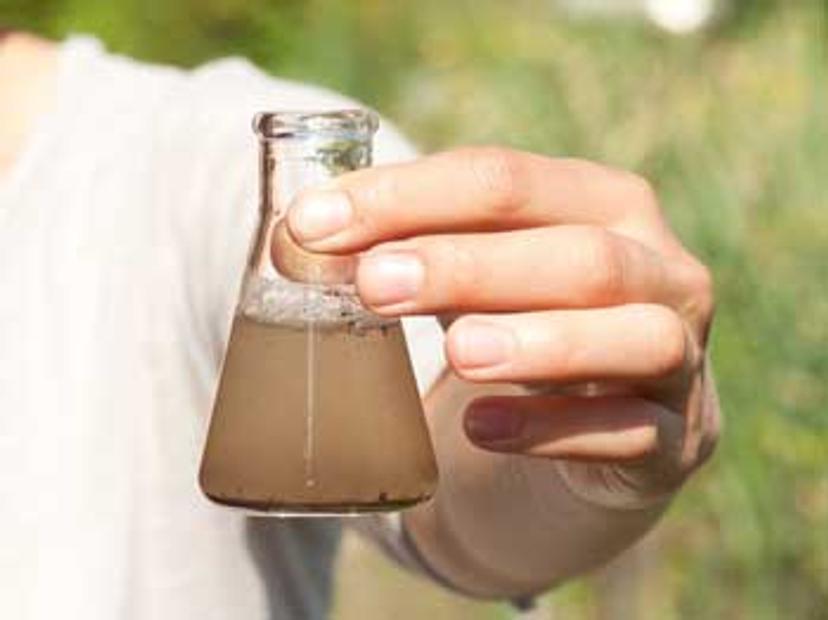
As pesticides, volatile organic compounds (VOCs), persistent organic pollutants (POPs) and industrial chemicals continue to creep into our surrounding environments, accurate analysis and determination are required to ensure contamination levels are being kept in check and are not reaching hazardous concentrations. Samples from water, soil, air and foodstuff need to be regularly tested for a variety of important analytes to help protect both the ecosystems and human health. For this, scientists use hyphenated chromatographic methods for detection.

In this article, discover novel techniques enabling faster and comprehensive environmental analysis for your lab.

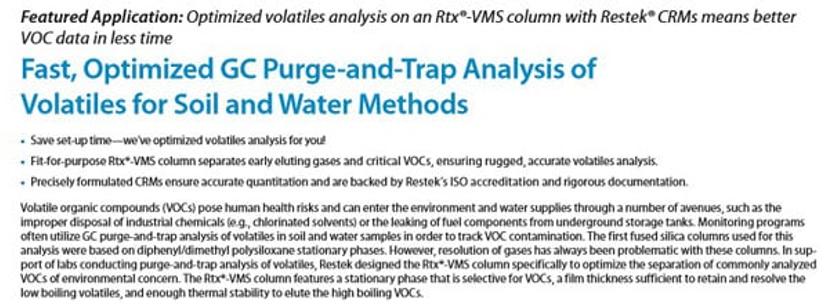
Fast, Optimized GC Purge-and-Trap Analysis of Volatiles for Soil and Water Methods

Purge and trap analysis of VOCs in soil and water samples has always been problematic with diphenyl/dimethyl polysiloxane columns. Discover how the Restek-designed Rtx-VMS columns optimize the separation of commonly analyzed VOCs of environmental concern.
Improve Analysis of Aldehydes and Ketones in Air Samples with Faster, More Accurate Methodology

Monitoring airborne carbonyls from industrial and vehicle emissions is important in controlling ozone and smog levels. However, methods often require long analysis times and can fail to provide accurate resolution. This application note discloses a fast and accurate methodology using Restek's Raptor LC columns for the analysis of airborne carbonyl pollutants.

Comprehensive Pesticide Residue Analysis by Liquid Chromatography Tandem-Mass-Spectrometry (LC/MS/MS)

Typically, pesticides have been monitored by gas chromatography (GC), leaving many polar and thermally unstable pesticides impossible to monitor. In this application note, discover the recent advances in LC/MS/MS for pesticide residue testing and how the Ultra Aqueous C18 columns are ideal for monitoring hundreds of potential pesticide contaminants, including those difficult to detect by GC.

To hear more about Restek's Raptor LC Columns, watch the SelectScience video interview here or to learn more about Restek's laboratory solutions, watch the Restek pure chromatography video here
Links

Tags

Gas ChromatographyGas chromatography (GC) is an analytical technique used to separate and quantitate mixtures of small and volatile compounds. Gas chromatographs or GC systems include components such as GC columns, detectors, pumps and autosamplers. Choose from packed or capillary GC columns, flame ionization (FID), photoionization (PID) electron capture detectors and selective or non-selective detectors. Find the best gas chromatographs in our peer-reviewed product directory: compare products, check customer reviews and receive pricing direct from manufacturers.UHPLC and HPLCHigh performance liquid chromatography (HPLC) and ultra high performance liquid chromatography (UHPLC), also known as UPLC, are analytical techniques used to separate, identify and quantitate components of complex mixtures including biological samples such as proteins and lipids as well as chemical mixtures of pesticides, drugs and oils. Both techniques are liquid chromatographic methods but differ by operating pressures (HPLC < 6000 psi < UHPLC ). Components of HPLC and UHPLC systems include columns, detectors, pumps, autosamplers and column heaters. Explore a range of UHPLC and HPLC columns for your specific sample needs including reverse phase, normal phase, ion exchange, HILIC, ion exclusion and size exclusion columns. For more specialized HPLC, explore FPLC, countercurrent LC and simulated moving bed systems. Find the best UHPLC and HPLC equipment in our peer reviewed product directory: compare products, check customer reviews and receive pricing direct from manufacturers.LC-MSLC-MS (liquid chromatography-mass spectrometry) systems and equipment are used for separation and quantitative analysis of complex mixtures, combining liquid chromatography and mass spectrometry. Quantify proteins, contaminants, pesticides or screen for drug metabolites with a high level of sensitivity. LC-MS systems and equipment include reverse phase, normal phase and specialized columns integrated with various MS detectors such as time-of-flight (TOF), quadrupole, orbitrap or ion trap mass analyzers. LC-MS/MS instruments equipped with a qTOF or triple quadrupole analyzer give greater sensitivity and resolving power to your analysis. Find the best LC-MS equipment in our peer-reviewed product directory: compare products, check customer reviews and receive pricing direct from manufacturers.GC-MS GC-MS (gas chromatography-mass spectrometry) instruments and equipment are used to separate, quantify and identify mixtures of small and volatile compounds, such as polycyclic aromatics, fatty acids and alcohols. Often used in drug detection, forensic investigation and environmental analysis for pesticides and contaminants, GC-MS is a powerful addition to your lab’s analytical capabilities. GC-MS/MS instruments equipped with a qTOF or triple quadrupole analyzers can give greater sensitivity and resolution to your analysis. Find the best GC-MS instruments and equipment in our peer-reviewed product directory: compare products, check customer reviews and receive pricing direct from manufacturers.Environmental ContaminationContaminants in the environment are harmful chemicals that are present in the air, land and water. These include pesticides, pharmaceuticals, persistent organic pollutants (POPs) and many more.
Three Novel Ways Scientists are Using Chromatography to Keep Environmental Contaminants at Bay