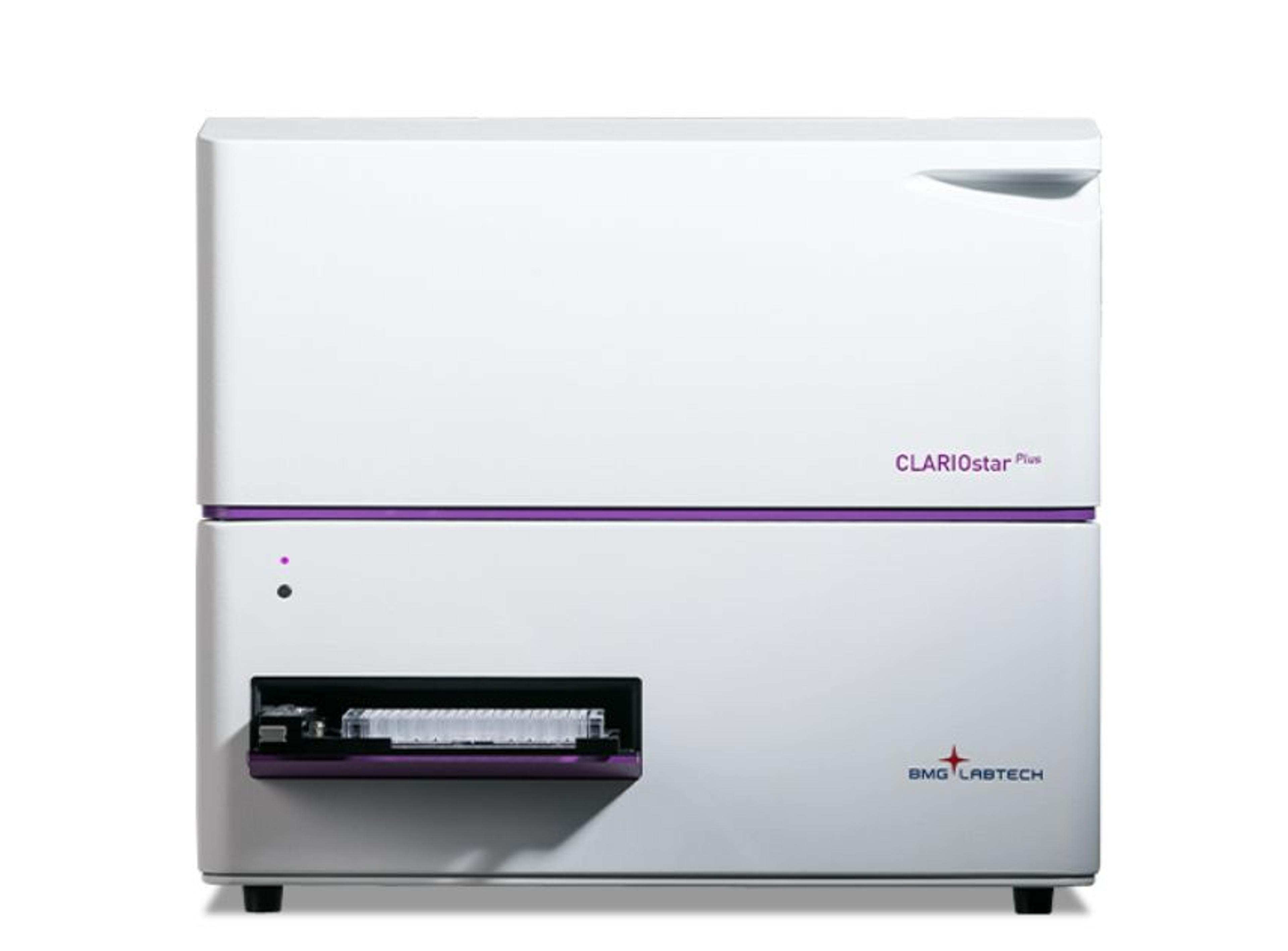
The Monochromator Reinvented: the CLARIOstar®

18 Aug 2014

Kerry Parker
CEO

Product news

BMG LABTECH will be showcasing its most versatile multi-mode microplate reader, the CLARIOstar, with Triple Detection Technology – filters, a spectrometer, and new advanced LVF Monochromators™. For high performance and flexibility in all of your assays.

• LVF Monochromators offer the greatest flexibility for fluorescence and luminescence
• Spectrometer provides the fastest spectral scanning for UV/Vis absorbance
• Optical filters ensure the greatest sensitivity in all advanced assays.

The CLARIOstar can be seen at ELRIG, booth Q6 and at MipTec, booth A24.

Enhanced Flexibility and Sensitivity with LVF MonochromatorsTM
Besides being one of the most sensitive microplate readers currently available, the CLARIOstar has a new and exciting technological advancement not found in other readers. LVF Monochromators are the most sensitive and most flexible monochromators currently available in a microplate reader. LVF Monochromators use patented linear variable filters to separate light into distinct wavelengths, unlike conventional monochromators that use diffracting gratings. With continuously adjustable bandwidths up to 100 nm (four times larger than conventional monochromators) and significantly increased performance, LVF Monochromators have filter-like sensitivity and flexibility for fluorescence and luminescence assays.

The LVF Monochromators can be used in any common fluorescence or luminescence assay, but they are also suited for more complex applications. Scanning the spectra of new or unusual fluorophores, where the excitation and emission wavelengths are unknown, or scanning fluorophores in non-standard buffer conditions where the pH may affect the peak maxima, is easily done. In addition, multiplexing assays with fluorophores or lumiphores of similar or overlapping spectra benefit greatly from definable bandwidths of 8 to 100 nms. This allows the user to define ‘filters’ that make the assay workable. Wavelength and bandwidth can be the difference between an okay and a fantastic assay.

Multi-mode CLARIOstar Does Not Compromise Performance for Convenience
In addition to the new and unique dual monochromators, the CLARIOstar has several other technological advancements that ensure the best performance for your research. A UV/Vis spectrometer can scan an entire absorbance spectrum from 220 to 1000 nm (at 1 nm resolution) in less than 1 second – this is technology previously found only in cuvette spectrometers. Ultra-fast, full spectrum absorbance measurements will change the way you do colorimetric assays. In addition optical filters, which can be used in combination with the LVF Monochromator, provide the greatest performance in advanced assays like fluorescence polarization, time-resolved fluorescence, and AlphaScreen® / AlphaLISA®.

Improved Cell-Based Assay Performance with the CLARIOstar
Most other microplate readers use fiber optics to measure cell-based assays from the bottom of the microplate. The CLARIOstar, however, has Direct Optic Bottom Reading. A series of motor driven mirrors directly reflects light to and from the microplate bottom, eliminating the need for inefficient fiber optics. With Direct Optic Bottom Reading, significantly more light is measured, which results in significantly better performance in fluorescent protein cell-based assays like GFP.

Visit BMG LABTECH at ELRIG (booth Q6) and MipTec (Booth A24).

With the CLARIOstar Anything is Possible – Any Wavelength, Any Bandwidth, Any Assay.

Links

Tags

High-Throughput ScreeningHigh-throughput screening (HTS) is an automated drug discovery technique for identification of active compounds against a compound library. Use HTS readers and integrated assay preparation / analysis workstations to screen your compounds. Identify active compounds against various HTS libraries, including membranes, proteins and peptides and HTS cell lines. Find the best high-throughput screening products in our peer-reviewed product directory: compare products, check customer reviews and receive pricing direct from manufacturers.Microplate Readers / DetectorsMicroplate readers are used to automate the detection and analysis of labeled or label-free components in microplates during assays or live-cell monitoring. Microplate readers are generally distinguished by their mode of detection. Types include absorbance, luminescence, fluorescence intensity, fluorescence polarization, TRF / FRET and multimode microplate readers. Microplate readers deliver a high throughput of samples by reading multiple wells simultaneously, with the 96-well format the most commonly used. As a result, microplate readers are often used in the drug discovery, bioassays, research and pharmaceutical industries for screening applications. Microplate loading can also be automated, with robotic microplate stackers to increase throughput. Find the best microplate readers in our peer-reviewed product directory: compare products, check customer reviews and receive pricing direct from manufacturers.ADME-ToxicologyADME-toxicology (ADME-Tox) studies are used in pharmacology and pharmacokinetics to assess the activity/toxicity of drugs <i>in vivo</i> or <i>in vitro</i>. Find bioassays for absorption, distribution, metabolism, and excretion of drug molecules including cytotoxicity, transporter/permeability, metabolism and activity assays as well as hepatocytes and cell lines for ADME. Find the best ADME-toxicology products in our peer-reviewed product directory: compare products, check customer reviews and receive pricing direct from manufacturers.Cell-Based AssaysCell-based assays are used to monitor the presence, quantity and activities of a desired cellular analyte including drug molecules or biomarkers. This can reveal information on cell health (apoptosis, cytotoxicity, viability and proliferation assays), cell metabolism, cell migration and cell signaling mechanisms. Find the best cell-based assay products, kits and equipment with our peer reviewed product directory: compare products, check customer reviews and receiving pricing direct from manufacturers.High-Content ScreeningHigh-content screening (HCS), also known as high-content analysis (HCA), is a high-throughput technique used in drug discovery to identify substances that alter the phenotype of cells. HCS uses fluorescent microscopic imaging and automated image analysis to investigate cellular events such as apoptosis, cell viability, GPCR activation, oxide production, neurite outgrowth, and cell signaling. Find the best fluorescent labeling reagents, cellular assays, and high-content imaging systems in our peer-reviewed product directory: compare products, check customer reviews and receive pricing direct from manufacturers.Fluorescence Based AssayFluorescence based assays are widely used in life science research and high-throughput screening to measure a broad range of cellular activities.Drug DiscoveryDrug discovery is the process of identifying potential new medications, involving stages such as target identification, compound screening, and preclinical development. It relies on cutting-edge technologies like high-throughput screening, artificial intelligence, and molecular modeling to accelerate the identification of drug candidates. Drug discovery plays a pivotal role in developing new therapies for diseases ranging from cancer to rare genetic disorders. Browse our peer-reviewed product directory to find the latest drug discovery technologies, compare options, check customer feedback, and get pricing directly from manufacturers.ELRIG