
The Innovative CLARIOstar Multi-mode Microplate Reader at analytica 2014
17 Mar 2014
Industry news
The CLARIOstar is BMG LABTECH most versatile multi-mode microplate reader. It has Triple Detection Technology – filters, a spectrometer, and new advanced LVF MonochromatorsTM. This trio of technologies ensures that the CLARIOstar does not compromise performance for flexibility in any of its eight different detection modes:
- LVF Monochromators offer the greatest flexibility for fluorescence and luminescence
- Spectrometer provides the fastest spectral scanning for UV/Vis absorbance
- Optical filters ensure the greatest sensitivity in all advanced assays.
The CLARIOstar can be seen at Analytica in Munich from April 1-4, Booth B1.314.
Enhanced Flexibility and Sensitivity with LVF MonochromatorsTM
Besides being one of the most sensitive microplate readers currently available, the CLARIOstar has a new and exciting technological advancement not found in other readers. LVF Monochromators are the most sensitive and most flexible monochromators currently available in a microplate reader. LVF Monochromators use patented linear variable filters to separate light into distinct wavelengths, unlike conventional monochromators that use metal gratings. With continuously adjustable bandwidths up to 100 nm (four times larger than conventional monochromators) and significantly increased performance, LVF Monochromators have filter-like sensitivity and flexibility for fluorescence and luminescence assays.
The LVF Monochromators can be used in any common fluorescence or luminescence assay, but they are also suited for more complex applications. Scanning the spectra of new or unusual fluorophores, where the excitation and emission wavelengths are unknown, or scanning fluorophores in non-standard buffer conditions where the pH may affect the peak maxima, is easily done. In addition, multiplexing assays with fluorophores or lumiphores of similar or overlapping spectra benefit greatly from definable bandwidths of 8 to 100 nms. This allows the user to define ‘filters’ that make the assay workable. Wavelength and bandwidth can be the difference between an okay and a fantastic assay.
Multi-mode CLARIOstar Does Not Compromise Performance for Convenience
In addition to the new and unique dual monochromators, the CLARIOstar has several other technological advancements that ensure the best performance for your research. A UV/Vis spectrometer can scan an entire absorbance spectrum from 220 to 1000 nm (at 1 nm resolution) in less than 1 second – this is technology previously found only in a cuvette. Ultra-fast, full spectrum absorbance measurements will change the way you do colorimetric assays. In addition optical filters, which can be used in combination with the LVF Monochromator, provide the greatest performance in advanced assays like fluorescence polarization, time-resolved fluorescence, and AlphaScreen® / AlphaLISA®.
Improved Cell-Based Assay Performance with the CLARIOstar
Most other microplate readers use fiber optics to measure cell-based assays from the bottom of the microplate. The CLARIOstar, however, has Direct Optic Bottom Reading. A series of motor driven mirrors directly reflects light to and from the microplate bottom, eliminating the need for inefficient fiber optics. With Direct Optic Bottom Reading, significantly more light is measured, which results in significantly better performance in fluorescent protein cell-based assays like GFP.
Please visit BMG LABTECH and experience the CLARIOstar yourself at Analytica in Munich, Germany from April 1-4 at Booth B1, Hall 314.
Related products
Request Quote for All Products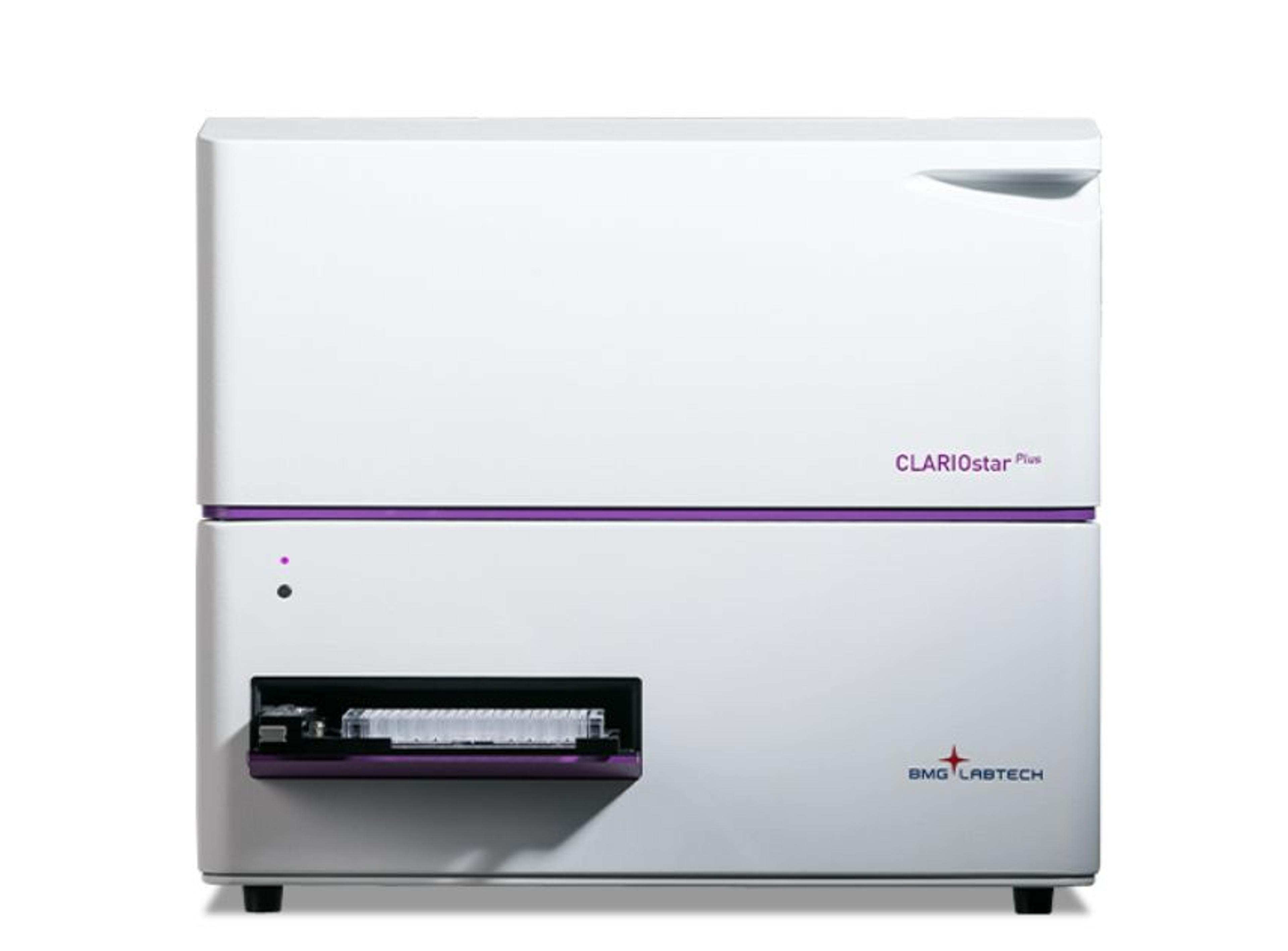
CLARIOstar® Plus Multi-mode Microplate Reader
BMG LABTECHMost flexible Multi-mode Microplate Reader for Assay Development