
Sensitivity for Screening, Flexibility for Assay Development - The New CLARIOstar® Multi-mode Microplate Reader at SLAS2014
6 Jan 2014
Product news
BMG LABTECH is proud to be a returning Diamond Sponsor for SLAS2014 in San Diego, CA where researchers can see the new and innovative CLARIOstar® microplate reader at Booth #921.
With Triple Detection Technology – filters, a spectrometer, and new advanced LVF Monochromators™ - the CLARIOstar has the sensitivity for mid-throughput screening and the flexibility for assay development. Or team it up with BMG LABTECH’s PHERAstar FS for the ultimate assay development and high throughput screening platform.
Greater Light Transmission, Increased Sensitivity - New, Innovative LVF Monochromators™
Besides being one of the most sensitive microplate readers currently available, the CLARIOstar® has a new, exciting technologically advanced monochromators not found in other readers. LVF Monochromators™ not only have adjustable wavelengths, but also adjustable bandwidths up to 100 nm. Currently, all other monochromators have either fixed or limited bandwidths only up to 30 nm. Thus LVF Monochromators™ can be used for the hundreds of different fluorescent protein, FRET, and BRET assays that require wider bandwidths. Never buy filters for these assays again.
Using patented linear variable filters and linear variable dichroic mirrors to separate light into distinct wavelengths, LVF Monochromators™ are unlike conventional monochromators that use prism gratings. With continuously adjustable bandwidths up to 100 nm and significantly increased sensitivity, LVF Monochromators have filter-like sensitivity and flexibility for fluorescence and luminescence assays.
With the CLARIOstar® Anything is Possible – Any Wavelength, Any Bandwidth, Any Assay. Experience the CLARIOstar® at SLAS2014 at Booth #921.
BMG LABTECH Events at SLAS2014
Also at SLAS2014, BMG LABTECH microplate readers will be highlighted at several tutorials and posters, including:
• Tutorial I: Drug Development Using 3D Engineered Heart Tissues: Screening to Disease Modeling with InvivoSciences on Monday January 20 at 12:30 PM in Room: 28D.
• Labcyte Tutorial II: Miniaturization and Automation of AlphaLISA® Assays with the Labcyte Echo® Liquid Handler and BMG PHERAstar FS on Monday January 20 at 12:30 PM in Room: 28C
• Tutorial III: SPARCL – A ‘No-Wash’ Cost-Effective High-Throughput Screening Alternative for Detecting Antibody-Antigen Interactions with Lumigen on Monday January 20 at 2:00 PM in Room: 24C
• Tutorial IV: Simplifying Protein-Protein Interactions, No Filters Needed - BRET and FRET Applications with a New More Sensitive Monochromator on Tuesday January 21 at 12:30 PM in Room: 25C
• Tutorial V: Improve Flexibility In Your HTS Enzyme Screening With the CLARIOstar® Microplate Reader and Transcreener ® Assays with BellBrook Labs on Tuesday January 21 at 2:00 PM in Room: 25A
• Poster 148: Assessing Epigenetic Enzyme Activity using HTRF® Epigenetic Assays from Cisbio with the PHERAstar FS from BMG LABTECH
• Poster 168: Cell Migration Assays from Platypus Technologies (Oris and Oris Pro) are Digitally Imaged Using the PHERAstar FS from BMG LABTECH.
• Poster 174: Cardiac safety screening with individualized human engineered heart tissues
• Poster 9: Universally Screen Kinase Assays that were Miniaturized Using the Echo® Liquid Handler from Labcyte with BMG LABTECH’s PHERAstar® FS
• Poster 11: More Light, Greater Sensitivity - Revolutionary New LVF Monochromators™ Technology in the CLARIOstar® Microplate Reader
• Poster 31: Validating Assays for High Throughput Enzyme Screening using Transcreener ® Assays from BellBrook Labs and the CLARIOstar® from BMG LABTECH
• Poster 37: Real-time beat-to-beat analysis of excitation-contraction coupling in human engineered heart tissues
• Poster 205: G-protein coupled receptor modulator high throughput screening using the PHERAstar FS from BMG LABTECH to detect Cisbio HTRF® assays miniaturized with Echo® liquid handling from Labcyte
URL: www.bmglabtech.com/slas/
Related products
Request Quote for All Products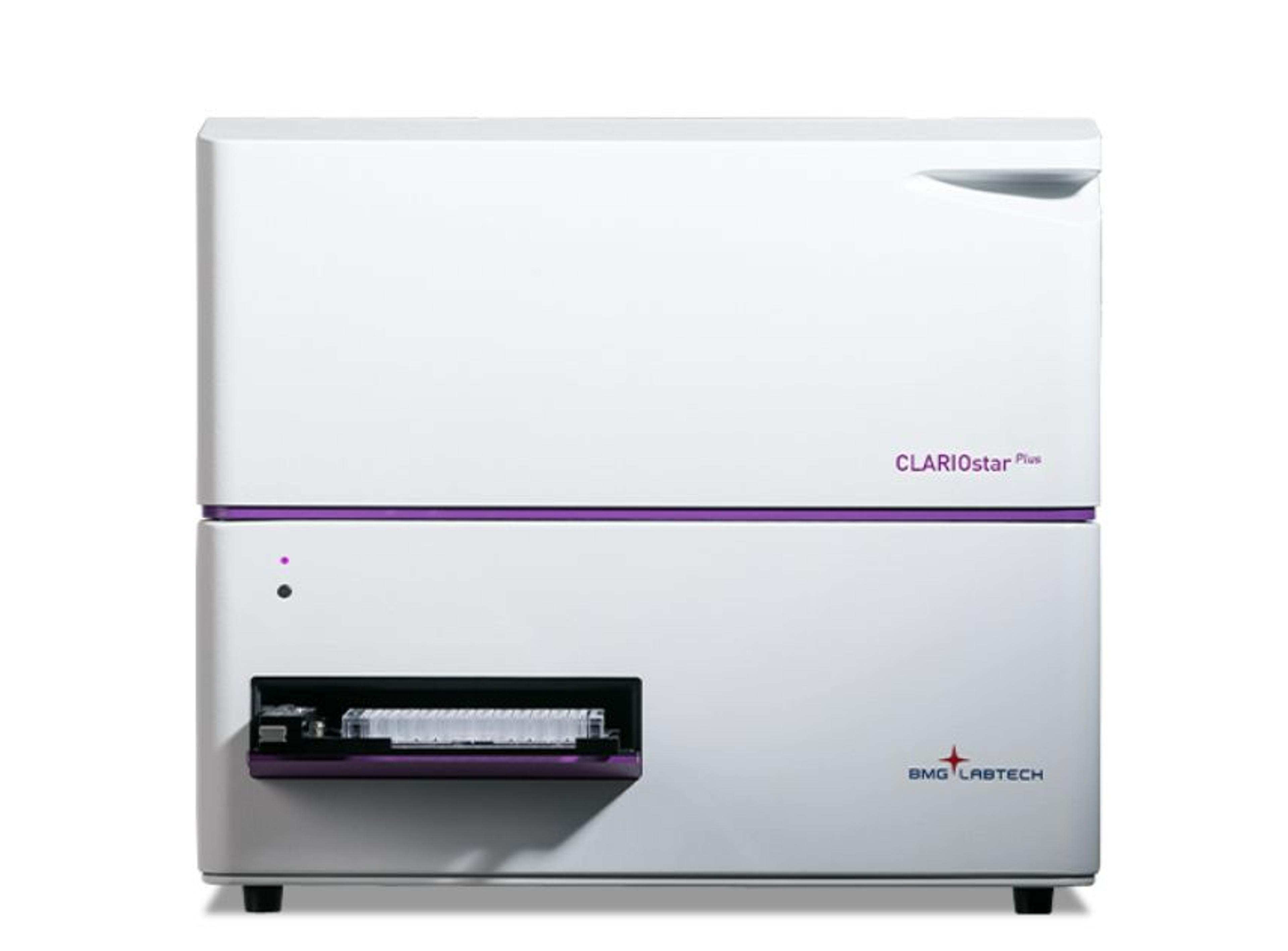
CLARIOstar® Plus Multi-mode Microplate Reader
BMG LABTECHMost flexible Multi-mode Microplate Reader for Assay Development