
‘Science should be disseminated and used for the benefit of mankind and the community’
Agricultural scientist, Janak Joshi, shares his future goals as a scientist and the need for clear scientific communication
4 Mar 2022
Editorial article


Lab product reviews can change the world by helping other scientists find the best equipment to accelerate their vital work. Here at SelectScience®, we are dedicated to promoting peer-to-peer communication that will make the difference - but we couldn't do it without our esteemed reviewers. In this regular feature, we put the spotlight on some of our most dedicated and impactful reviewers and find out what inspires them to keep sharing their knowledge with the global scientific community.
This week’s Reviewer in the Spotlight is Janak Joshi, postdoctoral research scientist at Colorado State University, Fort Collins, Colorado. As an agricultural scientist, his current research efforts focus on potato soft-rot and blackleg disease management. In this article, Janak tells us about his biggest challenges as a scientist and what he thinks needs to be done to improve communication within science.
Tell us a bit about your role and your current research
I am a postdoctoral research scientist at Colorado State University, Fort Collins, Colorado. I am currently working on potato soft-rot and blackleg disease management. Specifically, I am using a multi-omics approach accompanied by plant pathology, molecular biology, and biochemistry tools to identify resistance molecules and incorporate them into cultivated potatoes. In the future, I hope to have a potato that is resistant to bacterial diseases, for which control measures are not available.
I envision my future as a scientist that develops novel methods of plant disease management, thus reducing food losses and contributing towards mitigating global hunger
What have been your biggest challenges as a scientist?
My biggest challenge is to have a balance between all components of academia: including research, teaching, and outreach/extension. The information and understanding from science should be disseminated and used for the benefit of mankind and the community. Being so involved in research can cause many scientists to miss this balance so they have a hard time translating their research. I have learned to embrace all components as they complement each other.
What do you think needs to be done to improve science communication?
Communication is pivotal in science. It has the ability to influence and make people believe in it. The ideal communication should be driven based on the type of audience. However, as a rule of thumb, it should be simple and possibly connected to real-life scenarios and examples. I believe workshops on science communication, attending and giving presentations, and teaching can improve communication.
Why do you read and write lab product reviews on SelectScience?
I think lab product reviews are one of the best means to know a products’ performance and suitability for use. Thus, it helps other scientists to find the right product and it saves time and resources.
What is the most innovative piece of lab equipment you use?
I am interested in studying the variation and composition of plant molecules because it guides me towards more specific research questions. In that respect, HPLC and mass spectrometers are the innovative lab equipment that I have been recently using in my research.
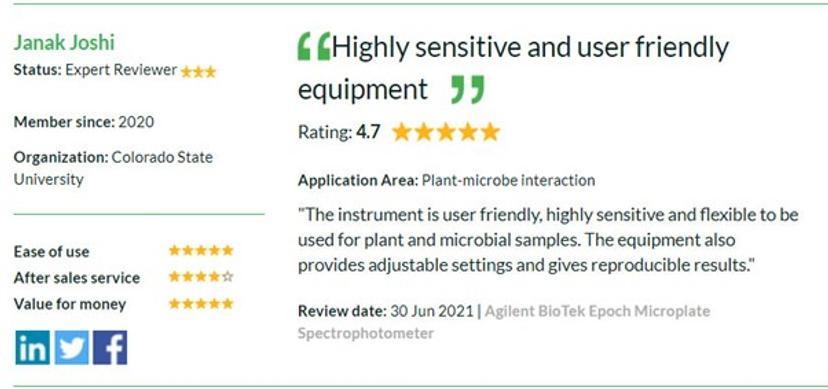
What do you envision for your future?
I envision my future as a scientist that develops novel methods of plant disease management, thus reducing food losses and contributing towards mitigating global hunger.
Would you like to feature in our Reviewer Spotlight? Write your review here to be in with a chance >>
Related products
Request Quote for All Products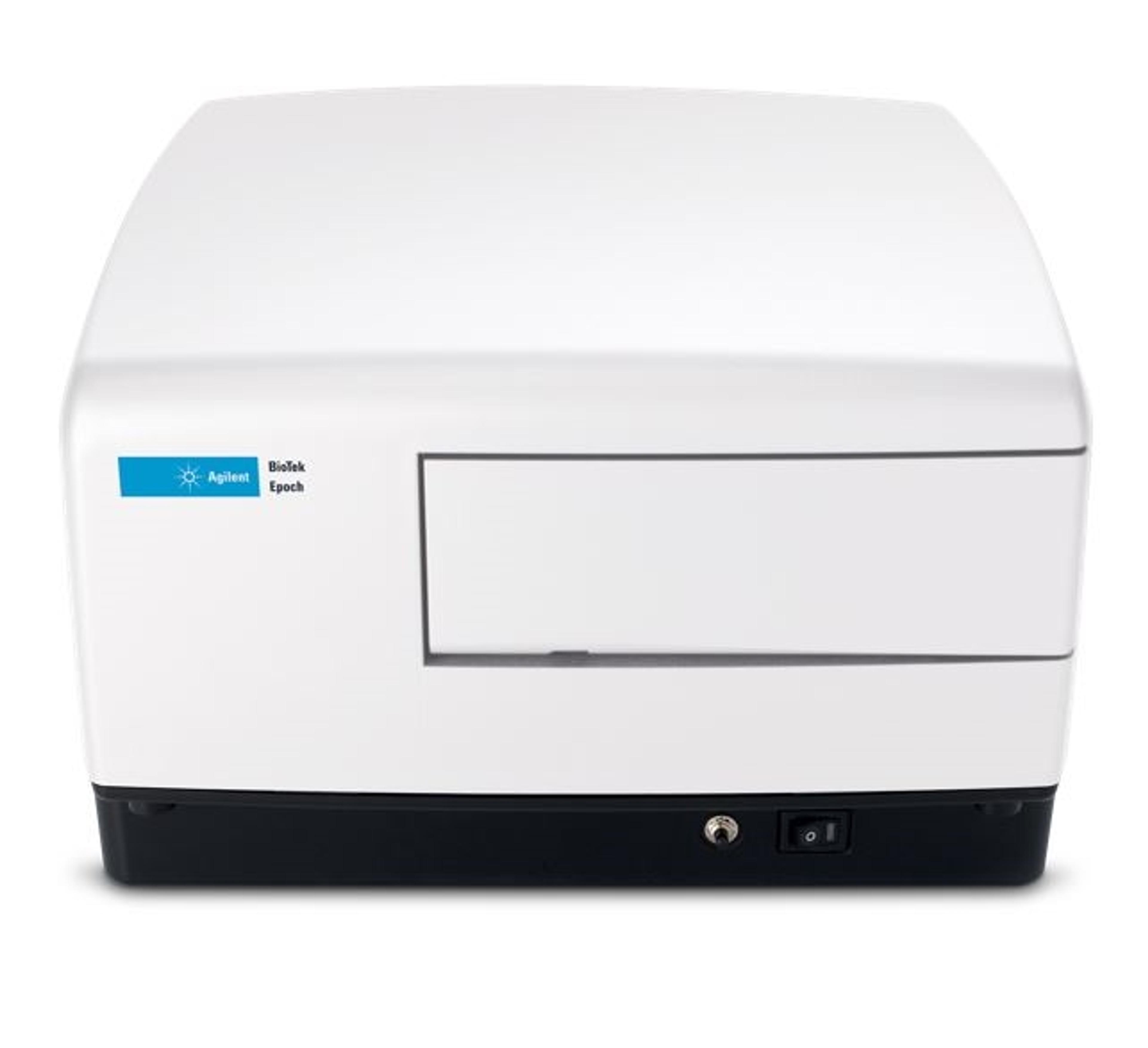
Agilent BioTek Epoch Microplate Spectrophotometer
Agilent TechnologiesThe Agilent BioTek Epoch microplate spectrophotometer has monochromator-based optics, for a filter-free, wide wavelength range for UV-Vis absorbance measurements. These measurements can be done in many microplate formats and in 2 µL samples when the available Take3 microvolume plate is used.