Rigaku to Present Latest X-ray Analytical Instrumentation at 2015 MRS Fall Exhibit

Rigaku will showcase its XRD, XRF and Raman technology at the 2015 MRS Fall Meeting & Exhibit in Boston

24 Nov 2015

Lois Manton-O'Byrne, PhD
Executive Editor

Industry news

Rigaku Corporation will be presenting its diverse lines of X-ray diffraction (XRD), X-ray fluorescence (XRF) and Raman spectroscopy instrumentation at the 2015 MRS Fall Meeting & Exhibit, Sunday, November 29, 2015 through Friday, December 4, 2015. The event is organized by the Materials Research Society and will be held at the Hynes Convention Center in Boston, Massachusetts. Rigaku, a global leader in X-ray analytical instrumentation, will be exhibiting at the event at booth #712.

The conference is the leading event for those in the field of materials research, and will showcase a wide range of product and service categories such as thermal processing equipment; electronic and electrical properties instruments; deposition equipment, processes and materials; materials characterization equipment; optical components and equipment and microscopes, including electron microscopy.

Materials analysis instruments from Rigaku range from benchtop devices, suited for researchers employing X-ray techniques, to high-end instruments with advanced analytical capabilities. Among the instruments on display at the event will be the fifth generation Rigaku MiniFlex benchtop X-ray diffraction instrument. The MiniFlex is a general purpose X-ray diffractometer that can perform qualitative and quantitative analysis of polycrystalline materials

MiniFlex Benchtop XRD

Rigaku Corporation

New 6th-generation general purpose benchtop XRD system for phase identification and phase quantification. New sixth generation MiniFlex X-ray diffractometer (XRD) is a multipurpose analytical instrument that can determine: phase identification and quantification, percent (%) crystallinity, crystallite size and strain, lattice parameter refinement, Rietveld refinement, and molecular structure. It is widely used in research, especially in material science and chemistry, as well as in industry for research and quality control. It is the newest addition to MiniFlex series of benchtop X-ray diffraction analyzers from Rigaku, which began with the introduction of the original MiniFlex system decades ago.   Overview: New 6th generation design Compact, fail-safe radiation enclosure Incident beam variable slit Simple installation and user training Factory aligned goniometer system Laptop computer operation Measurements: Phase identification Phase quantification Percent (%) crystallinity Crystallite size and strain Lattice parameter refinement Rietveld refinement Molecular structure Options: 8-position autosampler Graphite monochromator D/teX Ultra: silicon strip detector HyPix-400 MF: 2D HPAD detector Air sensitive sample holder Travel case
(11)

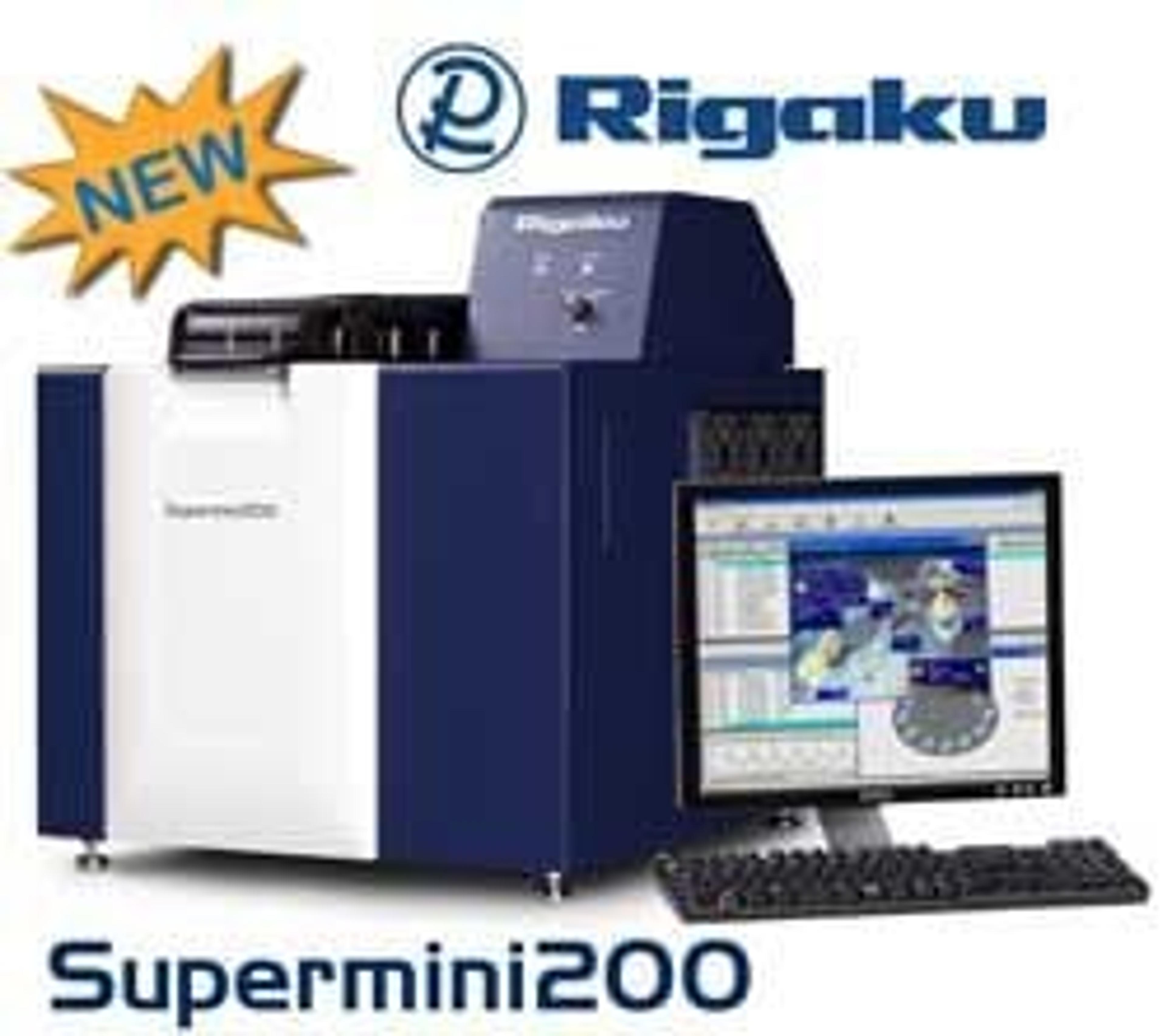
Supermini 200 Benchtop WDXRF Spectrometer

Rigaku Corporation

The new Supermini200 has improved software capabilities as well as a better footprint. As the world's only high-power benchtop sequential wavelength dispersive X-ray fluorescence (WDXRF) spectrometer for elemental analysis of oxygen (O) through uranium (U) of almost any material, the Rigaku Supermini200 uniquely delivers low cost-of-ownership (COA) with high resolution and lower limits-of-detection (LLD). Not only is the Rigaku Supermini200 an affordable choice for your XRF elemental analysis needs, the running costs are also low. P10 gas for the flow proportional detector is the only consumable. The Supermini200 does not require a source of cooling water, plumbing, or an external chiller, thereby decreasing system maintenance and lowering the overall lifetime cost of ownership of the system and yearly budgets for consumables and maintenance.Supermini is the only high powered (200 W) X-ray tube benchtop WDXRF system, providing excellent excitation resulting in lower detection limits and shorter measurement times. A unique and proprietary optical system is also employed to enhance sensitivity beyond the gains of the tube power.Supermini 200 Benchtop WDXRF Spectrometer Features: Analyze oxygen through uranium (O → U) Analyze: solids, liquids, powders, alloys and thin films Atmosphere: air, helium or vacuum X-ray tube: 50 kV, 200 W Pd-anode Primary beam filter: Zr is standard; Al optional Detectors: F-PC and scintillation Crystals: 3-position changer Autosampler: 12-position standard Vacuum: rotary pump standard Power: 100 – 120V (50/60 Hz) 15A or 200 – 240V (50/60 Hz) 10A

(0)

Links

Tags

Fluorescence SpectroscopyFluorometers and spectrofluorometers (also called fluorescence spectrometers) are used to measure the intensity and wavelength of fluorescent light emitted from a sample after excitation by illumination. Spectrofluorometers utilize monochromators to select the desired wavelengths, whereas filter fluorometers employ a set of filters. Spectrofluorometers for measuring steady-state fluorescence and lifetime fluorescence (or time-resolved fluorescence) are available, as well as fluorescence microscopes and microplate readers. Find the best fluorescence spectroscopy products in our peer-reviewed product directory: compare products, check customer reviews and receive pricing direct from manufacturers.Raman SpectroscopyRaman spectroscopy is used to discern the vibrational and rotational states of molecules and hence the chemical composition of a sample by measuring the inelastic scattering of monochromatic light. Explore a range of Raman spectrometers, including handheld/portable Raman spectrometers for QC/QA labs and in situ spectrometers for processes. Conduct Raman imaging for microanalysis of mixed samples using a Raman microscope. Raman spectrographs are also available. Find the best Raman spectroscopy products in our peer-reviewed product directory: compare products, check customer reviews and receive pricing direct from manufacturers.X-ray CrystallographyX-ray crystallography is an analytical technique used to determine the arrangement of atoms in a crystal. Monochromatic x-rays are produced from a synchrotron or x-ray generator. An x-ray crystallography system uses a detector to measure the x-ray diffraction from the crystal. The information is used to generate a 3D image of the crystal.X-Ray Diffraction and SpectroscopyX-Ray diffraction & spectroscopy are used in material characterization to discern the structure and elemental composition of a sample. X-Ray diffractometers (XRD) are superior instruments in elucidating the dimensional atomic structure of crystalline materials, including powders, thin films and single crystals. For large unit cells or ordered macromolecules, consider small-angle X-ray scattering (SAXS). X-ray spectroscopic techniques include X-ray fluorescence (XRF) and X-ray photoelectron spectroscopy (XPS), both providing simple and accurate methods for determining the elemental composition of a material. Energy dispersive (EDXRF) and wavelength dispersive (WDXRF) XRF spectrometers are available, as well as handheld/portable devices. High-resolution, 3D microstructure characterization of materials can be achieved with X-ray microscopes combining sub-micron resolution imaging with 3D computed tomography. Find the best XRD and XRF spectrometers in our peer-reviewed product directory: compare products, check customer reviews and receive pricing direct from manufacturers.NanotechnologyNanotechnology, or nanotech, is an engineering technique using molecular scale functional systems. Applications of nanotechnology include medicine and medical devices, electronics, air and water purification, food science and energy production.Particle CharacterizationParticle characterization instruments are used to determine particle size distribution, shape, surface area, zeta potential, density and porosity of particles and materials. Multiple tecchniques are available for determining particle size, shape and count including dynamic light scattering (DLS), laser diffraction, electrozone (Coulter technique), imaging particle analysis and single particle optical sensing. Determine the density of your material with a gas pycnometer or examine its surface area and porosity with gas adsorption analyzers and mercury porosimeters. Find the best particle characterization instruments in our peer-reviewed product directory: compare products, check customer reviews and receive pricing direct from manufacturers.Thermal Analysis EquipmentThermal analysis equipment is used for measuring heat flow, weight loss, dimension changes or thermomechanical properties and is important for analyzing a material’s performance and stability. Thermal analysis equipment includes differential scanning calorimeters (DSC), thermogravimetric analyzers (TGA), thermomechanical analyzers (TMA), dilatometers, thermometers, vapor sorption analyzers, boiling and melting point apparatus. Thermal analyzers can reveal properties such as melting, crystallization and glass transitions or other processes such as oxidation, decomposition, volatilization, as well as coefficients of thermal expansion and modulus. Find the best thermal analysis equipment in our peer-reviewed product directory: compare products, check customer reviews and receive pricing direct from manufacturers.Non-Destructive TechniquesNon-destructive techniques (NDT) describes a variety of analytical techniques used to evaluate the properties of a material. Common methods include ultrasonic, magnetic-particle, liquid penetrant, radiographic, remote visual inspection (RVI), and eddy-current testing. NDT is regularly used in forensic engineering, civil engineering, mechanical engineering, electrical engineering, systems engineering, aeronautical engineering, and medicine.Surface Area TestingPhysisorption studies fundamental parameters essential for the characterization of materials such as the specific surface area and pore size distribution. Properties such as porosity, strength, hardness, permeability, separation selectivity, corrosion, and thermal stress resistance can all be directly correlated to the porous structure of a material.Light MicroscopyLight microscopes or optical microscopes are used to visualize microscale objects under magnification, including cells, clinical specimens and materials. Lab equipment for light microscopy includes confocal microscopes, fluorescence microscopes, zoom and stereo microscopes. Microscope slides and imaging reagents are available for visualizing samples, as well as various microscope stages and incubators for large or temperature-sensitive samples. Find the best light microscopes in our peer-reviewed product directory: compare products, check customer reviews and receive pricing direct from manufacturers.Electron MicroscopyElectron microscopes (EM) are used to create high-resolution images of samples at the nanoscale by means of an accelerated beam of electrons as a source of illumination. Types of electron microscope include scanning electron microscopes (SEM), transmission electron microscopes (TEM), scanning transmission electron microscopes (STEM) and cryo-electron microscopes. Focused ion beam (FIB) microscopes are useful for modifying or milling a sample surface with nanometer precision, as well as imaging. Find the best electron microscopes in our peer-reviewed product directory: compare products, check customer reviews and receive pricing direct from manufacturers.Thermal ProcessesPolymeric MaterialsPolymeric materials are widely used in industries ranging from biomedical devices to packaging and electronics. Research into these materials focuses on their properties, including strength, flexibility, and degradation. Advances in polymer science have enabled the development of more sustainable and high-performance materials. Explore the best polymeric material products in our peer-reviewed product directory; compare products, check reviews, and get pricing directly from manufacturers.X-Ray FluorescenceX-ray fluorescence (XRF) is an analytical technique used to determine the elemental composition of materials. It is widely used in geology, materials science, and environmental testing for detecting heavy metals and other elements. Browse our peer-reviewed product directory to find the best XRF systems, compare products, check reviews, and get pricing directly from manufacturers.X-Ray Source
Rigaku to Present Latest X-ray Analytical Instrumentation at 2015 MRS Fall Exhibit