
Rigaku to Present Benchtop Spectroscopy Instrumentation at SWRM 2016
23 Oct 2016
Product news
Rigaku Corporation will be in attendance at the 2016 Southwest Regional Meeting of the American Chemical Society (SWRM) in Galveston, Texas, November 10-13, 2016.
Rigaku is presenting its lines of benchtop X-ray diffraction (XRD), X-ray fluorescence (XRF) and Raman spectroscopy instrumentation at Table 16.
The event will be held at the Galveston Convention Center and will focus on innovations in energy and medicine. The event will include a variety of symposia topics including analytical, biological, computational, inorganic, medicinal, organic, physical, and polymer chemistry.
Related products
Request Quote for All Products
Progeny™ Handheld Raman Analyzer
Rigaku CorporationThe new generation in handheld Raman analysis that streamlines your material ID workflow. From the evolution of handheld spectroscopy arrives Progeny – the first handheld Raman analyzer designed to be customizable and flexible for seamless integration into any work environment. Now you can perform lab-quality analysis of the widest range of solids, powders, liquids, and other substances to ensure consumer safety around the globe.Progeny provides the power of Raman spectroscopy in a handheld form with no compromises. You are empowered to choose the complexity of the task at hand. Its unique software design provides articulate communication of simple PASS/FAIL decision or more detailed analysis results for a variety of applications in the lab, in the field, or wherever you need data.Progeny™ Handheld Raman Analyzer Features: Accurately analyze your materials through packaging Minimize the learning curve with a smartphone-inspired interface Increase confidence in your material ID with unparalleled sensitivity Measure a wide range of materials with interference-free data Expand your data transfer flexibility (LIMS, wireless, and docking station)

MiniFlex Benchtop XRD
Rigaku CorporationNew 6th-generation general purpose benchtop XRD system for phase identification and phase quantification. New sixth generation MiniFlex X-ray diffractometer (XRD) is a multipurpose analytical instrument that can determine: phase identification and quantification, percent (%) crystallinity, crystallite size and strain, lattice parameter refinement, Rietveld refinement, and molecular structure. It is widely used in research, especially in material science and chemistry, as well as in industry for research and quality control. It is the newest addition to MiniFlex series of benchtop X-ray diffraction analyzers from Rigaku, which began with the introduction of the original MiniFlex system decades ago. Overview: New 6th generation design Compact, fail-safe radiation enclosure Incident beam variable slit Simple installation and user training Factory aligned goniometer system Laptop computer operation Measurements: Phase identification Phase quantification Percent (%) crystallinity Crystallite size and strain Lattice parameter refinement Rietveld refinement Molecular structure Options: 8-position autosampler Graphite monochromator D/teX Ultra: silicon strip detector HyPix-400 MF: 2D HPAD detector Air sensitive sample holder Travel case
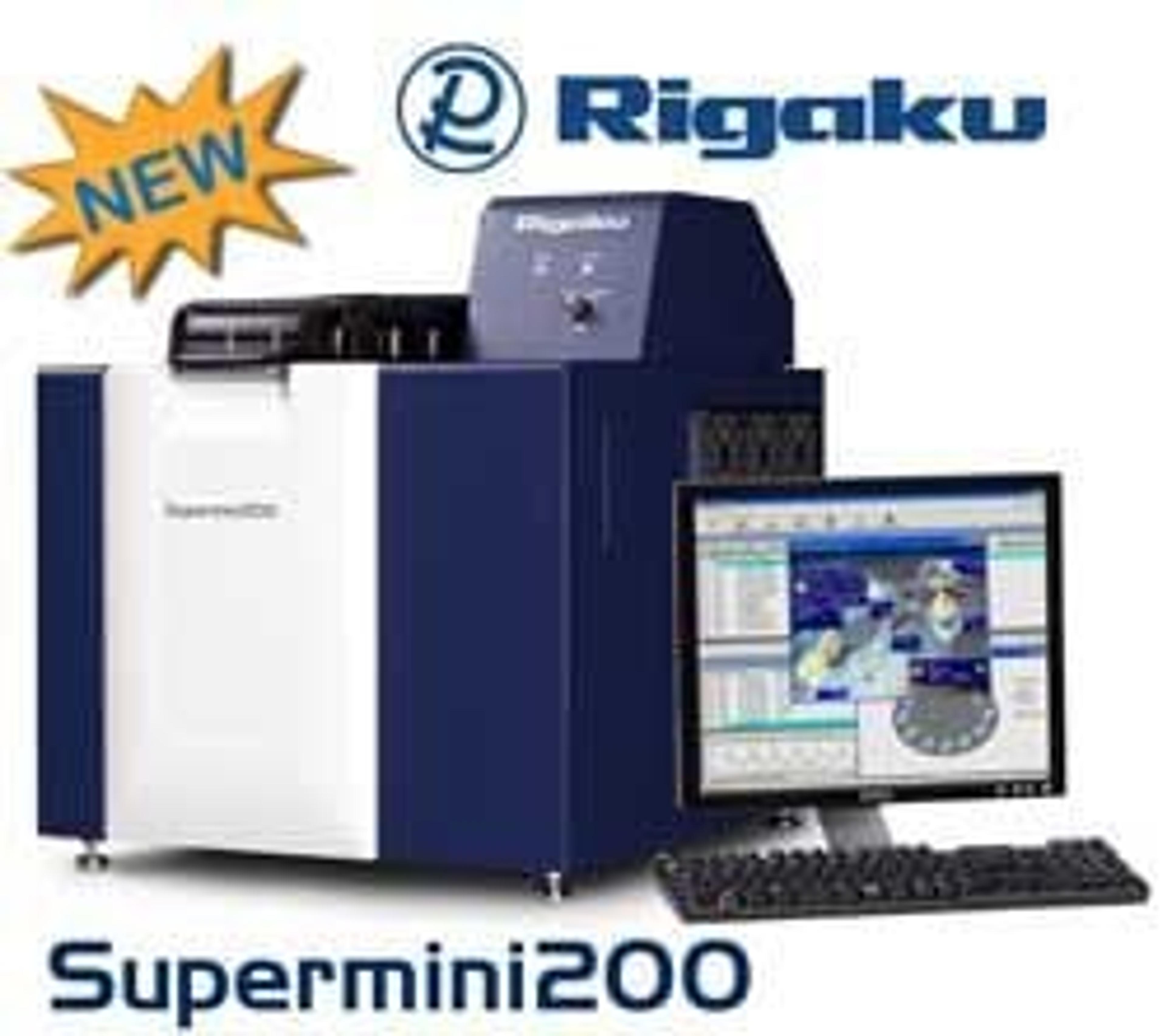
Supermini 200 Benchtop WDXRF Spectrometer
Rigaku CorporationThe new Supermini200 has improved software capabilities as well as a better footprint. As the world's only high-power benchtop sequential wavelength dispersive X-ray fluorescence (WDXRF) spectrometer for elemental analysis of oxygen (O) through uranium (U) of almost any material, the Rigaku Supermini200 uniquely delivers low cost-of-ownership (COA) with high resolution and lower limits-of-detection (LLD). Not only is the Rigaku Supermini200 an affordable choice for your XRF elemental analysis needs, the running costs are also low. P10 gas for the flow proportional detector is the only consumable. The Supermini200 does not require a source of cooling water, plumbing, or an external chiller, thereby decreasing system maintenance and lowering the overall lifetime cost of ownership of the system and yearly budgets for consumables and maintenance.Supermini is the only high powered (200 W) X-ray tube benchtop WDXRF system, providing excellent excitation resulting in lower detection limits and shorter measurement times. A unique and proprietary optical system is also employed to enhance sensitivity beyond the gains of the tube power.Supermini 200 Benchtop WDXRF Spectrometer Features: Analyze oxygen through uranium (O → U) Analyze: solids, liquids, powders, alloys and thin films Atmosphere: air, helium or vacuum X-ray tube: 50 kV, 200 W Pd-anode Primary beam filter: Zr is standard; Al optional Detectors: F-PC and scintillation Crystals: 3-position changer Autosampler: 12-position standard Vacuum: rotary pump standard Power: 100 – 120V (50/60 Hz) 15A or 200 – 240V (50/60 Hz) 10A