
PerkinElmer Launches Innovative Multiplexing System
1 Sept 2014Product news
AlphaPlex™ Reagent Technology Provides Life Sciences Researchers with More Data in Less Time
PerkinElmer Inc., a global leader focused on the health and safety of people and the environment, today announced the launch of the AlphaPlex™ reagent technology. The AlphaPlex technology is a homogeneous, all-in-one-well multiplexing reagent system for performing ultra-sensitive immunoassay analyses, while providing research professionals with more data in less time and with minimal human intervention.
AlphaPlex reagents are designed to extract more information from each assay by simultaneously quantifying multiple analytes in a single well. The AlphaPlex reagents draw upon PerkinElmer’s AlphaLISA® technology to quantify multiple analytes in a single well.
“PerkinElmer is committed to providing researchers with the technology, information and insights for achieving higher accuracy with less sample in a shorter time frame,” said Brian Kim, President, Life Sciences & Technology, PerkinElmer. “The AlphaPlex technology can reduce total assay time from one or two days to as little as two hours. These improvements can lead to advancements and discoveries, enabling the development of improved methods for diagnosing and treating diseases.”
Based on PerkinElmer’s proven Alpha Technology, an alternative to enzyme-linked immunosorbent assays (ELISAs), AlphaPlex reagents are a homogeneous luminescent proximity technology that enables quantification of multiple analytes in a single well. When the Donor and Acceptor beads are brought together, a cascade of chemical reactions is set in motion, causing a greatly amplified signal. By using multiple Acceptor beads which emit different wavelengths, multiple analytes can be detected.
Researchers can use AlphaPlex reagents to quantify a broad range of analytes, from nucleotides to large proteins, as well as immunophenotype various cell populations including immortalized, primary and stem cells. AlphaPlex reagents can be used to perform ratiometric signal measurement, allowing for higher reproducibility and lower false positive rate -- an important feature in high-throughput screening.
The new AlphaPlex technology can be read on Alpha-enabled, filter-based plate readers such as PerkinElmer’s EnVision® Multilabel Plate Reader, which may also be automated using the JANUS® Automated Workstation.
Photo Caption: AlphaPlex is a homogeneous luminescent proximity reagent technology that allows the quantification of multiple analytes in a single well. When the Donor and Acceptor beads are brought together, a cascade of chemical reactions is set in motion, causing a greatly amplified signal. By using multiple Acceptor beads which emit different wavelengths, multiple analytes can be detected.
Related products
Request Quote for All Products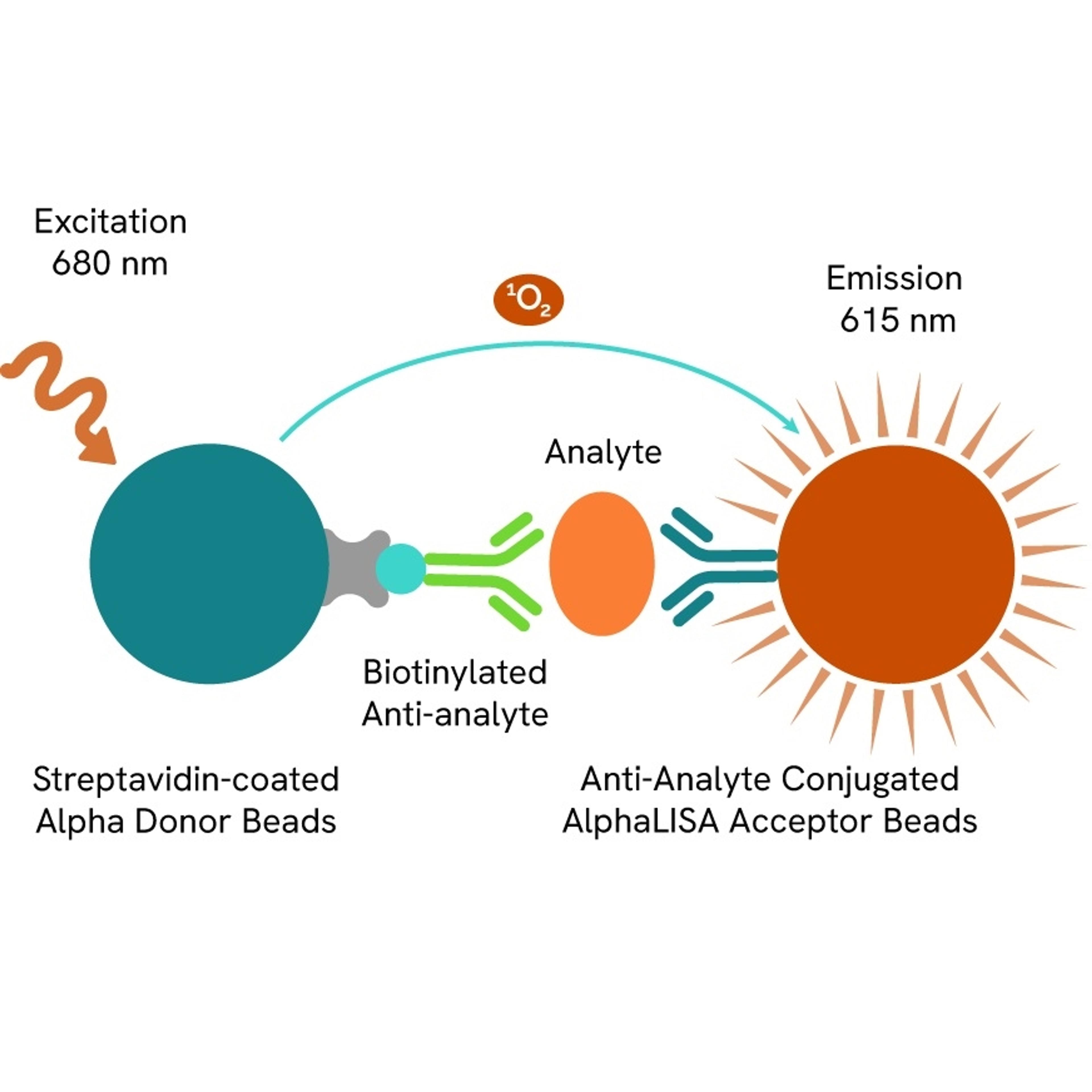
AlphaLISA
RevvityAlpha is a bead-based, no-wash luminescent technology. When Alpha Donor and Acceptor beads are brought together through binding to target, a cascade of chemical reactions is set in motion, creating an amplified signal. These versatile beads are conjugated with various biomolecules that enable detection of unique biological events, offering maximum flexibility.