
New Methods for Analysis of Polar Pesticides and Contaminants in Cereals, Grapes and Baby Food
In this poster presentation from AOAC, discover how IC-MS can offer an effective solution to longstanding problematic contaminant analysis
21 Dec 2016
Editorial article
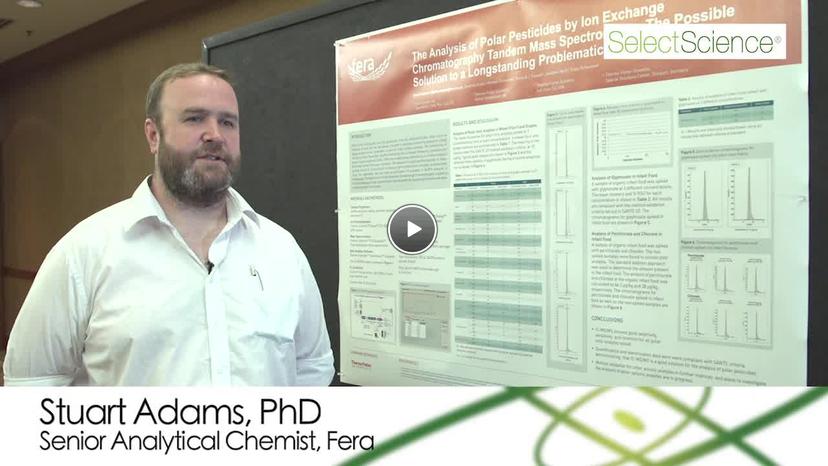

The AOAC 2016 Annual Meeting and Exposition, this year held in Dallas, Texas, aims to educate and facilitate the collaboration of scientists from around the world, through scientific sessions, roundtables, workshops, and poster presentations to meet a variety of analytical needs.
SelectScience® spoke to Dr Stuart Adams, Senior Analytical Chemist at Fera Science Ltd, UK, to hear how his laboratory is employing new methods to analyze challenging polar pesticides and other contaminants in food. Typically performed by LC-MS, as part of a method developed by the European Reference Laboratory (EURL), Dr Adams’ team are applying their in-depth knowledge of ion exchange chromatography with tandem mass spectrometry (IC-MS) as an effective alternative.
The Quick Polar Pesticides (QuPPe) method, set out by the EURL, utilizes a quick generic extraction method followed by several different LC-MS methods. However, after encountering difficulties obtaining the necessary retention time stability with liquid chromatography, Dr Adams’ team looked to apply a different method that would be able to better deal with the problematic compounds. The alternative chosen was IC-MS, which, he explained is a method that is well-established at Fera, having been introduced over 9 years ago.
Due to the challenging characteristics of polar pesticides, such as their low mass and amphoteric character, Dr Adams explained that single residue analyses using LC-MS were traditionally used. In contrast, he explained that a key feature of the new method was the ability to perform multiresidue analysis, whilst retaining selectivity. As a result, they were able to simultaneously investigate the presence of 13 pesticides and contaminants in cereal, grapes and infant food. Dr Adams believes that this is the direction pesticide analysis is moving, due to the substantial time and cost savings.

Formerly the Food and Environment Research Agency, Fera Sciences Limited is a leading supplier of scientific solutions, evidence and advice across the agri-food supply chain. It aims to support and develop a sustainable food chain, a healthy natural environment, and to protect the global community from biological and chemical risks.
Widely used in agriculture, pesticides can have massive benefits for crop productivity; however, it is difficult to ensure that residues are not above legislative limits in food further down the production line for hard to analyze polar pesticides. Dr Adams noted that one of the most commonly used herbicides is glyphosate, which has been reclassified as potentially carcinogenic, and has been currently re-registered for a limited time in the EU. Using IC-MS, Dr Adams and his team could successfully detect and analyze the presence of glyphosate in grapes, cereal, and baby food with good selectivity and sensitivity.
The same method was applied to organic baby food, confirming the absence of pesticides, but exposing the presence of contaminants, such as chlorate and perchlorate. These compounds can cause chronic and acute health issues and Dr Adams explained that, since 2010, they have been detected in foods at an increasingly high level, emphasizing the importance of accurate detection methods.
To conclude, Dr Adams highlights that the method demonstrated good selectivity and sensitivity for the targeted pesticides, both in the cereals and the grapes, with the method showing promise for baby foods. Using this method, they were able to meet all identification and method validation criteria set out in the SANTE guidelines. However, he believes that the method’s capabilities extend beyond just anionic pesticides, and his team are looking into method validation for cationic pesticides as well.