
ionKey/MS System Redefines MS Performance
4 Jun 2014
Product news
The new ionKey/MS™ System, a new approach for getting exceptional sensitivity, robustness and ease-of-use out of mass spectrometry for applications as far-ranging as bioanalyses and pharmacokinetic studies to food safety and environmental analyses. Intended for use with Waters ACQUITY UPLC M-Class System and Xevo® TQ-S Mass Spectrometer, the Waters ionKey/MS System physically integrates a UPLC separation into the mass spectrometer producing a significant improvement in sensitivity, enabling scientists to achieve unparalleled separation and detection of compounds. Waters introduced the ionKey/MS System at the Pittcon Conference and Exposition March 2 – 6. Waters is making the ionKey/MS System immediately available to scientists on a worldwide basis.
"ionKey/MS will change how the world thinks about LC/MS. With ionKey/MS we are enabling any scientist to operate the most sensitive LC/MS analysis on the market, eliminating many variables and simplifying the user experience," said Ian King, Ph.D., Vice President, Separations Technology, Waters Division. "This can have a big impact by reducing training requirements and standardizing operations. With the ionKey/MS System we have made it possible for scientists to reduce solvent and sample sizes. This results in more environmentally, ethically and economically –sound operation by lowering costs and solvent waste and reducing the amount of sample needed for analysis."
In addition to the enhanced sensitivity, scientists praise the plug and play nature of ionKey/MS. Scientists no longer have to contend with delicate fittings and columns and concern themselves with extra column dispersion and the inevitable variability and band broadening that comes with it. The ionKey/MS System's iKey Microfluidic Separation Device is designed so that all it takes is a few seconds for a scientist to insert it into the source of the mass spectrometer and with the turn of a key, make the fluidic and electric connections and lock it into place.
One scientist who has seen what the ionKey/MS System can do is Rand Jenkins, Ph.D. and Scientific Director of PPD Laboratories (www.ppd.com), a global contract research organization specializing in drug discovery, development, life cycle management and laboratory services. "I strongly believe that systems combining ease of use and optimum microflow performance, exemplified by Waters ionKey/MS, will be the next wave in both routine and advanced LC/MS analysis."
The ionKey/MS System's iKey Microfluidic Separation Device, which is about the size of a smart phone, contains the fluidic connections, electronics, ESI interface, column heater, eCord™ Intelligent Chip Technology and the 1.7 micron UPLC grade particles packed inside a 150 micron I.D. channel to perform hundreds upon hundreds of UPLC separations reproducibly and reliably without a degradation in performance. Besides storing the iKey device's dimensions, chemistry type, serial no., manufacturing and QC history, the unique eCord chip captures and records information such as operator name, instrument name, sample set name, date of first and last injection, total number of injections, observed back pressures and operating temperatures – usage data that is tied to the individual iKey device and is accessed with Waters Empower® Chromatography Data Software and MassLynx® Mass Spectrometry Software.
At this scale of chromatography, the savings in solvent approaches 90% and the ease-of-use that ionKey/MS System brings to the laboratory is a true game-changer.
Related products
Request Quote for All Products
ACQUITY UPLC System
WatersWaters ACQUITY UPLC - Dramatic Improvements in Speed, Sensitivity and Resolution Whether you work in methods development or quality assurance, in drug discovery and development or testing for safety in food supplies, you seek a productivity edge. With the ACQUITY UPLC® System, now you can get more information in a single, short run than you've ever seen with HPLC. Waters ACQUITY UPLC System UltraPerformance LC® (UPLC®) technology starts with unique 1.7 μm small-particle chemistries. Chromatographers no longer need to choose between speed and resolution–with UPLC you get both. Instrument Designed for Chemistry; Chemistry Designed for the Instrument The ACQUITY UPLC System has been holistically designed to match the performance needs of our innovative column chemistries with robust hardware, easy-to-use software and specialized support services. Small, pressure-tolerant particles High-pressure fluidic modules Minimized system volume Negligible carryover Reduced cycle times Fast response detectors Integrated system software and diagnostics With UPLC you have the ability to work more efficiently with higher speed, sensitivity and resolution at a much wider range of linear velocities, flow rates and backpressures to obtain superior results. The Waters ACQUITY UPLC System's high-pressure fluidics optimizes flow rates to make the most of small particle technology. The ACQUITY UPLC System's sample-handling design is designed to ensure exceptionally low carryover and reduced cycle time. And when interfaced with the Sample Organizer, it increases unattended sample capacity by ten times. High-speed detectors, both optical and mass, contribute to increased sensitivity and help manage the heightened speed and resolution requirements of UPLC. ACQUITY UPLC Systems are easily controlled, diagnosed, and monitored via a graphical system console interface. The console offers: Quick and easy access to critical instrument parameters Simple system start-up, elegant system status monitoring and predictive performance indicators to ensure maximum productivity Data management capabilities that are supported by both MassLynx™ and Empower™ software The ACQUITY UPLC System is also supported by Intelligent Device Management technology with our Connections® INSIGHT™ service, providing instrument diagnostics.

Empower™ Chromatography Data System
WatersThe Empower Chromatography Data System is Waters’ compliance-ready chromatography data software (CDS) for advanced data acquisition, processing, and reporting that simplifies the management of chromatography test results.
MassLynx MS Software
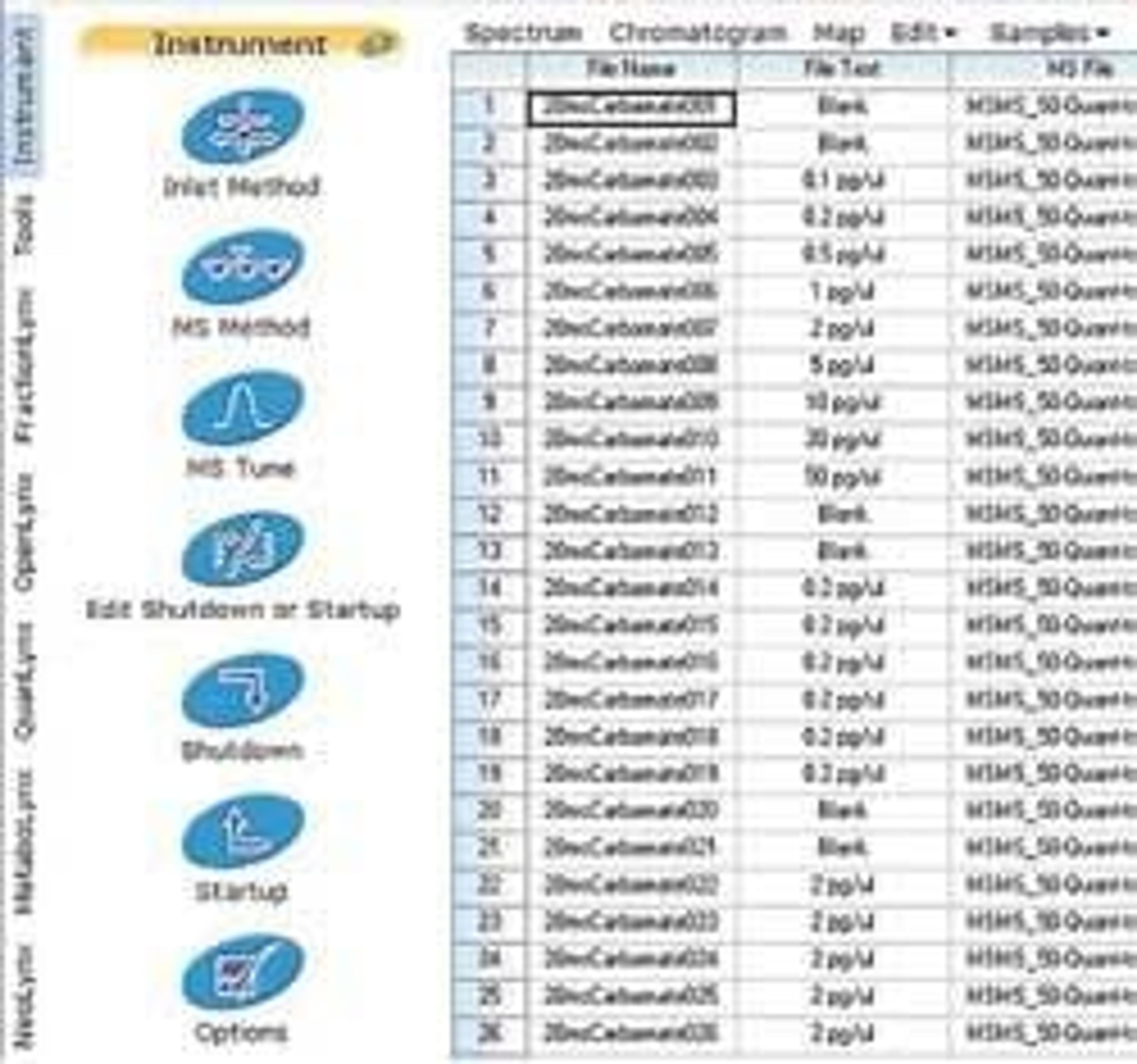
WatersAcquire, Analyze, Manage, and Share Mass Spectrometry Information MassLynx™ Software increases the speed at which you can convert your sample data into valuable knowledge. It provides you with the fundamental platform to acquire, analyze, manage, and share your mass spectrometry information. MassLynx intelligently controls any Waters mass spectrometry system, from sample and solvent management components to mass spectrometer and auxiliary detectors. MassLynx Software may acquire nominal mass, exact mass, MS/MS and exact mass MS/MS data. MassLynx’s Sample List is the core of the system. It maintains and consolidates the data on all of your samples. You also initiate any activities related to your sample from the Sample List. This "sample centric" approach simplifies the interaction with your LC/MS or GC/MS system, acquired data and processed results. Process Application-specific Data MassLynx Software features general purpose and specialized Application Managers that provide information for your specific MS analyses and data. Two come standard with MassLynx: QuanLynx™ for automated quantification included as standard with MassLynx OpenLynx™ for qualitative screening and identification Optional Application Managers can perform: Targeted quantitative analysis Mass-directed purification Metabolite identification Deconvolution of complex chromatograms Metabonomics & metabolomics Protein identification and protein characterization