
Future challenges in the food industry: How to increase throughput in sample preparation and qPCR the right way
Addressing the challenges of daily food quality control inspections
15 Nov 2019
Expert insights
The world's population is projected to have grown to around nine billion people by 2050. In addition to increasing the amount of food produced, the demand for food security will also increase and ensuring a high-quality level of food will become even more of a global challenge.
Quality criteria often have to meet national and international standards and the rising number of daily examinations on food composition or possible contamination pose new challenges to molecular biology investigations.
In this webinar, now available on demand, Melanie Kelm and Melanie Jahn, experts from Analytik Jena in the area of life sciences, sample preparation and qPCR, will provide solutions for the most common challenges associated with high-throughput real-time PCR, with a special focus on analysis in the food industry.
Read on for highlights from the webinar Q&A session or register to watch the full webinar on demand.
Watch Webinar Now
Melanie Kelm, Head of Product Management, Analytik Jena.
Q: If I want to analyze strongly colored samples, is there any influence from the qPCR?
MJ: Yes, color can influence your qPCR result. I recommend diluting samples to 1 to 10, or even 1 to 100. This allows you to get rid of the color and maybe get a better result as you’ll have fewer inhibitors in the end.
Q: How many targets can you detect in parallel from one sample?
MJ: This strongly depends on the qPCR system you are using, as well as the chosen target-specific assay. Most qPCR systems can have up to four or five colored channels, allowing you to detect this number of specific targets.
Q: How much lab space is needed for the whole workflow?
MJ: This depends on if you're working in a manual or an automatic way. Looking at the systems available from Analytik Jena, we are talking about bench-top devices and normally you would need about two or three meters on your workbench to position the whole workflow.
Q: Why is the pre-culturing step shorter when using qPCR than for conventional culturing
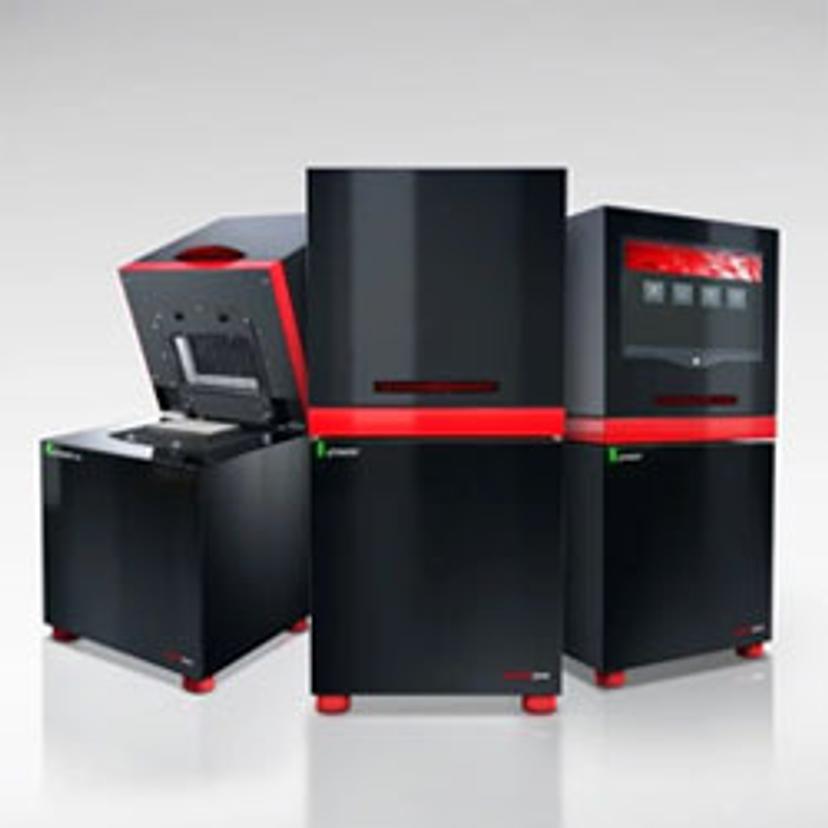
qTOWER³ Real-Time PCR Thermal Cycler by Analytik Jena The qTOWER³ product family guarantees well-founded real-time results as it benefits from peerless temperature control precision in the sample block regardless of the number of samples used – the number of samples can range from 96 up to 384.
MJ: qPCR offers high specificity and a low limit of detection. That means it's a really sensitive method. In some cases, you can reduce the cultivation time to an absolute minimum because qPCR is able to analyze one copy of your sample, in this case, of the bacteria.
Q: Is the workflow solution also available for other applications?
MJ: The devices within this workflow are unique and the specificity comes from the assays. You can use the whole workflow for a lot of other applications outside of the range of full diagnostics.
Q: If you don't have a full 96 samples each day, can you only run 20 samples, for example?
MJ: Yes, you can. With these devices, the extraction robot and the qPCR systems are adaptable to a certain number between 1 and 96. So, it's completely up to the user as to how many samples they would like to run.
Q: Is it possible to have more than one analysis from one food sample?
MJ: In principle, it’s possible. You have extracted DNA from one food sample which you are then able to use in several runs for multiple targets, depending on the detection kit you are using.
Q: How many 384-well qPCR runs can be performed in one day?
MJ: This depends on the length of each run. One run takes about one hour, allowing you to perform up to eight runs a day. This would involve performing your plate layout and your sample preparation between runs.
Q: Can you use the pipetting system for DNA isolation as well?
MJ: We offer two different pipetting stations. The InnuPure C16 touch can only be used for nucleic acid extraction. The CyBio Felix, however, can do both. We can use it as a system for nucleic acid extraction with ready-to-use kits, and you can also use it for other applications like the preparation of PCR or even for other liquid handling tasks.
Find out more on this topic by watching the full webinar on demand>>
SelectScience runs 3-4 webinars a month across various scientific topics, discover more of our upcoming webinars>>