
Friendly soil fungus could replace chemical sprays in battle against crop diseases
Release of natural airborne chemicals inhibits growth of crop pathogens
30 Sept 2025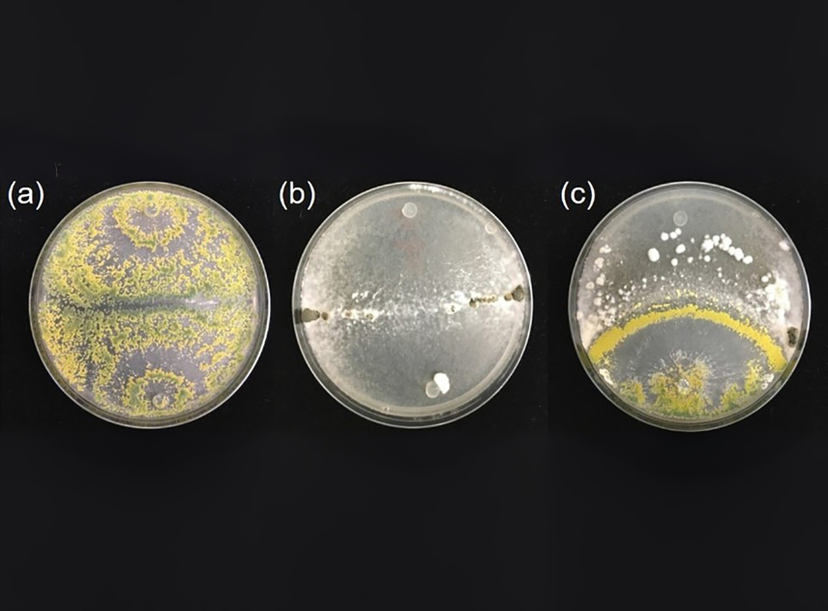
Plate cultures of (a) Trichoderma hamatum GD12 strain; (b) Sclerotinia sclerotiorum (c) co-culture of the two showing inhibitory effect of T. hamatum GD12 (bottom) on S. sclerotiorum (top). © Thomas, G. A. et al.
A common soil fungus could help farmers reduce their reliance on synthetic fungicides, new research suggests, by producing natural airborne chemicals that suppress devastating plant diseases.
Scientists at Rothamsted, along with partners at the universities of Warwick and Exeter, have found that Trichoderma hamatum — a fungus already known to protect plants — releases volatile organic compounds (VOCs) that inhibit the growth of crop pathogens. In laboratory tests, these natural vapours stalled the advance of Sclerotinia sclerotiorum, a mould responsible for rot in crops such as lettuce, beans and oilseed rape.
The study1 showed that when T. hamatum was grown alongside S. sclerotiorum, the interaction triggered a surge in VOC production, with the highest levels occurring after 17 days. Several of the identified chemicals, including 1-octen-3-one, proved able to halt not only S. sclerotiorum but also other destructive fungi such as Botrytis cinerea (grey mould), Pyrenopeziza brassicae (light leaf spot) and Gaeumannomyces tritici (take-all disease in wheat).
The findings suggest that such natural compounds could be developed into a more sustainable alternative to conventional fungicides, which are facing increasing regulatory restrictions in the UK and Europe.
Dr. Jozsef Vuts, one of the co-authors of the study, said, "Further work is needed to understand how these fungal VOCs operate in real-world farming conditions, and whether they can be harnessed effectively at scale. But the discovery offers fresh hope for greener crop protection at a time when agriculture is under pressure to cut chemical inputs."
References
1. Thomas, G. A., J. Vuts, D. M. Withall, et al. 2025. Inducible Volatile Chemical Signalling Drives Antifungal Activity of Trichoderma hamatum GD12 During Confrontation With the Pathogen Sclerotinia sclerotiorum. Environmental Microbiology Reports 17, no. 5: e70192. https://doi.org/10.1111/1758-2229.70192