Essential Information for Environmental Volatile Organic Compounds Analysis

Find all of the information you need on volatile organic compound analysis at Thermo Fisher Scientific

21 Dec 2016
Sonia Nicholas
Managing Editor and Clinical Lead

Editorial article

Image: Shutterstock/TTstudio

Editorial Review by Lois Manton O’Byrne, Editor, SelectScience®

Volatile Organic Compounds (VOC) are both naturally occurring and man-made. Man-made contaminants are used and produced in the processing of paints, adhesives, petroleum products, pharmaceuticals , refrigerants and many other uses. Examples of VOCs include halogenated hydrocarbons, ketones, acrylates, ethers, aromatics, nitriles, acetates and sulfides.

VOCs vaporize, evaporate or sublimate at room temperature, allowing them to escape into the atmosphere. As a result, sampling and extraction methods must be designed to minimize volatile loss for accurate quantitation. The type of compound being analyzed dictates the extraction method to be used. Extraction is commonly carried out using static headspace, or purge and trap methods, followed by gas chromatography, gas chromatography mass spectrometry.

Extraction and concentration

Purge and trap is probably the most commonly used and sensitive technique for VOC extraction. Find out more in this webinar, Innovations in routing sample analysis for volatile content using purge and trap technique: conserving helium and improving laboratory throughput. Watch the webinar to learn more about alternative carrier gas configurations and compare advantages and disadvantages of VOC analysis.

Headspace techniques are used for the analysis of compounds with high Henry’s law constants, such as fuel range organics. Learn more about the analysis of gasoline range organics as markers for oil spill water pollution, using a Thermo Scientific™ TriPlus™ 300 Headspace Autosampler and the Thermo Scientific™ TRACE™ 1310 GC, in this application note.
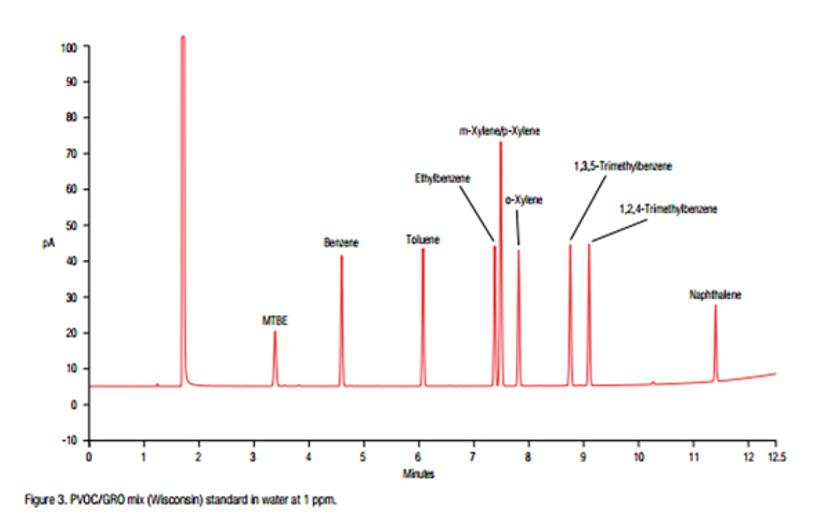
Figure 1: PVOC/GRO mix (Wisconsin) standard in water at 1 ppm1

Gas chromatography (GC) is the most common technique for identifying and quantitating VOCs. GC is used with flame ionization (FID), electron capture (ECD) or mass spectrometry (GC-MS). Learn more about environmental applications featuring the latest developments in GC technology in this series of five application notes.

Mass spectrometry is generally used instead of stand-alone GC for VOC’s as it provides a higher degree of confidence in compound identification. Helium is becoming more difficult and expensive to procure for MS/GS analysis, and although hydrogen can be cheaply and easily generated in the lab, this alternative carrier gas is highly reactive and flammable. In this application note, a method demonstrating the effectiveness of the Thermo Scientific™ Helium Saver Module coupled with the nitrogen purge feature of the Teledyne Tekmar Atomx automated VOC sample prep system is described. The method is shown to produce quality data while significantly reducing helium consumption.

Figure 2. Chromatogram with VOC standard at 2 ppb in full scan mode. The inset depicts the extracted ions for the first six gases2

Learn more about environmental VOC analysis, including details on regulatory methods, at Thermo Fisher Scientific’s VOC Analysis Page.

References:

1. Automated Determination of Gasoline Range Organics (GRO) in Water Via Valve-and-Loop Headspace GC

2. Helium Conservation in Volatile Organic Compound Analysis Using U.S. EPA Method 8260C

Links

Tags

Gas ChromatographyGas chromatography (GC) is an analytical technique used to separate and quantitate mixtures of small and volatile compounds. Gas chromatographs or GC systems include components such as GC columns, detectors, pumps and autosamplers. Choose from packed or capillary GC columns, flame ionization (FID), photoionization (PID) electron capture detectors and selective or non-selective detectors. Find the best gas chromatographs in our peer-reviewed product directory: compare products, check customer reviews and receive pricing direct from manufacturers.Ion ChromatographyIon chromatography, also known as ion exchange chromatography, is a high-performance liquid chromatographic technique used for the separation and identification of ions or polar molecules in a sample, including proteins, nucleotides and amino acids. Equipment includes ion exchange columns, ion exclusion columns, ion chromatography systems, pumps, and detectors. Find the best ion chromatography equipment in our peer-reviewed product directory: compare products, check customer reviews and receive pricing direct from manufacturers.Sample PreparationSample preparation can improve the quality and speed of separation techniques. Products to assist sample preparation include filtration equipment, evaporators, membranes and sieves.Environmental Monitoring and TestingEnvironmental monitoring and testing uses handheld portable analyzers, kits, spectrometers or chromatography systems for air, water, soil, food and other sample testing. Useful features of analyzers such as BOD and COD include portability, easy calibration, automation and sensitivity.  Environmental test kits for pH, water, moisture, etc, should be accurate, sensitive, reliable, fast and easy to use.Solid-Phase ExtractionSolid-phase extraction (SPE) is used for clean-up, extraction and concentration of semi-volatile or non-volatile analytes from complex mixtures including blood, urine and food samples. Multiple formats are available for conducting SPE, including prepacked SPE cartridges, disks and microplates, as well as SPE sorbent powders for manual packing. SPE systems can be used to automate the process and extract multiple samples at once. Solid-phase microextraction (SPME) and supported liquid extraction (SLE) products are also available in the same formats. Find the best SPE, SLE and SPME equipment in our peer-reviewed product directory: compare products, check customer reviews and receive pricing direct from manufacturers.GC-MS GC-MS (gas chromatography-mass spectrometry) instruments and equipment are used to separate, quantify and identify mixtures of small and volatile compounds, such as polycyclic aromatics, fatty acids and alcohols. Often used in drug detection, forensic investigation and environmental analysis for pesticides and contaminants, GC-MS is a powerful addition to your lab’s analytical capabilities. GC-MS/MS instruments equipped with a qTOF or triple quadrupole analyzers can give greater sensitivity and resolution to your analysis. Find the best GC-MS instruments and equipment in our peer-reviewed product directory: compare products, check customer reviews and receive pricing direct from manufacturers.Volatile Organic Compounds (VOCs)Volatile organic compounds (VOCs) are chemicals that have a low boiling point. Some VOCs are harmful to human health, whereas others can be used to determine the shelf-life of foods samples.
Essential Information for Environmental Volatile Organic Compounds Analysis