CrestOptics selected by Akoya Biosciences for spatial biology collaboration

Collaboration aims to provide new workflows, faster acquisition speeds and deeper resolution

28 Jun 2021

Diane Li
Assistant Editor

Industry news

CrestOptics S.p.A., a manufacturer of high-end microscopy solutions and advanced systems for fluorescence microscopy and diagnostic applications, has announced that it has been selected by Akoya Biosciences Inc., The Spatial Biology Company®, as a premier microscope provider to jointly develop new spatial biology and spatial phenotyping applications. CrestOptics has been invited to the partnership among other leading companies in the field of imaging and diagnostics to support Akoya’s Imaging Innovators (I2) Network.

“We are focused on developing versatile systems for a variety of applications to support researchers in the cell biology and imaging space, and are excited to be a part of this innovative collaboration to expand imaging capabilities for life sciences,” said Renato Giacobbo Scavo, CEO of CrestOptics.

“CrestOptics’ high-end instruments, such as our spinning disk confocal, can be paired directly to Akoya’s CODEX system for single-cell multiplex imaging enabling high resolution, large field of view, and fast 3D imaging to support researchers in this field of study,” said Alessandra Scarpellini, PhD, Head of Sales and Marketing at CrestOptics.

“Collaborating with leading imaging companies, including CrestOptics,will help accelerate further innovation in the field of spatial biology to provide faster and more precise tools for biological discoveries,” said Brian McKelligon, President and CEO of Akoya Biosciences. “By working together with partners we can further expand our CODEX system with the latest and most advanced microscopy platforms to streamline the user experience, add new workflows, accelerate acquisitions speeds, and provide deeper resolution.”

CrestOptics manufactures high-end microscopy instruments under own brand and as an original equipment manufacturer (OEM). The Company’s instrumentation can be integrated with other high-end imaging systems used in life science research to enhance the detection and performance of imaging.

Want the latest science news straight to your inbox? Become a SelectScience member for free today>>

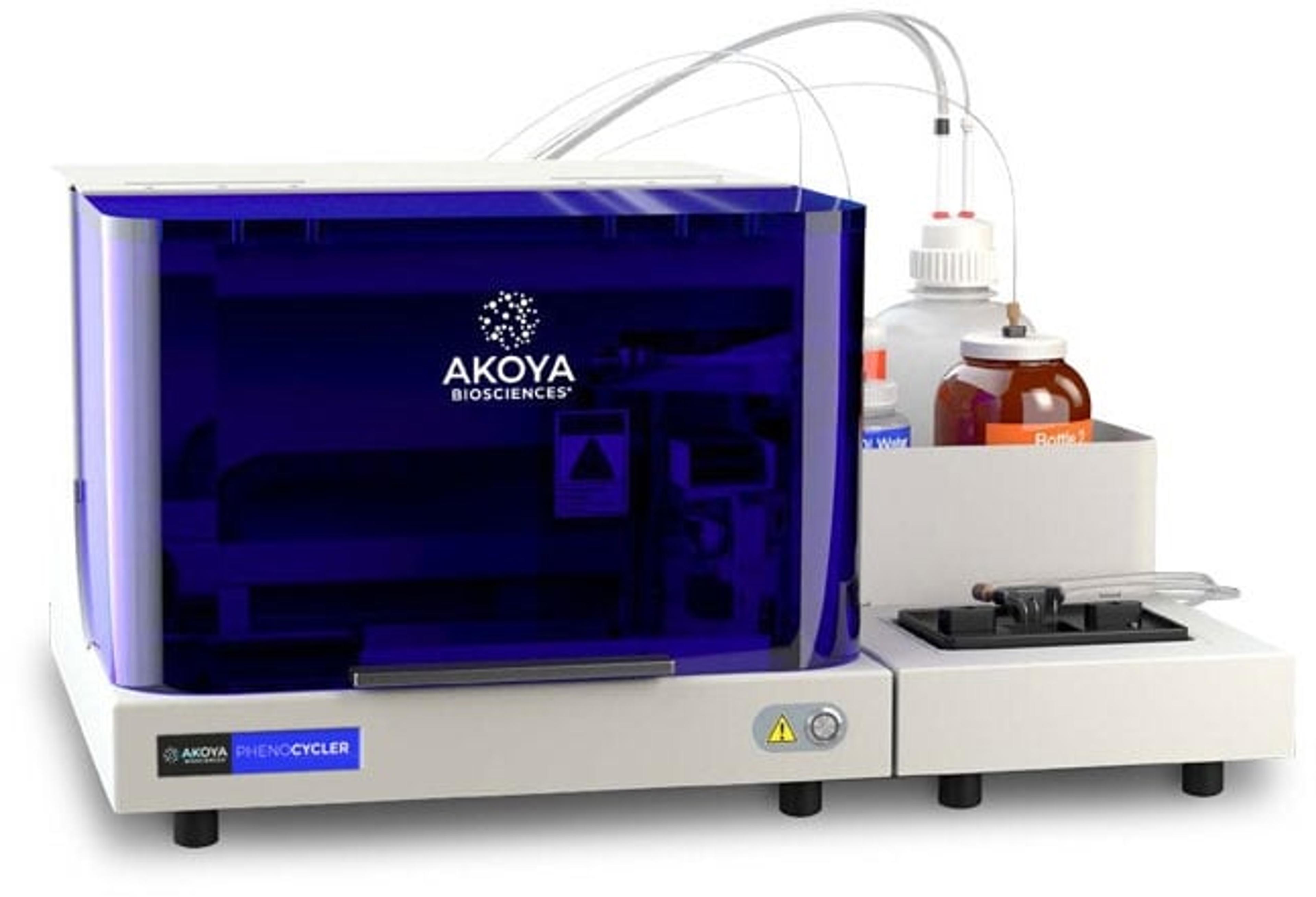
PhenoCycler®

Akoya Biosciences

The PhenoCycler ® is a cutting-edge fluidics control unit that integrates with the PhenoImager Fusion imaging platform creating the fastest spatial biology solution with unparalleled throughput. 

(3)

Links

Tags

Gel Doc / Image AnalysisGel documentation (gel doc) or gel imaging systems are used for the analysis of proteins, antibodies and nucleic acid immobilized in polyacrylamide or agarose gels, membranes or microarrays. Explore a range of a gel imaging systems, densitometers, scanners, transilluminators or UV lamp + CCD cameras for your image analysis solutions. Colorimetric, fluorescent and/or radioisotopic samples can be visualized and documented for further analysis. See gel doc / Image analysis software for quantitative 1D and 2D analysis of your samples. Find the best gel doc / image analysis products in our peer-reviewed product directory: compare products, check customer reviews and receive pricing direct from manufacturers.In Vivo Imaging Systems<i>In vivo</i> imaging systems, including pre-clinical imaging systems and medical imaging systems are used to non-invasively visualize and capture images of live animals and plants. Monitor the natural processes or diseases of your subjects using small-animal pre-clinical imaging systems, including single photon positron emission tomography (SPECT), positron emission tomography (PET), computed tomography (micro-CT), magnetic resonance imaging (MRI), X-ray radiography, ultrasound, fluorescence and bioluminescence imagers. Multimodal systems and software solutions are also available for correlative analysis of organ, tissue, cell, or molecular-level processes. Find the best in vivo imaging products in our peer-reviewed product directory: compare products, check customer reviews and receive pricing direct from manufacturers.Clinical ChemistryBiochemistry (or clinical chemistry) involves the analysis of bodily fluids using chemical tests. Techniques used include HPLC, chromatography, spectroscopy, mass spectrometry, immunochemical, electrophoresis, turbidometric / spectrophotometric assay, MRI and ISE analysis. Tests are often carried out on plasma or serum but urine (urinalysis) and fecal specimens are also processed.Clinical MicrobiologyMicrobiology is the study of microorganisms including protists, prokaryotes, fungi, and, often, viruses. Microorganisms are a useful research tool as genetic vectors and, in immunology, for antibiotic susceptibility testing, cellular biology and genetics. Microorganisms commonly grow readily in incubators with microbial culture media; this can contain chromogenic supplements to differentiate between cell lines. Estimate your culture’s density of microorganisms with colony counters, or screen and select colonies for desirable clones with automated colony pickers. Additionally, equipment is available to monitor environments for the presence of microbes and identify with microbial identification instruments. Find the best microbiology products in our peer-reviewed product directory: compare products, check customer reviews and receive pricing direct from manufacturers.Cell ImagingCell imaging can be achieved using a number of techniques including confocal microscopy, transmission electron microscopy, atomic force microscopy, and light sheet microscopy.ImagingImaging techniques are essential for obtaining visual representations of samples to understand structures, processes, and function in biological, chemical, and physical research. These tools range from traditional light microscopy to advanced imaging modalities like MRI and electron microscopy, providing researchers with valuable data for diagnostics, drug discovery, and material analysis. Explore imaging solutions in our peer-reviewed product directory to compare products, check reviews, and get pricing directly from manufacturers.3D Imaging3D imaging technologies allow for the visualization and analysis of three-dimensional structures at high resolution. These systems are used in fields like molecular biology, material science, and medical diagnostics. 3D imaging can be applied to visualize cells, tissues, and organs, providing valuable insights into their structure and function. Browse our peer-reviewed product directory to find the best 3D imaging solutions, compare products, check reviews, and get pricing directly from manufacturers.CollaborationCell BiologyCell biology studies the structure, function, and behavior of cells. Understanding cellular processes is essential for research in areas such as cancer biology, stem cell research, and neurobiology. Techniques like flow cytometry, microscopy, and cell culture enable researchers to explore cellular mechanisms in detail. Browse our peer-reviewed product directory to find the best cell biology tools and equipment, compare products, check customer reviews, and get pricing directly from manufacturers.Phenotypic ScreeningPhenotypic screening assesses cellular responses to compounds, enabling drug discovery and target identification. This technique is pivotal in finding effective treatments for complex diseases. Discover phenotypic screening platforms and tools with peer-reviewed comparisons and pricing in our directory.MultiplexingMultiplexing refers to the ability to measure multiple targets or analytes simultaneously in a single experiment. This technique is valuable for high-throughput screening, diagnostics, and complex assays, as it increases efficiency and data quality. Browse our peer-reviewed product directory to find the best multiplexing products, compare tools, check reviews, and get pricing directly from manufacturers.