Complete Workflows for Pesticide Analysis

In a poster presentation from AOAC, learn how to obtain qualitative and quantitative pesticide analysis results in two simple workflows

17 Jan 2017
Weylan Kiam-Laine
Microbiologist

Editorial article


The AOAC 2016 Annual Meeting and Exposition, held in Dallas, Texas, aims to educate and facilitate the collaboration of scientists from around the world, through scientific sessions, roundtables, workshops, and poster presentations to meet a variety of analytical needs.

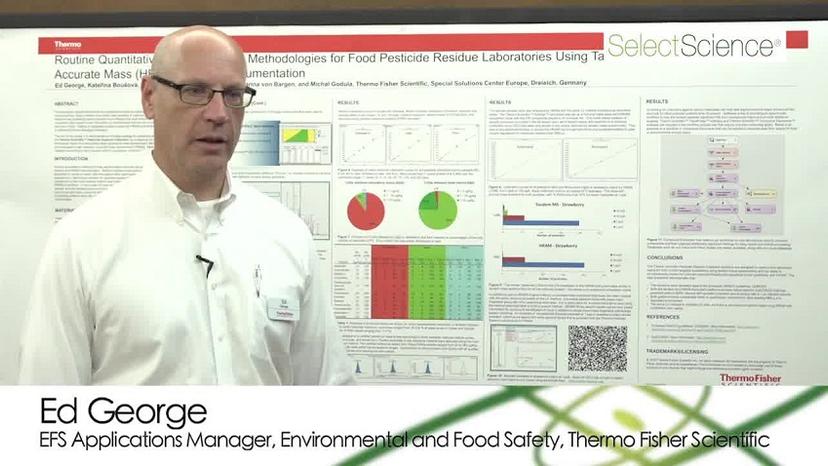
SelectScience® spoke to Ed George, Environmental and Food Safety Applications Manager, Thermo Fisher Scientific, to hear about the Pesticides Explorer Collection – two complete workflows for pesticide analysis, using high resolution accurate mass (HRAM) and/or triple quad mass spectrometry. In this presentation, Ed describes an experiment investigating pesticides within three different matrices.

To assist pesticide residues chemists in the laboratory, Ed explained the develop­ment of the Pesticide Explorer Collection: comprehensive start-to-finish LC-MS workflows for both triple quadrupole and HRAM instrumentation. The major benefit of the workflows is simply to help laboratories save time. As the methods have already been tested, the need to optimize hundreds of compounds or build complex spectral libraries is eliminated.

Three matrix types were ana­lyzed during method development with a quick, easy, cheap, effective, rugged, and safe (QuEChERS) extraction without cleanup. These were strawberry, which has a high sugar and water content; leek, which is a complex green vegetable with high pigment content; and flour, which is a dry matrix with low water content. Hundreds of pesticides covering most global regulatory requirements were identified and quantitated on both platforms. The Thermo Scientific™ TSQ Endura™ Triple Stage Quadrupole Mass Spectrometer and the Thermo Scientific™ Q Exactive™ Focus HRAM instruments were used in method development. Ed explained that both platforms include the instrument acquisition methods, software, consumables and compound database information making it easy for labs to get up-and-running. The triple quad approach is typically more commonly used and offers a simple methodology for the analysis of targeted pesticides. On the other hand, HRAM offers excellent quantitation as well but with the additional benefit of being able to screen for non-target pesticides against a comprehensive compound data base. Ed commented that it was “a really powerful tool that allows the expansion of a laboratories analytical scope well beyond routine targeted analysis”.

To make full use of non-target screening capability, the HRAM package includes Thermo Scientific™ Compound Discoverer™ Software, along with a compound database and spectral library of approximately two thousand compounds. Ed stated that using this software enables chemists to easily review statistically significant findings with many other tools to aid in the identification of unknown compounds.

In conclusion, Ed described the Pesticide Explorer Collection as ideal solutions for routine targeted quantitation of pesticides with either the HRAM or triple quadrupole MS platforms. HRAM provides the additional benefit of non-targeted screening allowing laboratories to promote a more comprehensive analysis. Ed noted that these pesticide workflow solutions will “hopefully protect public health better and make laboratories more efficient”.

Watch the full video and more interviews from the AOAC 2016 Annual Meeting.

Use any of these instruments for your research? Leave a product review today and help other scientists conducting research in your field.

Links

Tags

LC-MSLC-MS (liquid chromatography-mass spectrometry) systems and equipment are used for separation and quantitative analysis of complex mixtures, combining liquid chromatography and mass spectrometry. Quantify proteins, contaminants, pesticides or screen for drug metabolites with a high level of sensitivity. LC-MS systems and equipment include reverse phase, normal phase and specialized columns integrated with various MS detectors such as time-of-flight (TOF), quadrupole, orbitrap or ion trap mass analyzers. LC-MS/MS instruments equipped with a qTOF or triple quadrupole analyzer give greater sensitivity and resolving power to your analysis. Find the best LC-MS equipment in our peer-reviewed product directory: compare products, check customer reviews and receive pricing direct from manufacturers.Mass SpectrometryMass spectrometry (MS) is a powerful analytical technique used to identify and quantify molecules based on the mass-to-charge ratio of gas-phase ions. It provides detailed information about the structure, composition, and properties of compounds and is widely used across fields such as environmental monitoring, materials science, drug discovery and development, food and beverage testing, and wider chemical research. Key MS techniques include tandem mass spectrometry (MS/MS), liquid chromatography–mass spectrometry (LS-MS) and inductively coupled plasma (ICP-MS). Choosing from these wide range of techniques and technologies can be a daunting task, so keep up to date with scientific applications, performance expectations, and customer reviews here all in one place. Visit our product directory to receive quotes direct from the manufacturer. Environmental Monitoring and TestingEnvironmental monitoring and testing uses handheld portable analyzers, kits, spectrometers or chromatography systems for air, water, soil, food and other sample testing. Useful features of analyzers such as BOD and COD include portability, easy calibration, automation and sensitivity.  Environmental test kits for pH, water, moisture, etc, should be accurate, sensitive, reliable, fast and easy to use.PesticidesPesticides are used to protect crops from diseases, pests and unwanted plants. They are classed as persistent organic pollutants (POPs) and can be harmful to humans. The Environmental Protection Agency (EPA) currently regulates the use of pesticides in the USA. Food SafetyFood safety describes the prevention of food-borne illnesses. Contamination with a variety of pathogens can be prevented with adequate temperature control, hygiene and labeling. Food samples can be tested using GC/MS, HPLC, SPE, and qPCR to ensure their adherence to regulations.Data AnalysisThe analysis of data is the process of transforming, modeling and evaluating data to discover useful information from experimental results. Food TestingFood testing refers to a variety experiments including PCR, mass spectrometry, processing, QuEChERS, analyzing and Kjeldahl.Food ContaminationFood contamination refers to the presence of harmful substances or pathogens in food, posing risks to human health. Contaminants can be biological, chemical, or physical, and their detection is crucial for ensuring food safety. Advanced testing methods like PCR, chromatography, and spectroscopy are used to identify contaminants in food products. Browse our peer-reviewed product directory to find the best solutions for food contamination detection, compare products, check reviews, and get pricing directly from manufacturers.HRAM
Complete Workflows for Pesticide Analysis