
Biological food authenticity testing: What qPCR analysis can reveal about our food
Watch this on-demand webinar to find learn more about the different methods of analyzing DNA content in a variety of foods
5 Jan 2021Expert insights

Dr. Christine Gräfe and Sarah Köhler, Analytik Jena
Today, food fraud is a major issue. Food authenticity testing to counteract food fraud becomes more and more relevant the more complex the supply chain becomes. It is a hot topic for manufacturers, traders and consumers as well as public authorities. Food fraud can happen at many points throughout the supply chain and production process. A systematic, organized approach to food authenticity testing is therefore crucial for the industry and will need to involve many analytical parameters.
In this SelectScience® webinar, Dr. Christine Gräfe, product manager for nucleic acid extraction solutions at Analytik Jena, and Sarah Köhler, application specialist for life science at Analytik Jena, present simplified, reliable qPCR-based methods for molecular biological authenticity testing with a focus on species identification and GMO analysis as well as allergen detection. The webinar provides an overview of the complete workflow – from sample preparation and nucleic acid extraction to PCR-based analysis, including application examples. The presenters also give practical advice on how to master some of the more challenging tasks in each step of the workflow.
Read on for highlights from the live Q&A or register to watch the webinar at any time that suits you.
Watch on demandQ: Is there a solution for the extraction of food with high-fat contents?
SK: Doing extraction from fatty starting material is always tricky as the lysis might need to be optimized using tenside-containing buffers, and also because DNA quality is lowered by oil content. One solution could be the innuPREP DNA Mini Kit, or our specially designed PME Food DNA Extraction Kit that works well with food that is processed, and other fatty food products. Additionally, you should try to avoid carrying over the oily film after your centrifugation steps.
Q: Is it also possible to do origin analysis with your method?
CG: In principle, yes. We are using PCR-based technology - this means that we are detecting genes. When doing the origin analysis, this means that it is required that you have a gene which is unique for a specific geographic region, making it one possible method. On the other hand, there is also the possibility to do origin analysis via isotope ratio mass spectrometry. In this example, you may have some isotopes which are present in the soil of a specific geographical region, and you can detect them via their isotope mass ratio. This is often done for coffee and wine.
Q: We want to analyze spices. Can we analyze them by PCR too? Are there any special recommendations that you have?
SK: We work with some users who use the qTOWER3 to screen their spices and products for pathogens and different species. The handling of these samples can be difficult as they often contain secondary metabolites that can influence a reaction. Additionally, they often have strong dye properties and this has an effect on the results, especially in qPCR. So, there are several methods, but it's actually possible to detect pathogens in spices without previous extraction, which is the “quick and dirty” method. Here, it is often necessary to work with dilutions to generate reliable results. There are various detection assays available for several pathogens such as Salmonella, E.coli and Listeria and these might be used in the spice analysis.
Q: We are interested in the detection of traces of fish within different samples, especially processed foods. Do you have a solution for that?
SK: Fish detection or at least extraction can also be done with our PME Food DNA Extraction Kits or the innuPREP DNA Mini Kit. The detection can be done with innuDETECT Fish Assay which is a qPCR detection kit based on the TaqMan technique. It can be used for different fish species as it looks for fish-specific chromosomal genes and you can actually read about some fish detection examples in our application notes on our website if you are interested in that topic.
Q: Do you have any solutions for analyzing gelatin samples?
GC: The problems you often have with gelatin is high levels of background DNA and fragmentation due to the normal manufacturing procedure. It is challenging, but we have two dedicated kits for this. We have a gelatin DNA Extraction Kit and our universal kit, the PME Food DNA Extraction Kit. Those are really optimized for doing processed food, including gelatin. They do work really well.
Q: How many samples can be analyzed using this workflow a day?
SK: Sample throughput and the number of samples a day that you can analyze depend on your equipment and on your personnel. Are you working with a qPCR machine with 384 wells or just a 96-well format? How many samples do you manage to extract at once? As an example, if you use CyBio FeliX, it will take about one hour to extract 96 samples. If you run the FeliX four times (or have four devices available), you could extract about 380 samples - or 160 if you do it in duplicates. If you use the rest of the sample spaces for your controls, you can fully utilize the 384-well plate. Depending on how many machines you have, this whole procedure can take from three to seven hours. But if you want to completely automate your workflow, you could choose the qTOWER3(84) auto, which comes with automatic plate loading. It really depends on your resources.
Learn more about the different methods of analyzing DNA content in a variety of foods: Watch this webinar on demand here>>
SelectScience runs 10+ webinars a month across various scientific topics, discover more of our upcoming webinars>>
Related products
Request Quote for All Products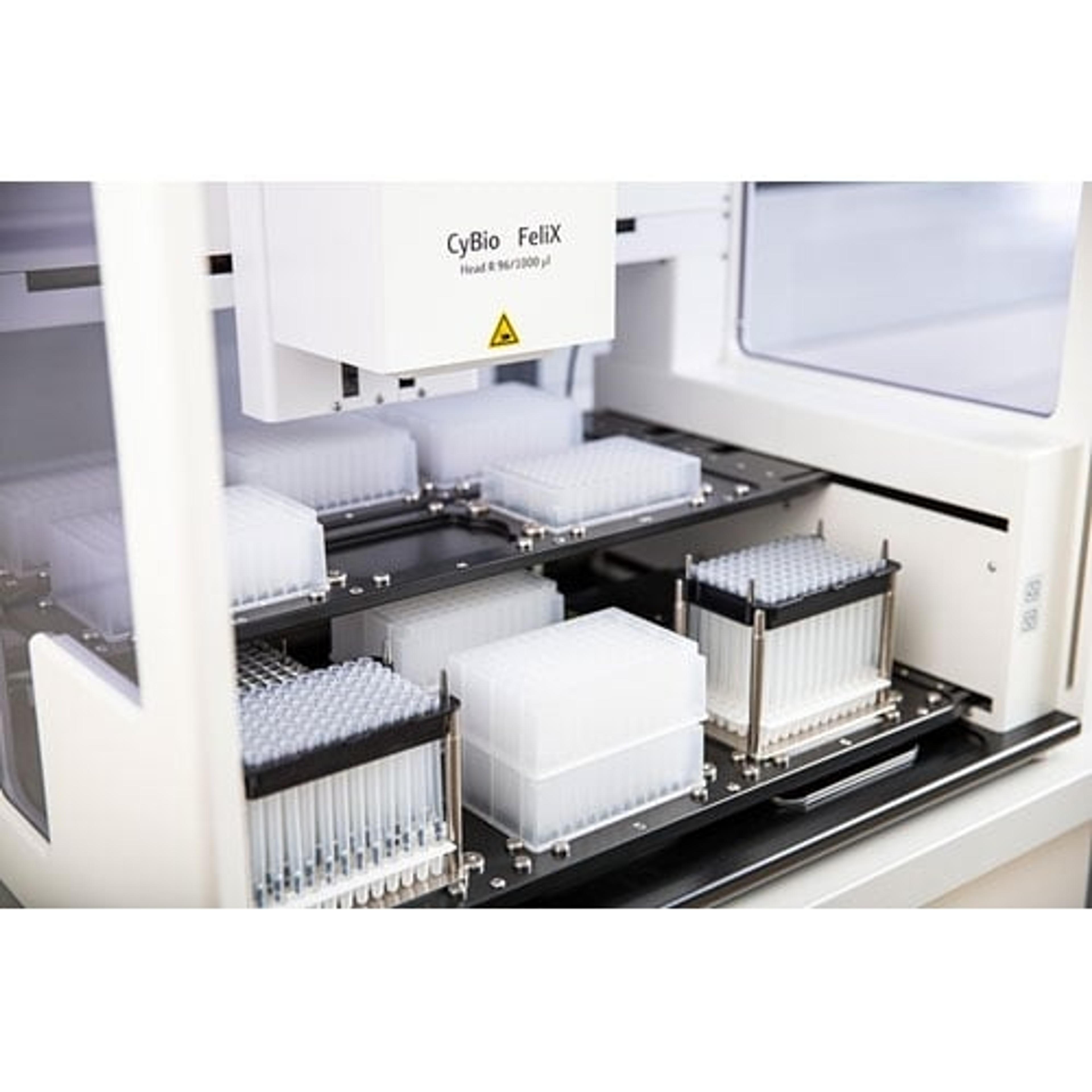
CyBio FeliX
Analytik Jena GmbH+Co. KGCyBio FeliX – Flexible Benchtop Liquid Handling Flexible pipetting platform for fully automated single to multichannel liquid handling. Discover the new accompanying CyBio FeliX SELECT Head with 8 independent channels and volumes for your hit picking, normalization and pooling applications.