
ASMS 2025 in review: Key moments, launches and innovations
Couldn’t make it to Baltimore? Here’s your essential round-up of the biggest scientific highlights, product debuts, and industry shifts from this year’s mass spectrometry event
9 Jun 2025
The 73rd American Society for Mass Spectrometry (ASMS) was held in Baltimore, USA from June 1–5, 2025, bringing together thousands of scientists, engineers, and industry leaders to celebrate the latest advancements in mass spectrometry and allied topics.
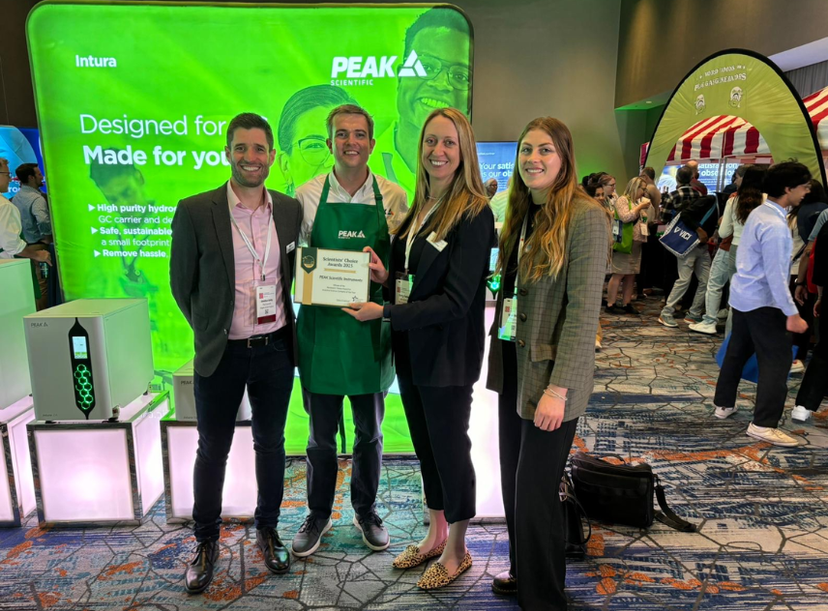
The Reviewer's Choice Award for Analytical Science Company of the Year was presented to PEAK Scientific Instruments
Our SelectScience® team were in attendance, connecting with experts in their field and leading manufacturers to gain first-hand insight into the latest developments and the innovations shaping the future of analytical science.
This in-person setting also gave us the opportunity to meet directly with manufacturers and present our Analytical Science Scientist' Choice Awards® to this year’s winners.
Topics in focus this year
From proteomics and biotherapeutics, to food quality and planetary science, ASMS 2025 included an elaborate series of presentations and workshops across a wide range of sectors with mass spectrometry at its core.
One standout presentation came from the Johns Hopkins Applied Physics Laboratory (APL), which described how a compact mass spectrometry system was deployed via rotorcraft to explore the organic-rich landscape of Saturn’s moon, Titan.
Lisa M. Jones from the University of California San Diego delivered another highlight with her work on hydroxyl radical protein footprinting (HRPF), demonstrating how mass spectrometry is being used to study protein structure in solution, critical for biopharmaceutical development and structural biology.
Other sessions also spotlighted emerging topics such as AI-assisted data interpretation and single-cell and spatial omics, areas that signal a continued expansion of the field.
Exhibitor round-up
As attendees explored the array of manufacturers in the exhibition hall, our team caught up with some of the leading solution providers to cover the latest advancements aimed at improving sensitivity, speed, and application-specific performance.
Here is a breakdown of some of the latest announcements from the show floor:
- Bruker introduced two new innovations this year:
- A new timsUltra AIP System with a breakthrough Athena Ion Processor (AIP) which can deliver up to 35% more peptide and 20% more protein identifications for highest sensitivity proteomics.
- A revolutionary timsOmni mass spectrometer designed to enable functional proteoform sequencing and post-translational modification (PTM) identification and localization with unprecedented depth and speed.
- Agilent unveiled the InfinityLab Pro iQ Series, a next-generation LC-mass detection poised to set new standards for intelligent mass detection, sensitivity, and sustainability.
- Waters set a new benchmark for robustness and sensitivity for high-throughput labs with the Xevo™ TQ Absolute XR Mass Spectrometer, which uses up to 50% less power and gas, and occupies up to 50% less bench space than other products in its class.
- Thermo Fisher Scientific showcased cutting-edge solutions for enhanced omics and proteomics applications, with the goal of driving breakthroughs in biopharmaceutical discovery and translational omics.
- Thermo Fisher Scientific also unveiled the Orbitrap Astral Zoom and Orbitrap Excedion Pro, next-generation mass spectrometers designed to deliver increased speed and sensitivity to set a new performance benchmark for high-resolution, accurate mass spectrometry.
- MOBILion Systems presented plans for its next-generation proteomics platform, highlighting customer use cases from its MOBIE Platform.
- Cerno Bioscience unveiled its breakthroughs in accurate small molecule and unknown compound identification.
- Biocrates launched the MxP® Quant 1000, a high-throughput, standardized metabolomics platform designed to drive therapeutic development through high-precision profiling of over 600 metabolites.
A community driving change

Thermo Fisher Scientific's Hospitality Suite pictured at ASMS2025, Baltimore
For attendees, scientists and manufacturers, ASMS 2025 upheld an informative, immersive and inspiring atmosphere. With each passing year, ASMS places greater emphasis not just on scientific content, but on creating a dynamic and energizing space that fuels innovation in mass spectrometry from all angles.
"For over 15 years, we have loved turning the Thermo Fisher Hospitality Suite at ASMS into not just a trade show booth, but an experience. My favorite part of the show is when we open doors and so many people pull their cameras out. But it’s not just about WOWing attendees for us — making complex scientific topics engaging and accessible is equally important, and we accomplish that by designing and animating information such that it’s packaged in a way that makes it relatable, impactful, and memorable." said Brian Cole, CEO, edgefactory.