Addressing global viral threats with biolayer interferometry technology
Discover how molecular virologists are making strides in SARS-CoV-2 research, and the technology that powers their research
12 Jul 2022
Editorial article

The US National Institute of Allergy and Infectious Diseases (NIAID/NIH) aims to expand the knowledge of infectious, immunologic, and allergic diseases, and develop flexible domestic and international research capacities to respond appropriately to disease threats at a global scale.
Working in the Laboratory of Viral Diseases at the NIAID, Dr. Alberto D. Lopez-Munoz, a molecular virologist postdoctoral fellow, is particularly passionate about understanding how viruses are able to mimic and modulate the human immune system and he is one of the many scientists around the world that have dedicated their research to a better understanding of the SARS-CoV-2 virus.
In this exclusive SelectScience® interview, Dr. Lopez-Munoz shares how cutting-edge label-free protein-protein interaction analysis has aided his scientific discoveries and highlights the importance of bridging the gap between bench research and industry.
How is your group hoping to impact the field of virology?
AL: Viruses are ubiquitous biological entities that pose a constant danger to living organisms, some of them being identified as critical human pathogens. The roster lengthens as humans come into more intimate contact with animal reservoirs harboring novel viruses and new technologies reveal human emerging viruses which cause zoonotic diseases that previously escaped detection or remained hidden.
The vertebrate immune system evolved in response to the threat posed by viruses. The importance of the immune system in protecting against lethal viral infections becomes obvious in innate or acquired immunodeficiencies, where depression of one or more elements of the system results in death from a typically ‘self-limited’ viral infection, or in the success of vaccines in preventing dangerous viral infections. On the other hand, viruses encode a wide repertoire of proteins dedicated to evading and modulating the human immune response. Understanding how viruses counteract the human immune system is critical for antiviral efficacy and vaccine design.
The overall mission of the Cellular Biology Section, within the Laboratory of Viral Diseases at NIAID, is to extend our basic understanding of the interaction between the host and viruses and to use viruses as tools to better understand cell biology.
How do you use Bio-Layer Interferometry (BLI)-based assays?
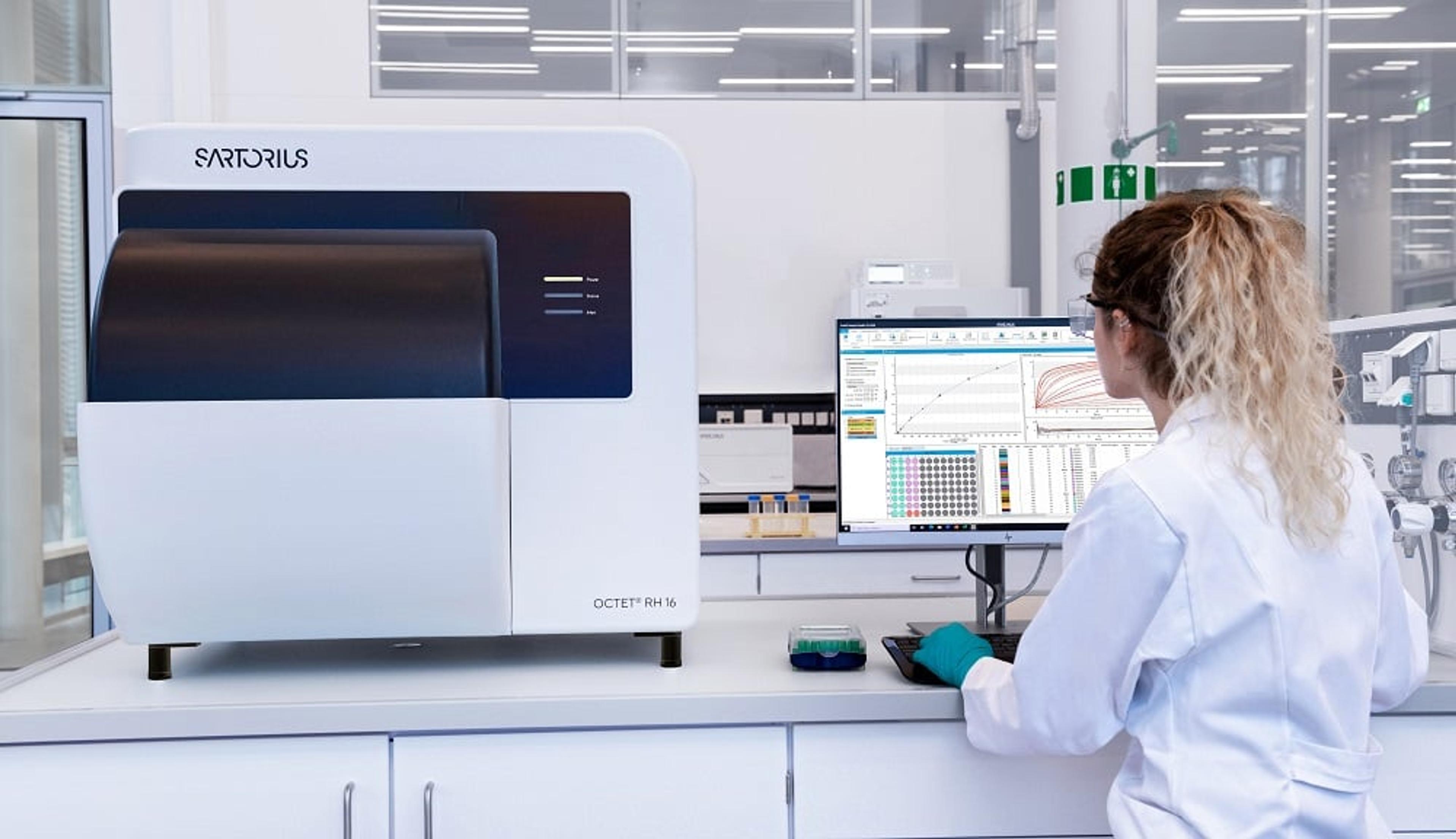
AL: We have extensively used our Octet® BLI instrument to screen interactions between human coronaviruses viral proteins and all commercially available key players of the innate immune system, in a high-throughput manner.
This technology was also instrumental in characterizing the molecular mechanism behind the ability of the SARS-CoV-2 nucleocapsid (N) protein to bind to the cell surface of live infected cells. I used Octet® BLI binding assays between viral proteins and glycans to investigate that.
All these interactions have been quantified in terms of binding affinity, where I calculated the affinity kinetics between SARS-CoV-2 N protein and 11 positively bound human chemokines, as well as heparan sulfate and heparin, by using heterogeneous binding models.
How was Octet® technology instrumental to this research?
- High-throughput screening binding assays where the ligand (tagged with 2X strep tag) was directly immobilized into streptavidin (SA) biosensors from crude cell lysates of transiently transfected cells. Dr. Lopez-Munoz screened all major structural and accessory SARS-CoV-2 proteins against 64 human cytokines to find positive hits for further characterization.
- Affinity kinetics calculations between SARS-CoV-2 N protein and 11 positively bound human chemokines and glycans, using heterogeneous binding models.
- Binding assays between immobilized proteins and glycans.
- Protein-protein competition assays, in the presence of glycans, to determine protein-binding domains of interactions.
You can find a preprint detailing Dr. Lopez-Munoz’s work here >>
What are the advantages of these technologies for your work?
AL: By using the Octet® BLI instrument, which provides a high-throughput system for biomolecular interactions analysis, we were able to scale up the screening of interaction between viral proteins and host factors of interest in an unprecedented time and cost-saving manner.
The high sensitivity and low unspecific binding activity of Sartorius SA biosensors allowed us to skip the long and laborious purification steps typically associated with recombinant protein production. The fact that we were able to immobilize our ligands of interest, directly into SA biosensors from crude cell lysates of transiently transfected cells, was critical to shortening experimental timelines.
The use of Data Analysis HT software has been extremely useful for better characterizing and interpreting biphasic biomolecular interactions, which deviate from first-order binding (1:1) and show binding heterogeneity.
With a wide range of ligand capture surfaces that allow for immobilization of antibodies, recombinant proteins, DNA, RNA, and virus-like particles, the Octet® BLI platform has become an invaluable tool in our laboratory for biomolecular interactions studies.
What are you excited about for the future of your work?
AL: Having discovered all the possibilities that the Sartorius system offers, we can now expand and optimize our method to discover other viral immunomodulators of the human immune system.
We are working on generating whole viral particles and different mutants (tagged with 2X strep tag) which we plan to immobilize into SA biosensors for biomolecular interactions studies and serum profiling.
Why is science communication and collaboration between researchers and industry so important?
AL: A bidirectional communication between bench researchers and industry is crucial to guarantee the availability of accurate, reliable, and reproducible reagents and instruments – the tools used for scientific discoveries.
Bench researchers face experimental and technical challenges daily, and their feedback can help the industry identify new needs and demands in a specific field, as well as to polish the currently available experimental products and systems.
Industry can also help bench researchers to optimize methods, increase lab productivity, reduce costs, and shorten experimental times, as well as more efficiently analyze results and extract scientific conclusions.
Find out how the Octet® platform can advance your research >>