
ResourceSeparations
YMC oligonucleotide columns
13 Sept 2023In this application note, YMC Europe provides a selection of studies, use case scenarios, and specifications for its range of oligonucleotide columns. Oligonucleotides are a powerful tool with vast potential in biotechnology and medicine. These short DNA or RNA sequences can target specific genes for therapeutic purposes, enhance diagnostics, and fuel advancements in synthetic biology, offering exciting opportunities for precision medicine and scientific innovation.
Related products
Request Quote for All Products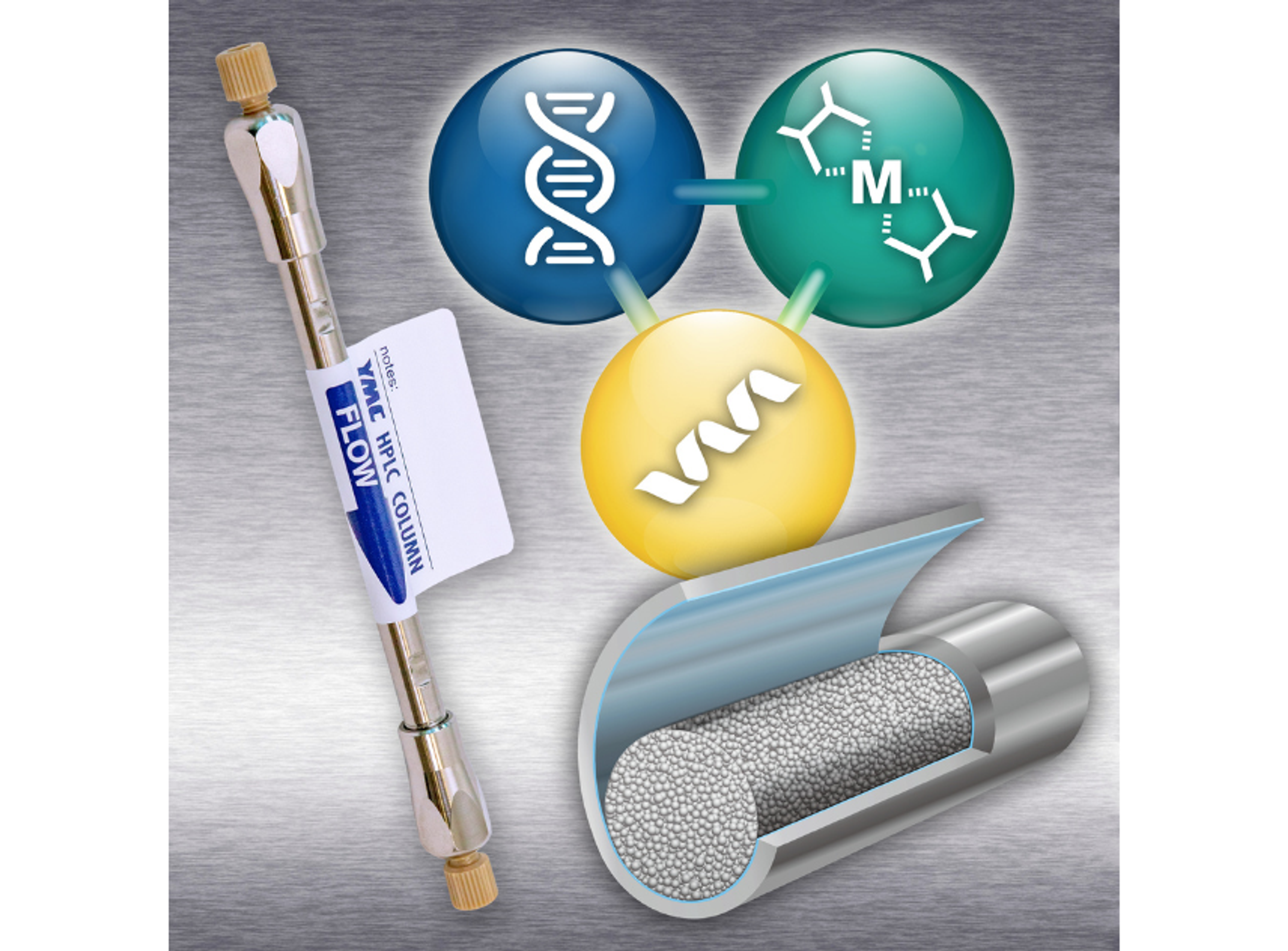
(Bio)inert RP/HILIC (U)HPLC Columns: YMC Accura Triart
YMC EuropeBioinert YMC Accura Triart RP and HILIC columns are available for the analysis of critical substances including selected proteins, (oligo)nucleotides and metal-coordinating compounds such as organophosphates.
Links
Tags
Gas ChromatographyGas chromatography (GC) is an analytical technique used to separate and quantitate mixtures of small and volatile compounds. Gas chromatographs or GC systems include components such as GC columns, detectors, pumps and autosamplers. Choose from packed or capillary GC columns, flame ionization (FID), photoionization (PID) electron capture detectors and selective or non-selective detectors. Find the best gas chromatographs in our peer-reviewed product directory: compare products, check customer reviews and receive pricing direct from manufacturers.UHPLC and HPLCHigh performance liquid chromatography (HPLC) and ultra high performance liquid chromatography (UHPLC), also known as UPLC, are analytical techniques used to separate, identify and quantitate components of complex mixtures including biological samples such as proteins and lipids as well as chemical mixtures of pesticides, drugs and oils. Both techniques are liquid chromatographic methods but differ by operating pressures (HPLC < 6000 psi < UHPLC ). Components of HPLC and UHPLC systems include columns, detectors, pumps, autosamplers and column heaters. Explore a range of UHPLC and HPLC columns for your specific sample needs including reverse phase, normal phase, ion exchange, HILIC, ion exclusion and size exclusion columns. For more specialized HPLC, explore FPLC, countercurrent LC and simulated moving bed systems. Find the best UHPLC and HPLC equipment in our peer reviewed product directory: compare products, check customer reviews and receive pricing direct from manufacturers.Size Exclusion ChromatographySize exclusion chromatography (SEC) is a liquid chromatographic technique used to separate and identify molecules based on their size, including polymers, proteins, nanoparticles & nucleic acid. SEC is further subdivided into gel filtration chromatography (GFC) and gel permeation chromatography (GPC) when an aqueous or organic mobile phase is used respectively. HPLC-based SEC systems and columns are available for analytical separation alongside SEC spin columns or filters to prep samples for many protocols. Find the best size exclusion chromatography equipment in our peer-reviewed product directory: compare products, check customer reviews and receive pricing direct from manufacturers.LC-MSLC-MS (liquid chromatography-mass spectrometry) systems and equipment are used for separation and quantitative analysis of complex mixtures, combining liquid chromatography and mass spectrometry. Quantify proteins, contaminants, pesticides or screen for drug metabolites with a high level of sensitivity. LC-MS systems and equipment include reverse phase, normal phase and specialized columns integrated with various MS detectors such as time-of-flight (TOF), quadrupole, orbitrap or ion trap mass analyzers. LC-MS/MS instruments equipped with a qTOF or triple quadrupole analyzer give greater sensitivity and resolving power to your analysis. Find the best LC-MS equipment in our peer-reviewed product directory: compare products, check customer reviews and receive pricing direct from manufacturers.Mass SpectrometryMass spectrometry (MS) is a powerful analytical technique used to identify and quantify molecules based on the mass-to-charge ratio of gas-phase ions. It provides detailed information about the structure, composition, and properties of compounds and is widely used across fields such as environmental monitoring, materials science, drug discovery and development, food and beverage testing, and wider chemical research. Key MS techniques include tandem mass spectrometry (MS/MS), liquid chromatography–mass spectrometry (LS-MS) and inductively coupled plasma (ICP-MS). Choosing from these wide range of techniques and technologies can be a daunting task, so keep up to date with scientific applications, performance expectations, and customer reviews here all in one place. Visit our product directory to receive quotes direct from the manufacturer.
Preparative ChromatographyPreparative chromatography equipment is used for purification purposes, separating and collecting compounds eluted from a mixture which can then be subsequently used for further purposes. This can be done in large quantities or small. Preparative chromatography systems are usually low to medium pressure liquid chromatographs that are semi-automated. Explore a range of preparative columns and fraction collectors. Find the best preparative chromatography equipment in our peer-reviewed product directory: compare products, check customer reviews and receive pricing direct from manufacturers.Protein QuantificationThe detection and quantification of proteins in a sample is vital across life sciences, pharmaceutical research and clinical diagnostics, and a variety of equipment is available to scientists to simplify the workflow. Proteins of interest can be easily labeled and detected on light-based detection instruments. Immunoassay kits allow you to identify a specific protein of interest and protein detection beads or antibody microarrays allow you to identify multiple specific proteins at once. Protein interactions and enzyme activity can also be monitored with protein-protein interaction assays. Additionally, the biophysical characterization of proteins is made easy with biokinetic analyzers. Find the best protein detection and quantification products in our peer-reviewed product directory: compare products, check customer reviews and receive pricing direct from manufacturers.DNA / RNA QuantificationDetection and quantification of nucleic acids is important in molecular biology, cloning, expression, forensics and clinical diagnostics. Nucleic acids can be detected by labeling with colorimetric, fluorescent or radio labels and using in situ hybridization kits to identify specific sequences. Multiple nucleic acids can be detected and quantified at once using RNA / DNA detection beads or RNA / DNA microarrays. Find the best DNA / RNA Quantification products in our peer-reviewed product directory: compare products, check customer reviews and receive pricing direct from manufacturers.DNADeoxyribonucleic Acid (DNA) is the main component of chromosomes and the carrier of genetic information of living organisms. Find out here about PCR, NGS, ChIP-Seq, gel imaging, and many other techniques which can be used for the analysis of DNA.OligosLow Bleed ColumnHPLCHigh-performance liquid chromatography (HPLC) is a technique for separating, identifying, and quantifying components in mixtures. It is widely used in chemical, pharmaceutical, and environmental analysis to ensure purity and identify unknown compounds. Explore the best HPLC systems in our peer-reviewed product directory; compare products, read reviews, and get pricing directly from manufacturers.