Ultimate guide to automated cell counting

Transform your lab work with an award-winning new solution backed by scientists worldwide

7 Dec 2020

Cell counting is a standard laboratory procedure that is routinely used within many experimental workflows, from life sciences to medical diagnostics. Conventional equipment in many labs, manual cell counting is operator-dependent and widely recognized as laborious and time-consuming with the potential for interpersonal differences in cell recognition, along with volume, dilution, and pipetting errors. Automation has been introduced to address these issues by removing subjectivity, generating rapid results, and providing precision, compliance, and consistency. Nonetheless, automation is not without its challenges, so careful consideration should be given when seeking out the best instrument for your applications.

This application eBook presents a comprehensive guide on how to easily optimize cell counting processes with state-of-the-art technologies, introduces a cell counting tool that offers flexibility via various slide formats, explores how to simply analyze and categorize cell populations, illustrates how to count peripheral blood mononuclear cells (PBMCs) isolated from whole blood samples, and also highlights how the LUNA-FX7™ Automated Cell Counter can satisfy all of your cell counting needs for use in general and bio/pharmaceutical laboratories, as well as GMP facilities. Download it free today for expert insight on topics including:

  • Counting cells: Is there a better way?
  • All your counting needs in one
  • The quest for optimal precision
  • The importance of cell size
  • CAR T: Monitoring cell health and viability
  • Monitor cell health and growth with precision
  • PBMCs: Optimize counting and viability
  • Meet the LUNA™ family: Tools for success

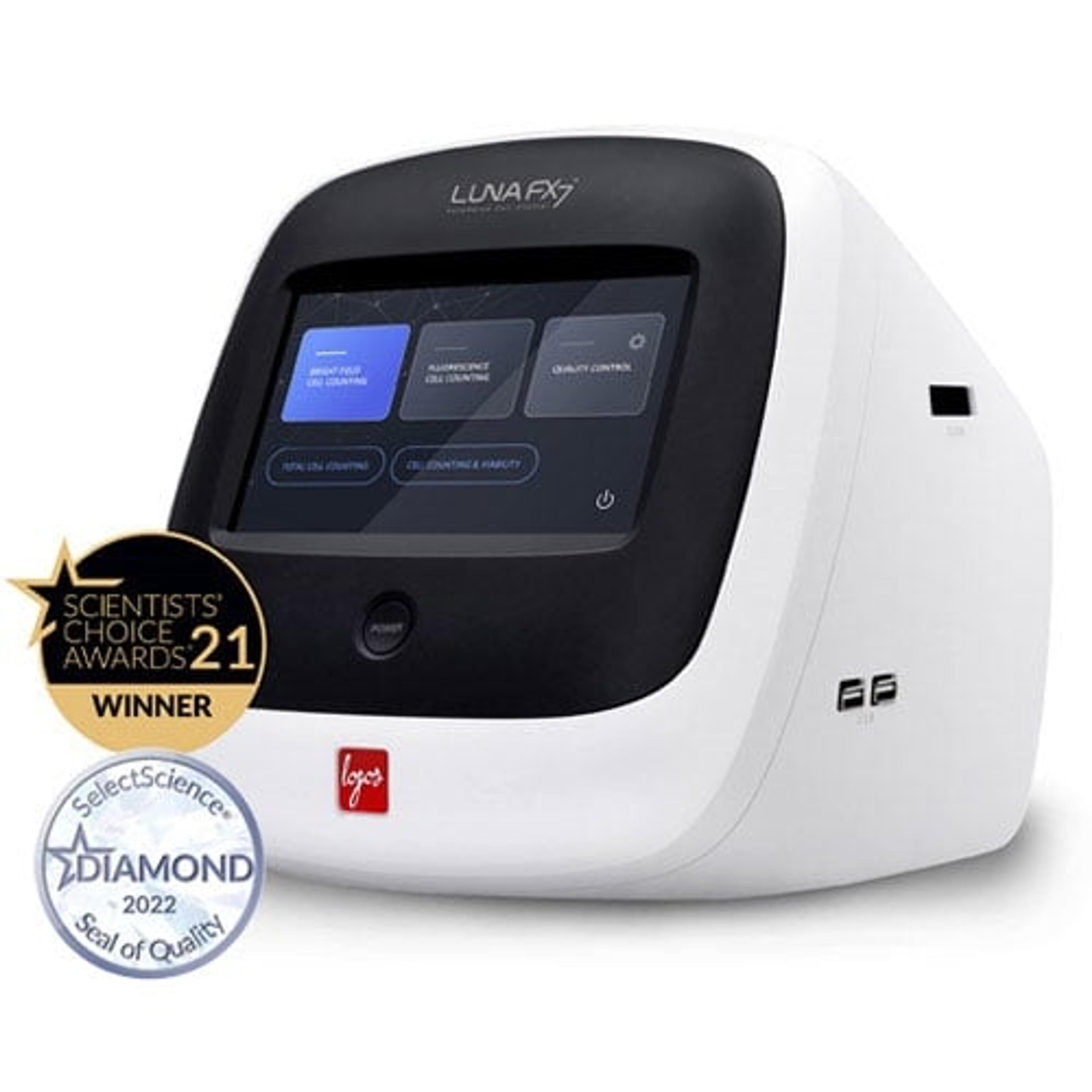
LUNA-FX7™ Automated Cell Counter

Logos Biosystems

The LUNA-FX7™ is our most powerful cell counter to date, with unmatched cell counting accuracy, new 1, 3 and 8-chamber slide options, state of the art optics, dual fluorescent and brightfield detection, and precision autofocus. The LUNA-FX7™’s new features such as the Bioprocess mode, Quality Control mode, and the CountWire™ (21 CFR Part 11 compliant) software will help companies and facilities meet and surpass quality and regulatory requirements.

(64)

Links

Tags

Cell / Tissue CultureCell culture or tissue culture is used to study the biology of cells or tissues and to isolate cellular products in an environment which can be manipulated and well defined. Accurately control your culture environment with bioreactors or culture incubators, bind your cells to a surface or together with an extracellular matrix. Distinguish cell types with differential media or proliferate cells with certain characteristics using selective media. Enrich your media with supplements such as growth factors, sera and vitamins. Find the best cell and tissue culture products, kits and equipment in our peer-reviewed product directory: compare products, check customer reviews and receive pricing direct from manufacturers.Cell Lines Stem Cells and Primary CellsPrimary cell cultures, established cell lines and stem cells are vital for <i>in vitro</i> and <i>ex vivo</i> experimentation. High-quality cells, optimized for your applications, alongside optimized cell substrates, growth medium and supplements, are critical for experimental success. Explore a range of cells suitable for your applications, including isogenic cell lines, competent cells, induced pluripotent stem cell (iPSC)-derived cell lines, fungal/bacterial/mammalian cell lines, stem cells and cancer cell lines. Find the best cells for your research in our peer-reviewed product directory: compare products, check customer reviews and receive pricing direct from manufacturers.Flow Cytometry / Cell CountingFlow cytometers are used to count, sort and examine multiple characteristics of cells. Other cell analysis equipment includes image cytometers, cell counters, fluorescence-activated cell sorters (FACS), magnetic-activated cell sorters (MACS), and a range of flow cytometry assay kits. Flow cytometers can reveal information on cell viability, cell proliferation, apoptosis and cell cycle progression, as well as identify cell populations and intracellular or cell-surface molecules. Additionally, some flow cytometers, known as FACS, have an additional sorting function after analysis. Cell counters and image cytometers count live and dead cell populations and can also conduct cell proliferation assays. Find the best flow cytometers, cell counters and cell sorters in our peer-reviewed product directory: compare products, check customer reviews and receive pricing direct from manufacturers.AutomationAutomation in laboratories and manufacturing processes enhances efficiency, precision, and scalability by reducing the need for manual intervention. It plays a critical role in improving productivity, minimizing human error, and accelerating workflows in fields like diagnostics, drug development, and industrial testing. Automation technologies include robotic systems, automated liquid handlers, and process control systems that streamline complex tasks and ensure consistent, reproducible results. Explore our peer-reviewed product directory to discover the best automation solutions, compare options, read user reviews, and get prices directly from manufacturers.Cell ImagingCell imaging can be achieved using a number of techniques including confocal microscopy, transmission electron microscopy, atomic force microscopy, and light sheet microscopy.Cell BiologyCell biology studies the structure, function, and behavior of cells. Understanding cellular processes is essential for research in areas such as cancer biology, stem cell research, and neurobiology. Techniques like flow cytometry, microscopy, and cell culture enable researchers to explore cellular mechanisms in detail. Browse our peer-reviewed product directory to find the best cell biology tools and equipment, compare products, check customer reviews, and get pricing directly from manufacturers.Cell CultureCell culture involves growing cells under controlled conditions, typically outside of their natural environment, to study cellular behavior, drug response, and disease models. Cell culture is crucial in biotechnology and biomedical research. Explore cell culture products in our peer-reviewed product directory; compare products, check reviews, and get pricing directly from manufacturers.