Turbidometric Performance of Thermo Scientific Multiskan FC and Multiskan GO

19 Jul 2015

Turbidometry is a special type of photometric measurement, which can be applied in a variety of research areas, for example, water and beverage quality control and microbial growth. This note describes the verification of the turbidometric performance of Thermo Scientific Multiskan FC microplate spectrophotometer and Multiskan GO photometer with a standard formazine solution.

Thermo Scientific Multiskan GO

Thermo Fisher Scientific

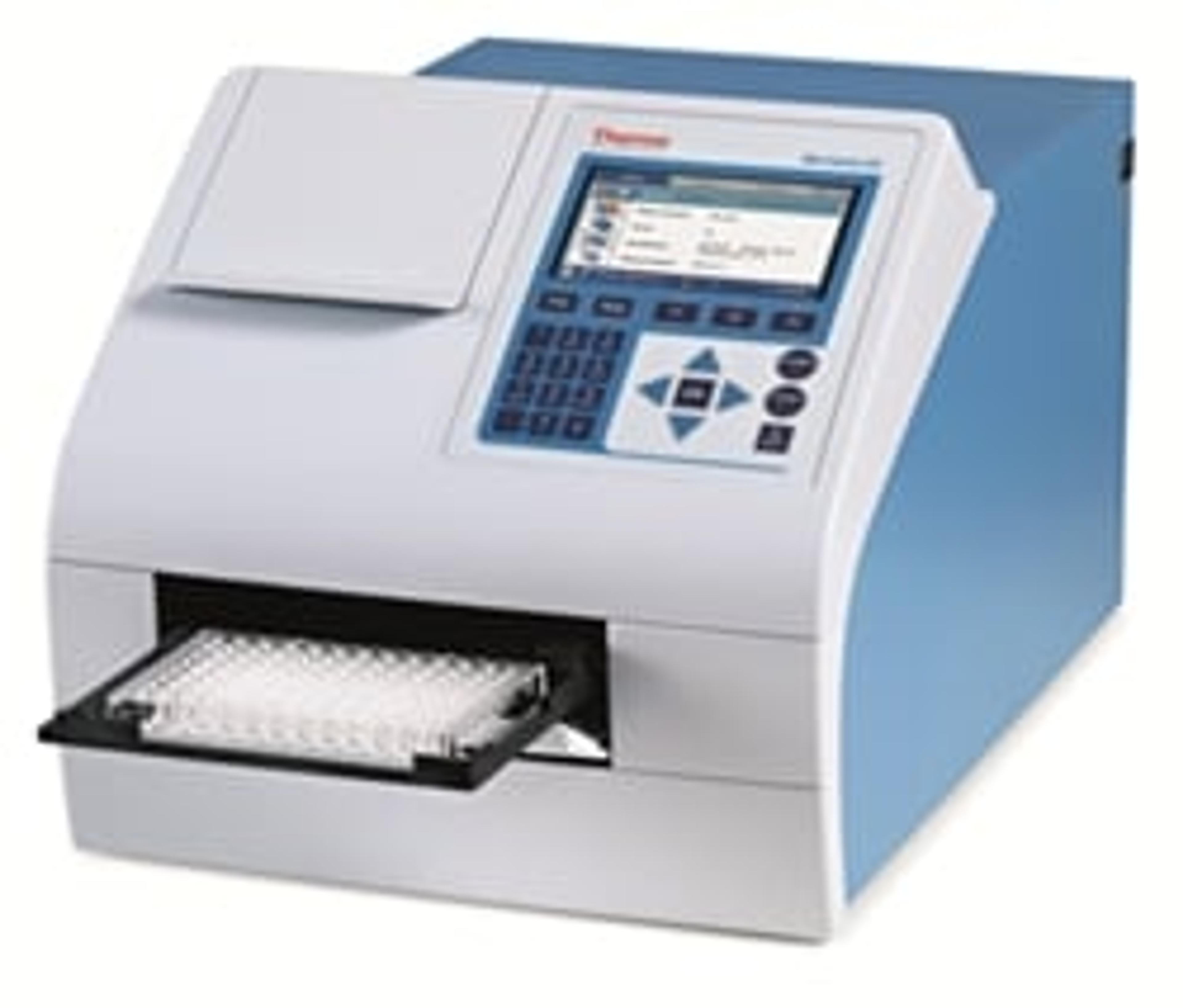
The Thermo Scientific Multiskan GO UV/Vis microplate spectrophotometer offers free wavelength selection for both 96- and 384-well plates and various types of cuvettes. It features a broad wavelength range with UV area and pathlength correction, as well as fast spectral scanning; making it ideal for virtually any photometric research application, including DNA, RNA and protein analysis. The Multiskan GO can be controlled as a stand-alone with straight-forward internal software for quick and simple measurements. And even the most demanding applications can easily be set up using the intuitive Thermo Scientific SkanIt software for PC control. Both the internal and PC software are available in multiple languages including English, French, German, Spanish, Portuguese, Russian, Chinese and Japanese.Key Features: Performs endpoint, kinetic and spectral scanning assays for 96- and 384-well plates, and cuvettes Compatible with Thermo ScientificTM μDropTM Plate – a quick and easy tool for DNA and RNA assays using sample volumes down to 2 μL Fast plate measurements - full spectrum of a sample in less than 10 seconds High quality data guaranteed by extensive self-diagnostics Automation compatible Application Areas: DNA and RNA quantification and purity Protein assays Immunoassays (ELISA) Cell proliferation and cytotoxicity assays Enzyme assays Reporter gene assays

(15)

Tags

Microplate Readers / DetectorsMicroplate readers are used to automate the detection and analysis of labeled or label-free components in microplates during assays or live-cell monitoring. Microplate readers are generally distinguished by their mode of detection. Types include absorbance, luminescence, fluorescence intensity, fluorescence polarization, TRF / FRET and multimode microplate readers. Microplate readers deliver a high throughput of samples by reading multiple wells simultaneously, with the 96-well format the most commonly used. As a result, microplate readers are often used in the drug discovery, bioassays, research and pharmaceutical industries for screening applications. Microplate loading can also be automated, with robotic microplate stackers to increase throughput. Find the best microplate readers in our peer-reviewed product directory: compare products, check customer reviews and receive pricing direct from manufacturers.Software PlatformsSoftware platforms are useful for various stages of laboratory experiments from data collection to data storage and processing. For instance lab software is available for system control, data management, data analysis and qualification / validation.Automated Liquid HandlingAutomated liquid handling equipment is used to mix, dilute and dispense allotted volumes of liquid into microplates and other vessels automatically. The robotic, liquid handling arms can dispense from single channel to 3456 multichannel as well as operate nanoliter dispensing, enabling high throughput of samples. Find the best automated liquid handlers in our peer-reviewed product directory: compare products, check customer reviews and receive pricing direct from manufacturers.Protein BiologyThe analysis of protein expression, identity and function is vital for many areas of life science research and drug discovery. Some of the most commonly used techniques in protein analysis include Western blotting, electrophoresis and mass spectrometry.DNADeoxyribonucleic Acid (DNA) is the main component of chromosomes and the carrier of genetic information of living organisms. Find out here about PCR, NGS, ChIP-Seq, gel imaging, and many other techniques which can be used for the analysis of DNA.Liquid Handling WorkstationLiquid handling workstations automate the process of sample preparation, improving accuracy and efficiency. These systems are essential for high-throughput applications in biological, chemical, and pharmaceutical research, reducing human error and increasing reproducibility. Workstations come equipped with robotic arms, pipetting tools, and other accessories to streamline lab workflows. Explore liquid handling workstations in our peer-reviewed product directory; compare products, check reviews, and get pricing directly from manufacturers.RNARNA is a nucleic acid that plays a key role in gene expression and protein synthesis. It serves as a messenger between DNA and ribosomes, carrying genetic instructions to produce proteins. Advances in RNA-based therapies, such as mRNA vaccines and gene editing, have revolutionized treatment strategies for genetic disorders and infectious diseases. Explore RNA research tools and therapies in our peer-reviewed product directory; compare products, check customer reviews, and get pricing directly from manufacturers.Assay DevelopmentThe process of proving an assay to be sensitive with respect to the target is known as assay development. The assay should be able to characterize novel compounds and measure the potency of these compounds against a validated biological target.
Turbidometric Performance of Thermo Scientific Multiskan FC and Multiskan GO