
The BioFLECT/CTTM system: A “non-isotopic preclinical SPECT and PET system”
9 Jun 2013Bioscan’s BioFLECT™ (Fluorescence Emission Computed Tomography)
system is the first commercialized real 3D optical imaging system on the
market that offers the ability to non-invasively image and quantify
temporal changes in fluorescence throughout the body of murine
models. Unlike 2D optical imaging systems, the detectors on the
BioFLECT™ are placed on a ring that surrounds the animal in a 360-
degree configuration. This methodology allows for much higher sampling
of both excitation and emission photons for each position of the
excitation laser. This technology is necessary to improve the sensitivity
and the resolution required for accurate quantitation of deep foci within
the subject.
Related products
Request Quote for All Products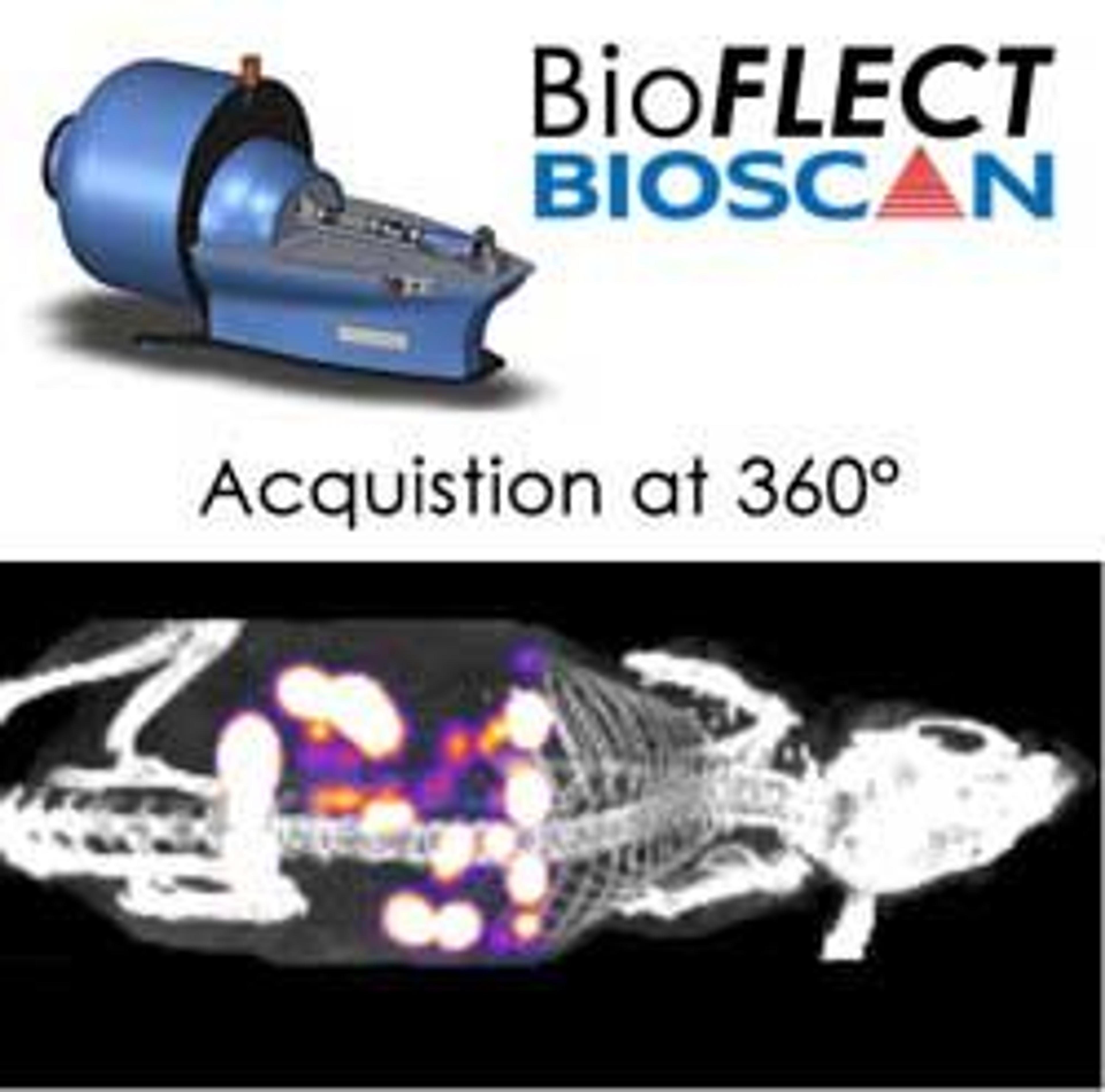
Bioscan BioFLECT™ 400
Bioscan Inc.The new Bioscan BioFLECT 400 is the first in vivo optical imaging system offering true 360° fluorescence tomography. BioFLECT uses the photon emission data acquired from 360° and a state-of-the-art 3D reconstruction engine to quantitatively reconstruct the 3D spatial distribution of fluorescent probes in live animals. This approach yields superior, consistent resolution, sensitivity and quantitation throughout the subject. The impact for researchers is breakthrough optical imaging performance that can yield truly differentiated research results. BioFLECT 400 comes equipped with 4 standard laser and emission filter combinations. Researchers can select up to 8 additional lasers (for a maximum of 12), and up to 12 additional emission filters (for a maximum of 16), to image their preferred probes. Whether you image below 500 nm, above 700 nm, or somewhere in between, BioFLECT 400 can achieve your research objectives. BioFLECT 400 also supports emerging probes in the near-infrared spectrum with available lasers well into the 800 nm range for improved attenuation characteristics and even a 980 nm laser for use with up-converting fluorophores. Available filters can enable detection of emissions approaching 900 nm.

BioFLECT™ In Vivo Preclinical Imager
Bioscan Inc.BioFLECT™ In Vivo Preclinical Imager - The Only True 360° Tomographic Optical Imager With the launch of the BioFLECT, Bioscan will enable researchers to realize the full potential of in vivo optical imaging for the first time. With BioFLECT’s true 360° tomographic system, researchers will no longer have to choose between imaging only near the surface of the subject or partial tomography solutions that distort the subject or create artifacts.BioFLECT™ In Vivo Preclinical Imager Key Features: Provides uniform sensitivity and resolution throughout the subject Enable researchers to examine deep tissue phenomena such as spontaneous metastases without sacrificing image quality or quantitative accuracy Fully integrated, one-pass X-Ray CT (upgrade option) provides anatomical correlation data that significantly improves the segmentation and resolution of the optical image BioFLECT™ In Vivo Preclinical Imager Benefits: Uniform resolution and sensitivity throughout the subject Fewer assumptions/artifacts in reconstruction Accurate measures of fluorophore concentrations throughout the entire animal No distortion of body shape—true anatomical displacement of animal 3D localization of fluorophore within animal True tomography - quantitatively detect photons from 360° Recon uses accurate model of light propagation in tissue Automated multispectral imaging Strongest excitation & detection in the near-infrared spectrum Deep tissue penetration Data analysis with Bioscan’s InVivoScope imaging processing software Wide variety of laser and filter options across multiple wavelengths Easy change of lasers and filters Upgrade to integrated/one-pass X-Ray CT Minerve-compatible animal bed for sequential imaging CT data-enhanced segmentation