
ResourceMaterials
Superior sample preparation for elemental analysis of Li-ion battery materials
26 May 2022In this application note, the ultraWAVE with Single Reaction Chamber (SRC) technology was used to completely mineralize components present in Li-ion batteries in a single run, including materials such as ores and graphite.
Related products
Request Quote for All Products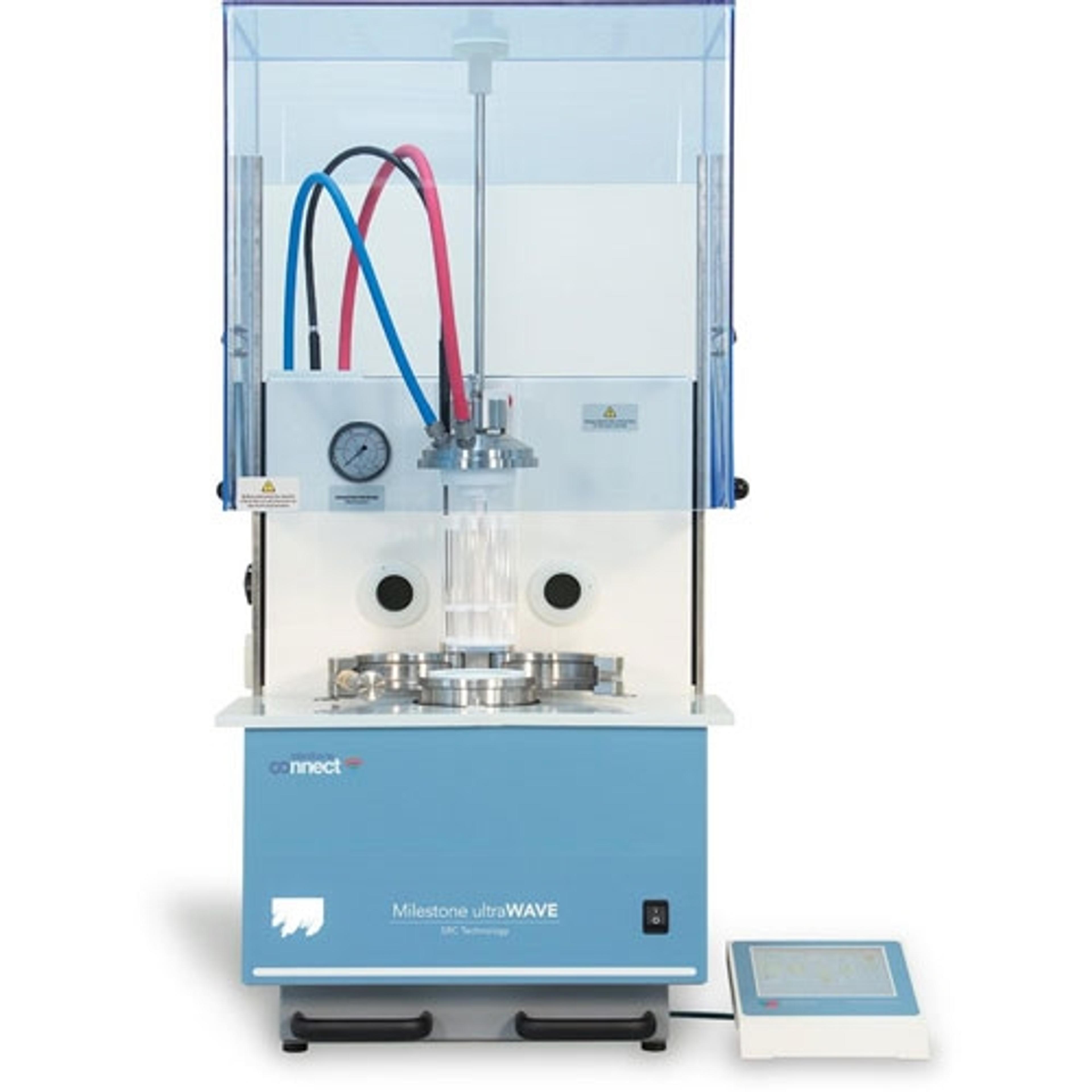
ultraWAVE SRC (Single Reaction Chamber) Microwave Digestion System
MilestoneultraWAVE has already revolutionized and enhanced the way analytical chemists think to sample preparation for trace metal analysis in hundreds of laboratories all over the world. ultraWAVE is based on the SRC (Single Reaction Chamber technology), invented by Milestone several years ago ( EP0728038B1 ). SRC technology achieves extraordinary performance capabilities combining microwave heating with a high-pressure reactor which acts simultaneously as microwave cavity and vessel.
Links
Tags
Atomic Absorption / Emission SpectroscopyAtomic absorption spectroscopy (AAS) and atomic emission spectroscopy (AES) — also called optical emission spectroscopy (OES) — are used to detect the elemental constituents in samples. Both techniques involve the atomization of a sample. Atomic absorption spectrometers may use a flame or furnace to create an atomic vapor of the sample before irradiation with spectral light. Optical emission spectrometers may use a flame, inductively coupled plasma (ICP), microwave plasma (MP) or spark arcs to atomize and excite the sample. At higher excitation energies, electrons can be emitted instead of photons, which can be useful for samples that can’t be atomized and for surface analysis. Explore electron spectroscopy equipment such as Auger spectrometers and photoelectron spectrometers for surface elemental analysis of samples. Find the best atomic absorption, photoelectron and optical emission spectrometers in our peer-reviewed product directory: compare products, check customer reviews and receive pricing direct from manufacturers.X-Ray Diffraction and SpectroscopyX-Ray diffraction & spectroscopy are used in material characterization to discern the structure and elemental composition of a sample. X-Ray diffractometers (XRD) are superior instruments in elucidating the dimensional atomic structure of crystalline materials, including powders, thin films and single crystals. For large unit cells or ordered macromolecules, consider small-angle X-ray scattering (SAXS). X-ray spectroscopic techniques include X-ray fluorescence (XRF) and X-ray photoelectron spectroscopy (XPS), both providing simple and accurate methods for determining the elemental composition of a material. Energy dispersive (EDXRF) and wavelength dispersive (WDXRF) XRF spectrometers are available, as well as handheld/portable devices. High-resolution, 3D microstructure characterization of materials can be achieved with X-ray microscopes combining sub-micron resolution imaging with 3D computed tomography. Find the best XRD and XRF spectrometers in our peer-reviewed product directory: compare products, check customer reviews and receive pricing direct from manufacturers.Sample PreparationSample preparation can improve the quality and speed of separation techniques. Products to assist sample preparation include filtration equipment, evaporators, membranes and sieves.Batteries