ResourceSeparations

Simple and Reliable Quantitation of ppt-level PAHs in Air by TD–GC–MS

19 Feb 2016

This application note from Markes International showcases their new sorbent tube which can be used to analyze harmful air pollutants such as polycyclic aromatic hydrocarbons. The optimized method explained in this note has increased extraction efficiency, absence of a dilution stage and more efficient transfer of compounds leading to overall increased sensitivity.

ACTI-VOC

Markes International Ltd

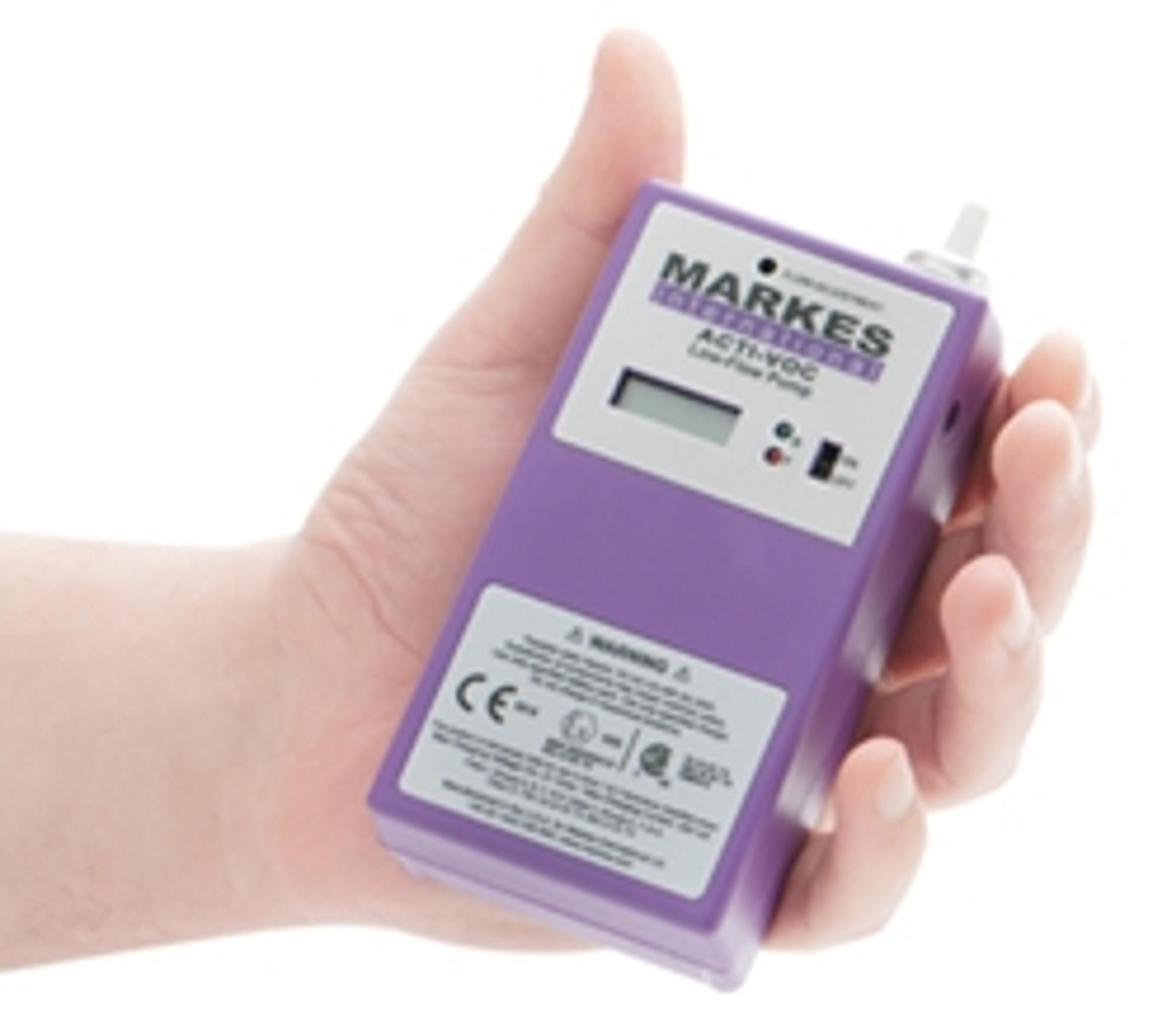
ACTI-VOC™ is a robust low-flow pump for sampling vapour-phase organic compounds (VOCs) onto sorbent tubes for subsequent analysis by thermal desorption (TD). Being lightweight, easy-to-use and intrinsically safe, ACTI-VOC is ideal for personal monitoring and a wide range of other air and gas sampling applications. Optimised for thermal desorption tubes Unlike other personal monitoring pumps on the market, ACTI-VOC is optimised for sampling onto thermal desorption tubes, and automatically compensates for different impedances, ensuring constant flow rates whatever the sorbent packing. Product highlights • Optimised for sampling onto thermal desorption tubes • Compatible with any thermal desorption tube (up to a max. flow of 350 mL/min) • Constant-flow sampling from 20–200 mL/min • Constant-pressure sampling from 1–350 mL/min • Simple screw-operated flow adjustment makes ACTI-VOC easy to calibrate • Intrinsically safe (ATEX-approved) • Long battery life ensures stable performance for over 8 hours • Pocket-sized, lightweight and easy to use • Supplied in a convenient carry-case with charger and accessories

(0)

Links

Tags

AutosamplersAutosamplers are automated sample loaders used with a number of separation and analytical techniques. HPLC autosamplers use automated partial or full-loop injection systems and place samples in vials or microplates for analysis. Autosamplers can also be used for elemental analysis. Features to consider include repeatability, syringe capacity, footprint and temperature controls.  Sample PreparationSample preparation can improve the quality and speed of separation techniques. Products to assist sample preparation include filtration equipment, evaporators, membranes and sieves.FiltrationFiltration and microfiltration are used to separate solids, particulates or large molecules from fluids (liquid or gases) in order to purify the filtrate. Explore a range of filter formats, including filter paper, plates and membranes for your separation needs. While larger particulates may be separated by gravity filtration, smaller particulates may require additional force for timely separation. Microfiltration equipment includes vacuum filters, as well as positive pressure, crossflow and centrifugal filtration devices. Find the best filtration products in our peer-reviewed product directory: compare products, check customer reviews and receive pricing direct from manufacturers.Gas Generators and AnalyzersGas generators are used for supplying or monitoring a regular flow of a high purity gas such as nitrogen, hydrogen or zero air for applications such as gas chromatography. Gas analyzers can be used in supply chain processes and laboratory experiments with portable analyzers for monitoring CO<sub>2</sub> and O<sub>2</sub> levels as well as trace gases. Regular flow can be produced with gas control modules and flow meters. Find the best gas generators and analyzers in our peer-reviewed product directory: compare products, check customer reviews and receive pricing direct from manufacturers.Environmental Monitoring and TestingEnvironmental monitoring and testing uses handheld portable analyzers, kits, spectrometers or chromatography systems for air, water, soil, food and other sample testing. Useful features of analyzers such as BOD and COD include portability, easy calibration, automation and sensitivity.  Environmental test kits for pH, water, moisture, etc, should be accurate, sensitive, reliable, fast and easy to use.Particle CharacterizationParticle characterization instruments are used to determine particle size distribution, shape, surface area, zeta potential, density and porosity of particles and materials. Multiple tecchniques are available for determining particle size, shape and count including dynamic light scattering (DLS), laser diffraction, electrozone (Coulter technique), imaging particle analysis and single particle optical sensing. Determine the density of your material with a gas pycnometer or examine its surface area and porosity with gas adsorption analyzers and mercury porosimeters. Find the best particle characterization instruments in our peer-reviewed product directory: compare products, check customer reviews and receive pricing direct from manufacturers.GC-MS GC-MS (gas chromatography-mass spectrometry) instruments and equipment are used to separate, quantify and identify mixtures of small and volatile compounds, such as polycyclic aromatics, fatty acids and alcohols. Often used in drug detection, forensic investigation and environmental analysis for pesticides and contaminants, GC-MS is a powerful addition to your lab’s analytical capabilities. GC-MS/MS instruments equipped with a qTOF or triple quadrupole analyzers can give greater sensitivity and resolution to your analysis. Find the best GC-MS instruments and equipment in our peer-reviewed product directory: compare products, check customer reviews and receive pricing direct from manufacturers.Gas AnalysisGas analysis is used to measure the composition of gases in various environments, such as industrial processes, air quality monitoring, and environmental studies. Techniques like gas chromatography and mass spectrometry are commonly used. Explore gas analysis tools in our peer-reviewed product directory; compare products, check reviews, and get pricing directly from manufacturers.PAHsHydrocarbonThermal DesorptionThermal desorption is a technique used to release volatile compounds from solid samples by heating them. It is often used in environmental testing and analysis of complex materials. Explore thermal desorption systems in our peer-reviewed product directory; compare products, check reviews, and get pricing directly from manufacturers.Airborne PollutantsAirborne pollutants are particulates, biological molecules or other harmful materials that exist in the atmosphere. These pollutants are known to cause harm to health and the environment. Examples include persistent organic pollutants (POPs), carbon monoxide, sulfur oxides, and nitrogen oxides.Air Quality