Rapid Determination of Nitrobenzenes in Drinking Water Using Automated SPE with GC-ECD

30 Nov 2016

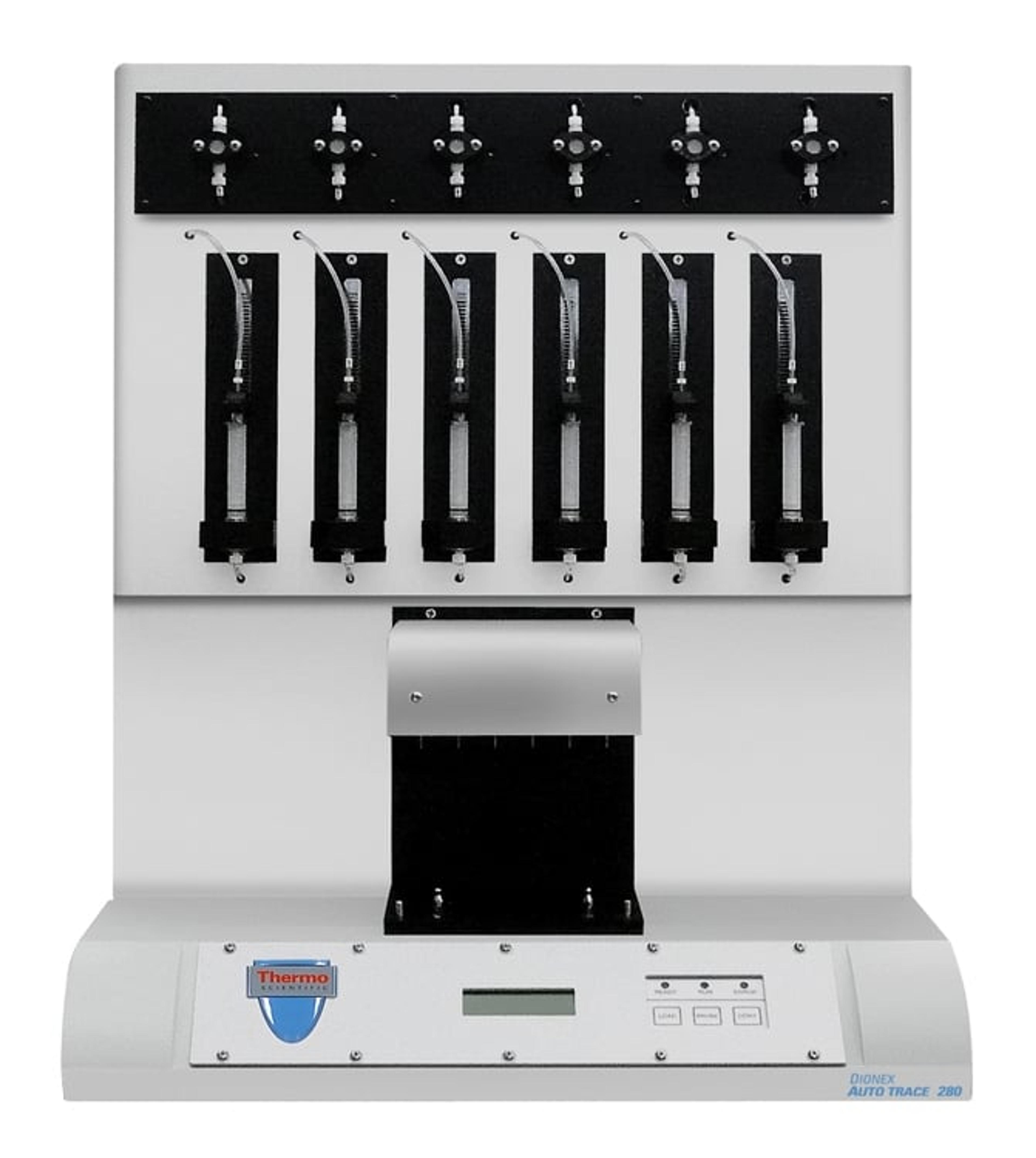
This application note demonstrates the use of automated SPE with GC-ECD for the determination of 15 nitrobenzene compounds in finished drinking water. The automated Thermo Scientific™ Dionex™ AutoTrace 280 Solid Phase-Extraction instrument was used in conjunction with the Thermo Scientific™ TRACE™ 1310 gas chromatograph using an Instant Connect micro ECD. This work optimizes SPE and gas chromatography conditions and the results show high sensitivity (MDL of 0.02 ug/L) for the 15 nitrobenzene compounds specified in HJ 648-2013.

Thermo Scientific™ Dionex™ AutoTrace™ 280 Solid-Phase Extraction Instrument

Thermo Fisher Scientific

The Thermo Scientific™ Dionex™ AutoTrace™ 280 Solid-Phase Extraction (SPE) instrument is a powerful, high-throughput workstation dedicated specifically for automating SPE. The Dionex AutoTrace 280 instrument automates the cartridge or disk conditioning, sample loading, rinsing, and eluting steps for large volume aqueous solution extractions (20 mL to 20 L).The unit can process up to six samples in parallel, automatically conditioning, washing, and eluting SPE cartridges or disks with a choice of up to five reagents. The unit also segregates aqueous and solvent waste using separate waste lines for efficient, cost effective waste handling.AutoTrace 280 Solid-Phase Extraction Instrument Features: Use SPE technology for liquid-liquid extraction Automated sample loading of liquids onto SPE cartridges Automated eluting of SPE cartridges with organic solvent Closed systems with a fan to vent solvent vapors Positive pressure loading and elution of samples and solvents Benefits: Reduced solvent usage and elimination of glassware Does not require technician involvement to maintain a reservoir of liquid in the SPE cartridge Does not require technician involvement to control the flow of organics solvent through the SPE cartridge No hood required Provides constant flow of liquids through SPE cartridges

(0)

Tags

Gas ChromatographyGas chromatography (GC) is an analytical technique used to separate and quantitate mixtures of small and volatile compounds. Gas chromatographs or GC systems include components such as GC columns, detectors, pumps and autosamplers. Choose from packed or capillary GC columns, flame ionization (FID), photoionization (PID) electron capture detectors and selective or non-selective detectors. Find the best gas chromatographs in our peer-reviewed product directory: compare products, check customer reviews and receive pricing direct from manufacturers.Sample PreparationSample preparation can improve the quality and speed of separation techniques. Products to assist sample preparation include filtration equipment, evaporators, membranes and sieves.Environmental Monitoring and TestingEnvironmental monitoring and testing uses handheld portable analyzers, kits, spectrometers or chromatography systems for air, water, soil, food and other sample testing. Useful features of analyzers such as BOD and COD include portability, easy calibration, automation and sensitivity.  Environmental test kits for pH, water, moisture, etc, should be accurate, sensitive, reliable, fast and easy to use.GC-MS GC-MS (gas chromatography-mass spectrometry) instruments and equipment are used to separate, quantify and identify mixtures of small and volatile compounds, such as polycyclic aromatics, fatty acids and alcohols. Often used in drug detection, forensic investigation and environmental analysis for pesticides and contaminants, GC-MS is a powerful addition to your lab’s analytical capabilities. GC-MS/MS instruments equipped with a qTOF or triple quadrupole analyzers can give greater sensitivity and resolution to your analysis. Find the best GC-MS instruments and equipment in our peer-reviewed product directory: compare products, check customer reviews and receive pricing direct from manufacturers.Water PurificationThere are a number of water purification methods available to remove contamination from laboratory water. These systems include demineralization, reverse osmosis, filtration and ultrafiltration. A combination of methods is sometimes necessary to achieve purified water suitable for use in experiments.Chromatography Method DevelopmentChromatography method development is the process of designing and optimizing chromatographic techniques to separate and analyze complex mixtures. This includes selecting appropriate stationary and mobile phases, determining flow rates, and optimizing detection methods. Successful method development is essential for high-quality results in fields like pharmaceuticals, food safety, and environmental analysis. Explore chromatography method development tools in our peer-reviewed product directory; compare products, check reviews, and get pricing directly from manufacturers.ChromatographyChromatography is a powerful technique used to separate and analyze components of mixtures based on their chemical properties. It is widely used in fields like biochemistry, pharmaceuticals, and environmental analysis. By exploiting differences in the interaction of substances with a stationary phase and a mobile phase, chromatography enables precise purification and quantification of compounds. Whether you're working with complex biological samples or industrial chemicals, chromatography is essential for obtaining high-quality results. Browse our peer-reviewed product directory to find the best chromatography systems, compare products, read customer reviews, and get pricing directly from manufacturers.Water AnalysisAnalytical methods used to test the purity of drinking water include determining the level of contaminants abides to the level set by the Environmental Protection Agency (EPA).Drinking Water AnalysisAnalytical methods used to test the purity of drinking water include determining the level of contaminants abides to the level set by the Environmental Protection Agency (EPA).
Rapid Determination of Nitrobenzenes in Drinking Water Using Automated SPE with GC-ECD