ResourceMaterials

Quantitative Analysis of Soda-lime Glass with Supermini200

Quantitative Analysis of Soda-lime Glass with Supermini200

21 Dec 2015

Glass is very common material used in various situations with long historical roots. Soda-lime glass is considered to be the first human made glass, and is still being used in many forms such as light bulbs for lamps, LCD monitors and mirrors. Although the basic component of glass is SiO2, elements such as Na2O and CaO are added to change the characteristics of the glass depending on the intended use. Addition of different elements in certain quantities can change the physical and chemical properties such as melting point, moisture resistance and thermal expansion. Some trace elements can color glass. X-ray fluorescence (XRF) analysis quickly and easily offers precise elemental analysis results allowing control of glass composition in the production process. This application note describes the analysis of soda-lime glass using the Supermini200.

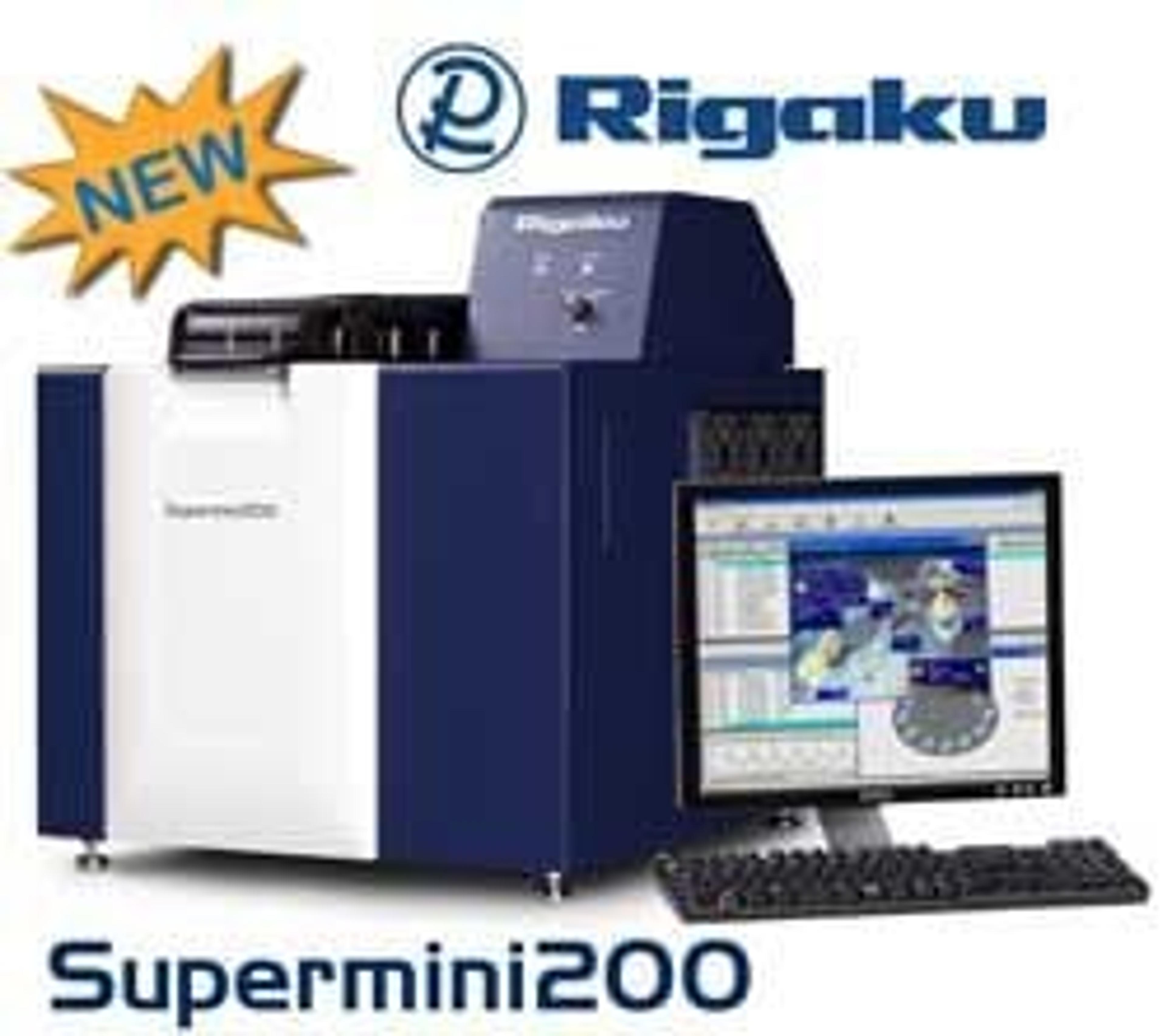
Supermini 200 Benchtop WDXRF Spectrometer

Rigaku Corporation

The new Supermini200 has improved software capabilities as well as a better footprint. As the world's only high-power benchtop sequential wavelength dispersive X-ray fluorescence (WDXRF) spectrometer for elemental analysis of oxygen (O) through uranium (U) of almost any material, the Rigaku Supermini200 uniquely delivers low cost-of-ownership (COA) with high resolution and lower limits-of-detection (LLD). Not only is the Rigaku Supermini200 an affordable choice for your XRF elemental analysis needs, the running costs are also low. P10 gas for the flow proportional detector is the only consumable. The Supermini200 does not require a source of cooling water, plumbing, or an external chiller, thereby decreasing system maintenance and lowering the overall lifetime cost of ownership of the system and yearly budgets for consumables and maintenance.Supermini is the only high powered (200 W) X-ray tube benchtop WDXRF system, providing excellent excitation resulting in lower detection limits and shorter measurement times. A unique and proprietary optical system is also employed to enhance sensitivity beyond the gains of the tube power.Supermini 200 Benchtop WDXRF Spectrometer Features: Analyze oxygen through uranium (O → U) Analyze: solids, liquids, powders, alloys and thin films Atmosphere: air, helium or vacuum X-ray tube: 50 kV, 200 W Pd-anode Primary beam filter: Zr is standard; Al optional Detectors: F-PC and scintillation Crystals: 3-position changer Autosampler: 12-position standard Vacuum: rotary pump standard Power: 100 – 120V (50/60 Hz) 15A or 200 – 240V (50/60 Hz) 10A

(0)

Links

Tags

Fluorescence SpectroscopyFluorometers and spectrofluorometers (also called fluorescence spectrometers) are used to measure the intensity and wavelength of fluorescent light emitted from a sample after excitation by illumination. Spectrofluorometers utilize monochromators to select the desired wavelengths, whereas filter fluorometers employ a set of filters. Spectrofluorometers for measuring steady-state fluorescence and lifetime fluorescence (or time-resolved fluorescence) are available, as well as fluorescence microscopes and microplate readers. Find the best fluorescence spectroscopy products in our peer-reviewed product directory: compare products, check customer reviews and receive pricing direct from manufacturers.X-Ray Diffraction and SpectroscopyX-Ray diffraction & spectroscopy are used in material characterization to discern the structure and elemental composition of a sample. X-Ray diffractometers (XRD) are superior instruments in elucidating the dimensional atomic structure of crystalline materials, including powders, thin films and single crystals. For large unit cells or ordered macromolecules, consider small-angle X-ray scattering (SAXS). X-ray spectroscopic techniques include X-ray fluorescence (XRF) and X-ray photoelectron spectroscopy (XPS), both providing simple and accurate methods for determining the elemental composition of a material. Energy dispersive (EDXRF) and wavelength dispersive (WDXRF) XRF spectrometers are available, as well as handheld/portable devices. High-resolution, 3D microstructure characterization of materials can be achieved with X-ray microscopes combining sub-micron resolution imaging with 3D computed tomography. Find the best XRD and XRF spectrometers in our peer-reviewed product directory: compare products, check customer reviews and receive pricing direct from manufacturers.Thermal Analysis EquipmentThermal analysis equipment is used for measuring heat flow, weight loss, dimension changes or thermomechanical properties and is important for analyzing a material’s performance and stability. Thermal analysis equipment includes differential scanning calorimeters (DSC), thermogravimetric analyzers (TGA), thermomechanical analyzers (TMA), dilatometers, thermometers, vapor sorption analyzers, boiling and melting point apparatus. Thermal analyzers can reveal properties such as melting, crystallization and glass transitions or other processes such as oxidation, decomposition, volatilization, as well as coefficients of thermal expansion and modulus. Find the best thermal analysis equipment in our peer-reviewed product directory: compare products, check customer reviews and receive pricing direct from manufacturers.Mechanical TestingMechanical testing explores the elastic and inelastic nature of a material when force is applied. A mechanical test shows whether a material is suitable for its intended application by measuring hardness, tensile strength, elongation, elasticity, and fatigue limit.Non-Destructive TechniquesNon-destructive techniques (NDT) describes a variety of analytical techniques used to evaluate the properties of a material. Common methods include ultrasonic, magnetic-particle, liquid penetrant, radiographic, remote visual inspection (RVI), and eddy-current testing. NDT is regularly used in forensic engineering, civil engineering, mechanical engineering, electrical engineering, systems engineering, aeronautical engineering, and medicine.Thermal ProcessesX-Ray FluorescenceX-ray fluorescence (XRF) is an analytical technique used to determine the elemental composition of materials. It is widely used in geology, materials science, and environmental testing for detecting heavy metals and other elements. Browse our peer-reviewed product directory to find the best XRF systems, compare products, check reviews, and get pricing directly from manufacturers.Trace Level ImpuritiesTrace level impurities refer to low concentrations of unwanted substances found in chemicals, pharmaceuticals, and other products. Detecting and removing these impurities is crucial for product safety and regulatory compliance. Explore trace impurity analysis tools in our peer-reviewed product directory; compare products, check reviews, and get pricing directly from manufacturers.GlassGlass is an amorphous solid (non-crystalline) typically made up of silica and silicon dioxide. This transparent solid has many applications, from window panes to optical lenses for microscopes.Moisture Analysis
Quantitative Analysis of Soda-lime Glass with Supermini200