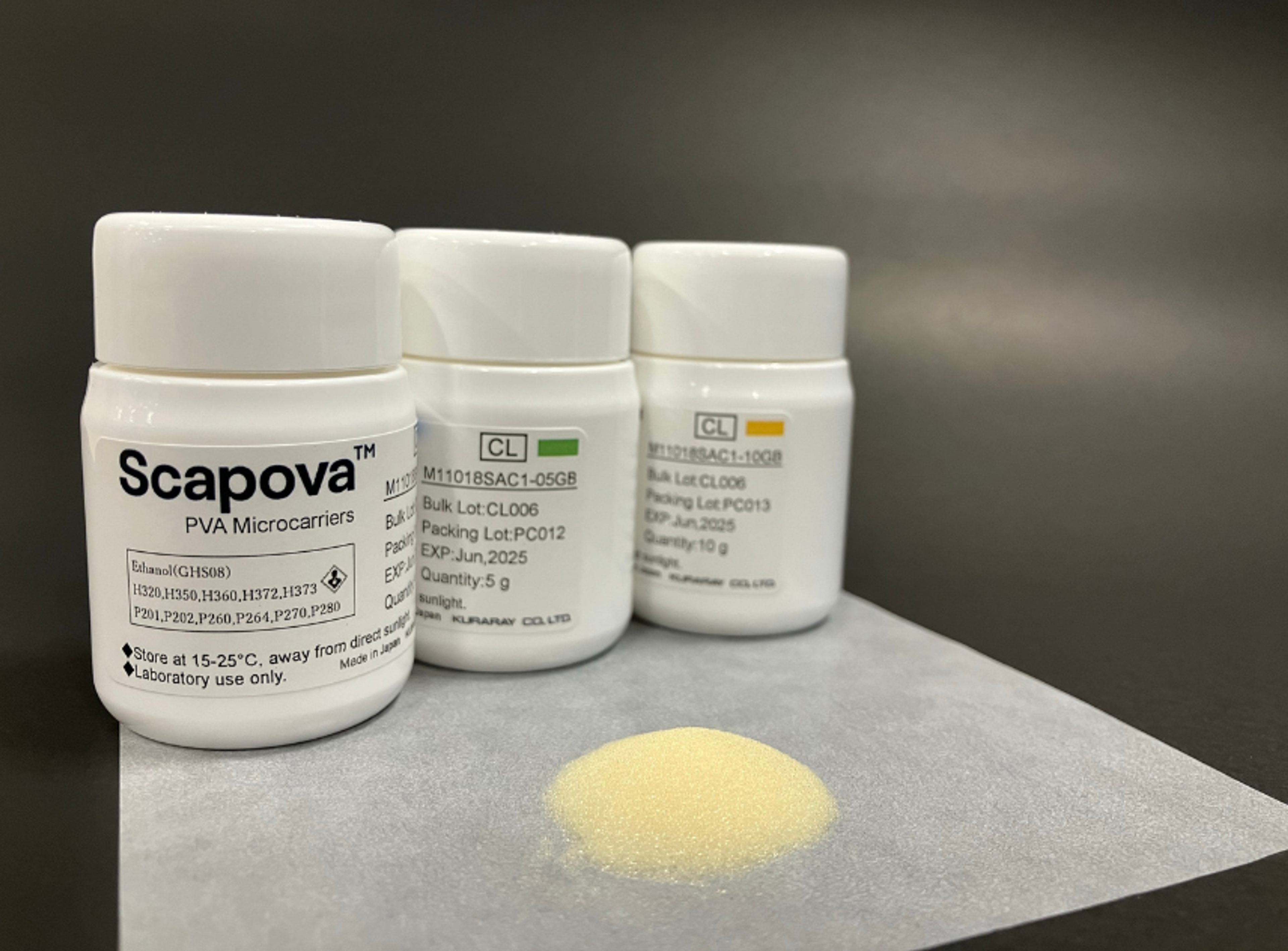
PVA microcarriers for Vero cell expansion

18 Apr 2024

Microcarrier cultures have a strong history in large-scale production of anchorage-dependent mammalian cells, notably in the vaccine industry. Kuraray addresses the growing demand for increased cell yields by introducing PVA microcarriers, a novel hydrogel-based microcarrier specifically designed for cell cultivation. PVA hydrogel, known for its biocompatibility, provides an optimal microenvironment for cell growth. These microcarriers enhance surface area-to-volume ratio, fostering cell growth. The report focuses on expanding Vero cells on Kuraray's PVA microcarriers. Vero cells, crucial for producing viral vaccines, are well-suited for microcarrier-based cultivation due to their anchorage-dependent nature and high quantities required for vaccine manufacturing.

Scapova™ CL PVA Microcarriers 10g

Kuraray Life Innovation Promotion Group

SCAPOVA™ is the brand name of PVA microcarriers that is manufactured by Kuraray. SCAPOVA™ CL has a collagen coated surface. SCAPOVA™ CL has higher cell proliferation than competitors. And due to the robustness of PVA, SCAPOVA™ CL is less likely to break, and there is little contamination during cell collection. All microcarriers are gamma irradiated.

(0)

Scapova™ CL PVA Microcarriers 5g

Kuraray Life Innovation Promotion Group

SCAPOVA™ is the brand name of PVA microcarriers that is manufactured by Kuraray. SCAPOVA™ CL has a collagen coated surface. SCAPOVA™ CL has higher cell proliferation than competitors. And due to the robustness of PVA, SCAPOVA™ CL is less likely to break, and there is little contamination during cell collection. All microcarriers are gamma irradiated.

(0)

Scapova™ CL PVA Microcarriers 1g

Kuraray Life Innovation Promotion Group

SCAPOVA™ is the brand name of PVA microcarriers that is manufactured by Kuraray. SCAPOVA™ CL has a collagen coated surface. SCAPOVA™ CL has higher cell proliferation than competitors. And due to the robustness of PVA, SCAPOVA™ CL is less likely to break, and there is little contamination during cell collection. All microcarriers are gamma irradiated.

(0)

Links

Tags

AntibodiesAntibodies are used in techniques such as confocal and fluorescence microscopy, flow cytometry, ELISA, ELISPOT, immunohistochemistry, western blotting and immunopreciptation. Select specific antigen reactivity, high specific affinity, low non-specific binding, monoclonal or polyclonal, primary or secondary antibodies and associated conjugates such as an enzyme or dye for visualization.Cell / Tissue CultureCell culture or tissue culture is used to study the biology of cells or tissues and to isolate cellular products in an environment which can be manipulated and well defined. Accurately control your culture environment with bioreactors or culture incubators, bind your cells to a surface or together with an extracellular matrix. Distinguish cell types with differential media or proliferate cells with certain characteristics using selective media. Enrich your media with supplements such as growth factors, sera and vitamins. Find the best cell and tissue culture products, kits and equipment in our peer-reviewed product directory: compare products, check customer reviews and receive pricing direct from manufacturers.Cell Lines Stem Cells and Primary CellsPrimary cell cultures, established cell lines and stem cells are vital for <i>in vitro</i> and <i>ex vivo</i> experimentation. High-quality cells, optimized for your applications, alongside optimized cell substrates, growth medium and supplements, are critical for experimental success. Explore a range of cells suitable for your applications, including isogenic cell lines, competent cells, induced pluripotent stem cell (iPSC)-derived cell lines, fungal/bacterial/mammalian cell lines, stem cells and cancer cell lines. Find the best cells for your research in our peer-reviewed product directory: compare products, check customer reviews and receive pricing direct from manufacturers.Vaccine DevelopmentVaccine development focuses on creating immunizations to protect against infectious diseases. The process involves identifying antigens, developing and testing vaccine efficacy, and ensuring safety through preclinical testing and multiple clinical trial phases. Scientists use various approaches, including weakened or inactivated viruses, protein subunits, or mRNA. Advanced platforms and rapid diagnostic tools aid in vaccine research and testing. Explore vaccine development solutions in our peer-reviewed product directory; compare products, read reviews, and get pricing directly from manufacturers.