
Multiplex Pluripotency Analysis of STEMCCA™ Vector-Reprogrammed iPS Cells using MILLIPLEX® MAP Magnetic Bead Assays
7 May 2013For the application of induced pluripotent stem cells (iPSC) and human embryonic stem cells (hESC) in research, it is crucial to characterize the identity and potency status of the pluripotent stem cells by measuring molecular markers during cultivation. This application note describes how MILLIPLEX® MAP multiplexed bead-based immunoassays, which use Luminex® xMAP® technology to provide a complementary assay to flow cytometry, can be used for quickly assessing the potency status of a cell population.
Related products
Request Quote for All Products
MILLIPLEX MAP Human Stem Cell Pluripotency Magnetic Bead Panel 1 - Stem Cell Multiplex Assay
MerckProduct Overview: The MILLIPLEX® Human Stem Cell Pluripotency Magnetic Bead Panel 1 (Cat. No. 48-617MAG) is a premixed panel to be used for the simultaneous quantification of the following 4 analytes in cell lysates: c-Myc, Nanog, Oct 3/4, and Sox2. The detection assay is a rapid, convenient alternative to Western Blotting and immunoprecipitation procedures. Each kit has sufficient reagents for one 96-well plate assay. Background Information: The expression of the transcription factors Oct 3/4, Sox2 and Nanog play a critical role in the maintenance of pluripotency and self renewal in stem cells. c-Myc, a member of the helix-loop-helix-leucine zipper family, is a transcription factor that regulates the expression of multiple genes involved in apoptosis, cell differentiation and cell proliferation. In stem cells it seems to control the balance between stem cell self-renewal and differentiation. Thus the presence of the four proteins Oct-3/4, Sox2, Nanog and c-Myc are indicators for the pluripotency of iPS cells and human embryonic stem cells. Applications: This MILLIPLEX® MAP Human Stem Cell Pluripotency Magnetic Bead Panel 1 is a Stem Cell Characterization multiplex assay. The analytes available for this multiplex kit are: c-Myc, Nanog, Oct 3/4, Sox2.
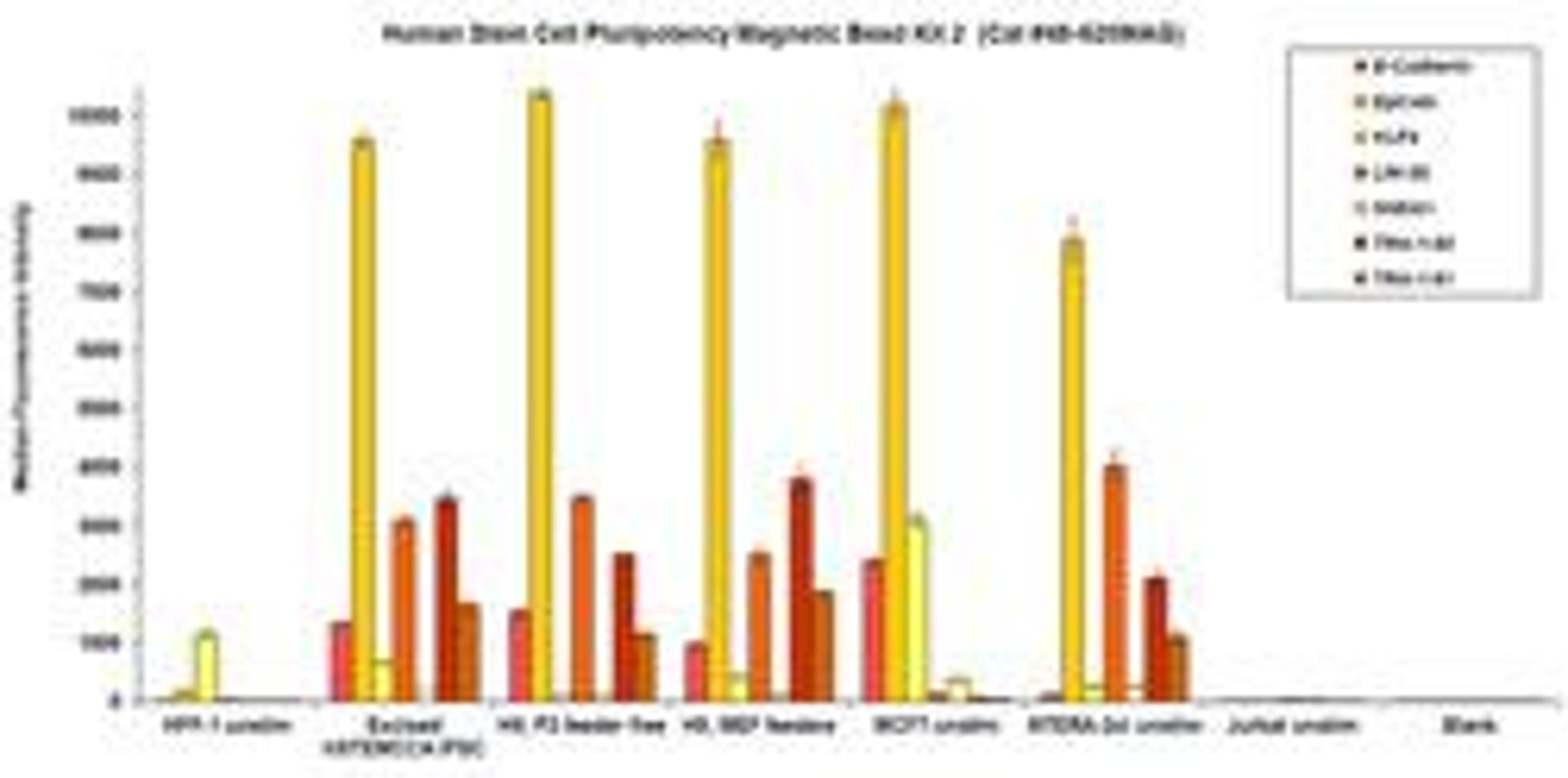
MILLIPLEX MAP Human Stem Cell Pluripotency Magnetic Bead Panel 2 - Stem Cell Multiplex Assay
MerckProduct Overview: The MILLIPLEX® Human Stem Cell Pluripotency Magnetic Bead Kit 2 (Cat. No. 48-620MAG) is a premixed kit to be used for the simultaneous quantification of the following 7 analytes in cell lysates: E-Cadherin, EpCam, KLF4, LIN-28, and the glycostructures TRA-1-60, TRA-1-81 and SSEA1. The detection assay is a rapid, convenient alternative to Western Blotting and immunoprecipitation procedures. Each kit has sufficient reagents for one 96-well plate assay. Background Information: The expression of transcription factors, translational regulators and trans-membrane proteins, as well as cell surface glycostructures, play critical roles in the maintenance of pluripotency and self renewal in stem cells and can serve as markers of cell status. Applications: This MILLIPLEX® MAP Human Stem Cell Pluripotency Magnetic Bead Panel 2 is a Stem Cell Characterization multiplex assay. The analytes available for this multiplex kit are: E-Cadherin, EpCam, KLF4, LIN-28, SSEA1, TRA-1-60, TRA-1-81.