Miniaturize to maximize: Precision liquid handling & dispensing for discovery and applied research

Essential techniques for PCR, mass spec sample prep, direct titration, assay development, and more

18 Dec 2025
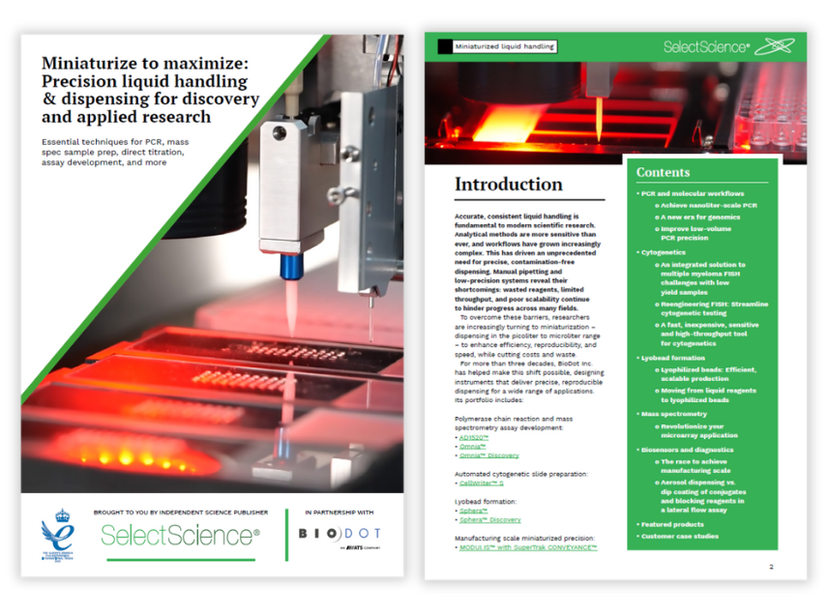
Front cover of Miniaturize to maximize: Precision liquid handling & dispensing for discovery and applied research

Discover how miniaturized precision liquid handling can enhance assay efficiency, reproducibility, and speed, while cutting costs and waste.

To overcome barriers associated with manual pipetting, researchers are increasingly turning to miniaturized liquid handling – dispensing in the picoliter to microliter range – to enhance efficiency, reproducibility, and speed, while cutting costs and waste.

In this SelectScience guide, explore a range of precision liquid handling solutions from BioDot Inc. that are transforming discovery and applied research, from sample preparation for PCR and mass spectrometry, to assay development, diagnostics, and biosensor production.

Whether you are optimizing an assay, developing a diagnostic platform, or engineering high-value bioproducts, this guide offers practical insight into how miniaturized liquid handing can enable your lab to do more with less.

Download the eBook to learn about solutions for:

  • PCR and molecular workflows
  • Cytogenetics
  • Lyobead formation
  • Mass spectrometry
  • Biosensors and diagnostics

You will find application notes, brochures, and datasheets that will help you learn more about potential solutions for your lab. Plus, read case studies to hear how BioDot precision liquid handling technology is transforming workflows across animal health, cancer diagnosis, and point-of-care test manufacturing.

Links

Tags

Mass SpectrometryMass spectrometry (MS) is a powerful analytical technique used to identify and quantify molecules based on the mass-to-charge ratio of gas-phase ions. It provides detailed information about the structure, composition, and properties of compounds and is widely used across fields such as environmental monitoring, materials science, drug discovery and development, food and beverage testing, and wider chemical research. Key MS techniques include tandem mass spectrometry (MS/MS), liquid chromatography–mass spectrometry (LS-MS) and inductively coupled plasma (ICP-MS). Choosing from these wide range of techniques and technologies can be a daunting task, so keep up to date with scientific applications, performance expectations, and customer reviews here all in one place. Visit our product directory to receive quotes direct from the manufacturer. PCR and Thermal CyclingPolymerase chain reaction (PCR) kits and thermal cyclers are used for the in vitro amplification of DNA permitting subsequent analysis and experimental procedures. Explore a range of high-quality polymerase, primers and nucleotides or simplify your workflow with a PCR mastermix. Find reverse transcription PCR (RT-PCR) and cDNA synthesis kits for RNA products and libraries. Quantitatively measure the amplification of DNA with real-time PCR (qPCR) and droplet digital PCR (ddPCR) kits and systems, and discover automated PCR setup solutions to increase throughput. Alternative DNA amplification methods also include recombinase polymerase amplification (RPA) kits. Find the best PCR kits and thermal cyclers and purification equipment in our peer-reviewed product directory: compare products, check customer reviews and receive pricing direct from manufacturers.BiosensorsBiosensors are devices used to detect an analyte using biological molecules specific to the analyte coupled to a detector. Biosensor instruments may be photometric, typically using surface plasma resonance (SPR), electrochemical or QCM (quartz crystal microbalance) biosensors. Biosensors should be selective, portable, robust and sensitive and have a fast response time. Systems may be manual or automated and usually have associated software.Genome AnalysisGenomics, the study of genomes, includes functional genomics, evolutionary genomics and comparative genomics. There are many genomic technologies such as DNA sequencing of whole genomes, computational biology and bioinformatics. DNA and nucleic acids must be isolated and concentrated from cells for analysis with kits, automated analyzers and software. Other useful technologies for studying genomics include PCR, microarrays and electrophoresis.Drug DeliveryDrug Delivery refers to dosage form, route of administration, formulations, technologies, and systems for transporting a pharmaceutical compound in the body as needed to safely achieve its desired therapeutic effect. Drug delivery is often approached via the biopharmaceutical or small molecule drug's formulation, but it may also involve medical devices or drug-device combination products. Considerations include instrumentation, software and services. Microarray AnalysisMicroarrays, also known as biochips, are used for the detection and analysis of multiple genes, proteins, antibodies, or biomarkers on a single microchip. This can reveal information on protein or gene expression, single nucleotide polymorphism (SNP), copy number variation (CNV), epigenetics and patient health in clinical diagnostic tests. Discover a range of microarray scanners and prefabricated antibody, protein, RNA and DNA microarrays for your analysis or consider creating your own custom microarrays with a microarray printer. Find the best microarray products in our peer-reviewed product directory: compare products, check customer reviews and receive pricing direct from manufacturers.Point-of-CarePoint-of-Care Testing (POCT) or Near Patient Testing (NPT) products are available for urine, blood and other clinical chemistry analyses. POCT includes: blood glucose testing, blood gas and electrolytes analysis, rapid coagulation testing (PT / INR), rapid cardiac markers diagnostics, drugs of abuse screening, urine strips testing, pregnancy testing, fecal occult blood analysis, food pathogens screening, hemoglobin diagnostics, infectious disease testing and cholesterol screening.Lateral Flow AssaysCytogeneticsFreeze DryingCancer DiagnosticsThere are a wide variety of diagnostic tests for cancer available, and this range continues to expand as our knowledge of cancer improves. Current diagnostic methods include biopsy, imaging and blood tests for known biomarkers. New methods in research development include liquid biopsies and cancer breathalyzers.